FEWS NET
Production and Market Flow Maps: Guinea Maize
The agricultural sector in West Africa plays a crucial role in the regional economy, with maize being a staple crop in several countries.
2013 · 1 pages
Sign in to readA free account is required to download.
Abstract
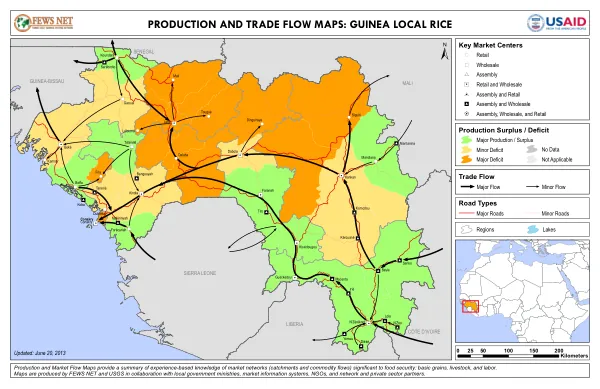
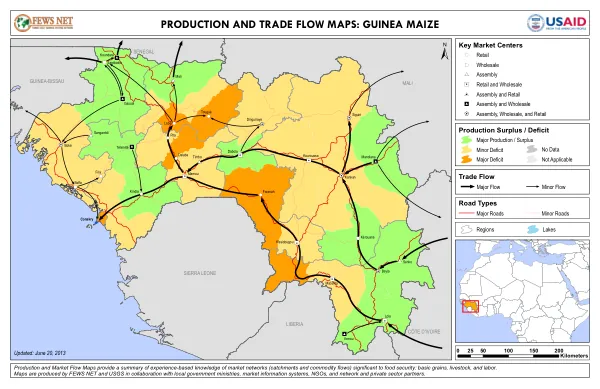
In Guinea, maize production is a significant contributor to the national food security. The country's geography, with its diverse climate and soil types, presents both opportunities and challenges for maize production. Guinea's maize production is concentrated in the western regions, including Conakry, Boffa, Boké, and Sangarédi. These areas have fertile soils and adequate rainfall, making them suitable for maize cultivation. However, the country's transportation infrastructure, including roads and ports, is limited, which can hinder the movement of maize from production areas to markets. The production and trade flow maps for Guinea maize provide valuable insights into the country's market networks and commodity flows. These maps are produced by FEWS NET and USGS in collaboration with local government ministries, market information systems, NGOs, and network and private sector partners. The maps highlight key market centers, including retail, wholesale, and assembly points, which are critical for the movement of maize from production areas to consumption centers. The maps also provide information on production surplus and deficit areas, which can help policymakers and stakeholders identify areas that require support to improve maize production and trade. In Guinea, the production surplus areas are primarily located in the western regions, while the deficit areas are found in the eastern and central regions. The maps also highlight the importance of major roads, which are critical for the movement of maize from production areas to markets. The trade flow maps for Guinea maize show that the country's maize is primarily traded within the region, with significant flows to neighboring countries, including Mali, Senegal, Guinea-Bissau, Côte d'Ivoire, Sierra Leone, Liberia, and others. The maps also highlight the importance of assembly and wholesale markets, which are critical for the movement of maize from production areas to consumption centers. Overall, the production and trade flow maps for Guinea maize provide valuable insights into the country's market networks and commodity flows. These maps can help policymakers and stakeholders identify areas that require support to improve maize production and trade, and can inform decision-making on investments in infrastructure, market development, and other initiatives that can improve the country's food security.
Related documents