USAID
Program for Participation and Collective Reparation of Victims
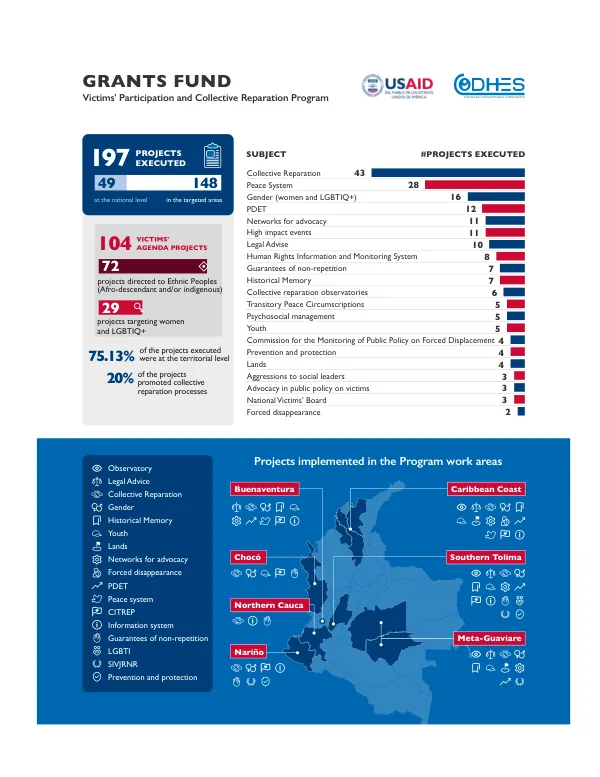
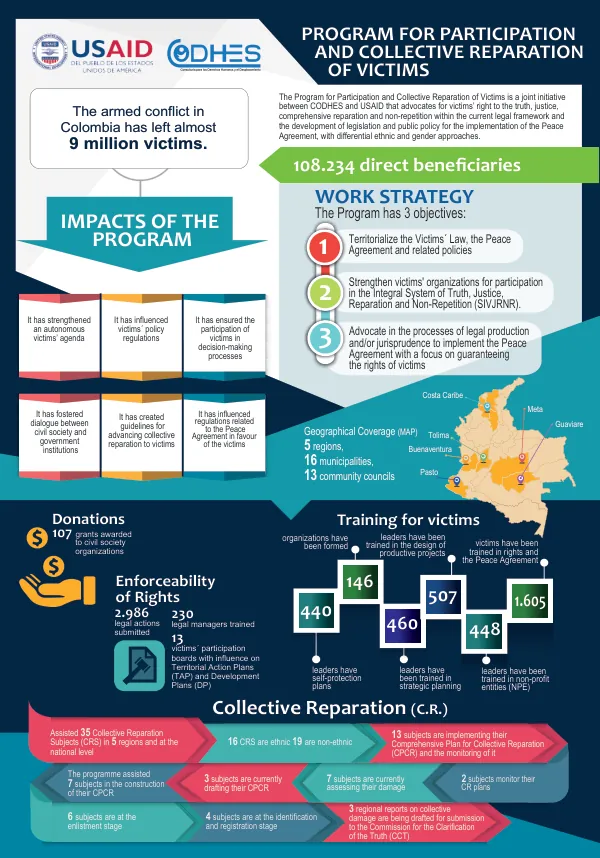
The armed conflict in Colombia has left almost 9 million people affected, with 108.234 direct beneficiaries of the Program for Participation and Collective Reparation of Victims.
2019 · 2 pages
Sign in to readA free account is required to download.
Abstract
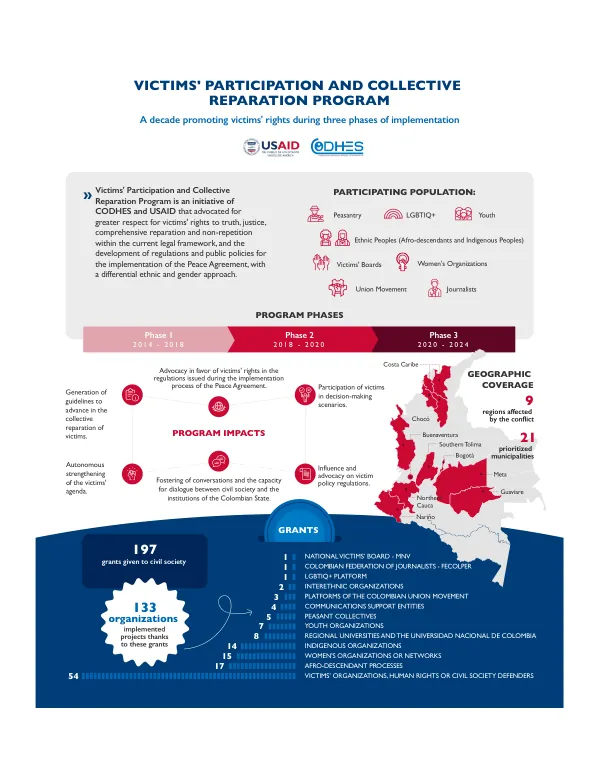
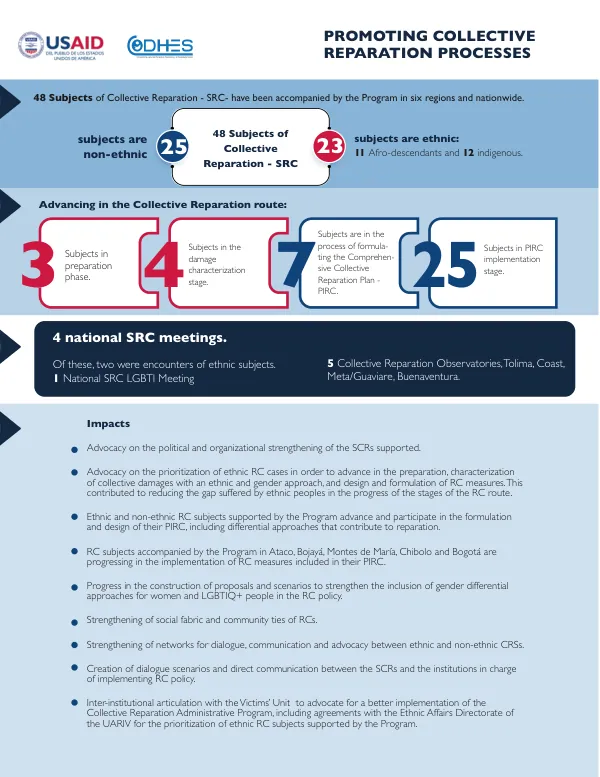
This program is a joint initiative between CODHES and USAID, aiming to promote victims' rights to truth, justice, comprehensive reparation, and non-repetition within the current legal framework and the development of public policy for the implementation of the Peace Agreement. The program focuses on differential ethnic and gender approaches, with the establishment of 146 organizations and the formation of 460 leaders. These organizations have developed self-protection plans, and 440 leaders have been trained in strategic planning. Additionally, 146 leaders have been trained in the design of productive projects, 107 grants have been awarded to civil society organizations, and 107 training sessions have been conducted for victims. The program has also made significant progress in enforcing victims' rights, with 2,986 legal actions submitted and 13 legal managers trained. Furthermore, 448 victims' boards with influence on Territorial Action Plans (TAP) and Development Plans (DP) have been established. The program has also strengthened the capacity of victims' organizations for participation in the Integral System of Truth, Justice, Reparation, and Non-Repetition (SIVJRNR). The program's work strategy focuses on three main areas: Territorializing the Victims' Law, the Peace Agreement, and the policies related to the SIVJRNR; strengthening victims' organizations for participation in the SIVJRNR; and advocating for the implementation of the Peace Agreement with a focus on guaranteeing the rights of victims. The program has achieved significant results in these areas, including the establishment of 5 regions, 16 municipalities, and 13 community councils. The program has also made significant progress in collective reparations, assisting 35 Collective Reparation Subjects (CRS) in 5 regions and at the national level. Additionally, 7 subjects have constructed their Individual Comprehensive Plan for Collective Reparation (ICPCR), and 2 subjects are monitoring their CR plans. The program has also influenced victims' participation in decision-making processes, ensuring their voices in the development of public policy and regulations. The program has also had a significant impact on the Peace Agreement, influencing the explicit inclusion of victims' rights in legislative acts and regulations related to the SIVJRNR. The program has also established protocols for victims' participation in the SIVJRNR, including the specific needs of victims of forced displacement. Furthermore, the program has influenced the National Development Plan, modifying and expanding targets related to victims' rights. The program has also prevented regressive reforms to the regulation of SIVJRNR bodies and the victims' law. The Constitutional Court has consolidated a jurisprudential line of respect for the rights of victims in the implementation of the Peace Agreement. The Court has also clarified and delineated the scope of prior consultation in the implementation of the Peace Agreement. The program has also made significant progress in advocacy, with 20 citizen interventions before the Constitutional Court, 5 interventions in public hearings before the Constitutional Court, and 16 interventions in Congress. Additionally, the program has conducted 25 policy analyses and/or analysis of the content of policies related to the implementation of the Peace Agreement and victims' rights.