USAID DEC
Projet d'appui à la sécurité alimentaire, la réconciliation et la résilience II (PASERREL II): Semi-Annual Program Performance Report
Sign inMERCY CORPS INTERNATIONAL
Projet d'appui à la sécurité alimentaire, la réconciliation et la résilience II (PASERREL II): Semi-Annual Program Performance Report
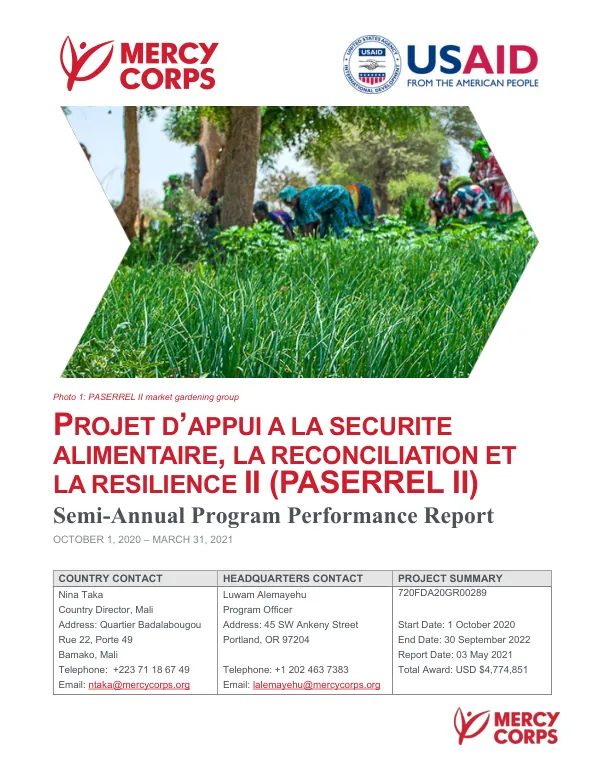
The Projet d'appui à la sécurité alimentaire, la réconciliation et la résilience II (PASERREL II) is a two-year intervention implemented by Mercy Corps in central Mali, aiming to improve the well-being and economic resilience of communities through a holistic and conflict-sensitive response.
2021 · 36 pages
Sign in to readA free account is required to download.
Abstract
The program builds on the efforts of previous projects, including PASERREL I, to address the urgent humanitarian and resilience needs of communities in the sectors of economic recovery and market systems (ERMS), agriculture and food security, shelter and settlements, and water, sanitation, and hygiene (WASH). The program focuses on two main outcomes: conflict-affected communities maintaining and increasing their well-being through ongoing shocks and tensions, and conflict-affected communities receiving a holistic and timely humanitarian assistance package in the aftermath of conflict, displacement, and health-related shocks. To achieve these outcomes, the program leverages Mercy Corps' established presence in all target cercles through the previous PASERREL I award and a complementary USAID/BHA-funded emergency food security project. During the reporting period (October 2020 - March 2021), key program activities included the identification of new sites in Bandiagara and Djenné cercles, revitalization of selection committees in the target cercles of Koro, Bankass, Bandiagara, Djenné, and Mopti, and establishment of new selection committees in the added sites. A total of 750 participants were selected for the restoration and development of new livelihoods, and 500 participants were trained on the entrepreneurship curriculum in the five intervention cercles. In the sector of agriculture and food security, 600 new participants were identified in all five target cercles, and local suppliers were identified and selected for the distribution of seed vouchers. The distribution of vegetative vouchers was also implemented, with a total of 1,200 vouchers distributed to farmers in the target cercles. Additionally, 250 participants received training on resilient agriculture practices, and 200 participants received training on perma-gardens. The program also implemented activities in the sector of shelter and settlements, including the distribution of shelter non-food items (NFIs) to 1,200 households, and the rehabilitation and construction of latrines in 15 cercles. In the sector of water, sanitation, and hygiene (WASH), 1,500 households received WASH NFIs, and 200 participants received training on conflict management and social cohesion. The program aims to provide a holistic and tailored response to the ongoing emergencies in central Mali, meeting the needs of 9,540 households (74,412 individuals), of which approximately 6,464 households (50,419 individuals) are internally displaced persons (IDPs). The program's ultimate goal is to improve the well-being and economic resilience of conflict-affected communities in central Mali. The program's performance summary indicates that a total of 2,500 participants were trained on entrepreneurship and livelihoods restoration, and 1,200 households received shelter NFIs. Additionally, 1,500 households received WASH NFIs, and 200 participants received training on conflict management and social cohesion. The program's achievements demonstrate its commitment to providing a holistic and timely humanitarian assistance package to conflict-affected communities in central Mali. The program's challenges and lessons learned highlight the importance of conflict-sensitive and COVID-19 approaches in maintaining humanitarian access and operational continuity. The program's successes demonstrate its ability to provide a tailored response to the ongoing emergencies in central Mali, meeting the needs of conflict-affected communities and improving their well-being and economic resilience.
Related documents