USAID DEC
Projet de renforcement des capacités des jeunes des quarts pauvres dans la région de Casablanca
Sign inNEAR EAST FOUNDATION
Projet de renforcement des capacités des jeunes des quarts pauvres dans la région de Casablanca
The concept of leadership is multifaceted and has been studied extensively in various fields, including sociology, psychology, and education.
2009 · 28 pages
Sign in to readA free account is required to download.
Abstract
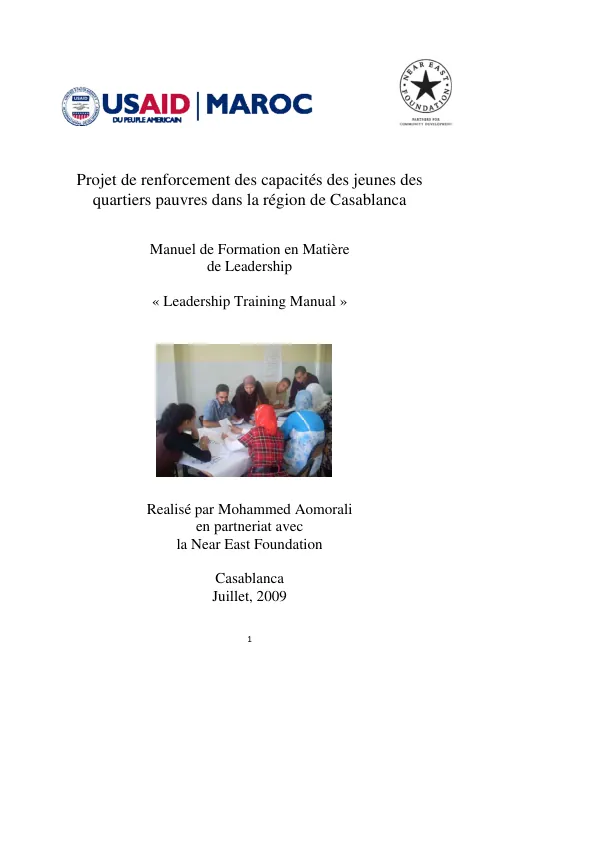
According to sociologists, leadership is one of the primary roles generated by the relationships between members of a group. It refers to the relationship of trust that exists between a leader and a group to achieve a common objective. This means that a leader merits the quality of leadership by their ability to mobilize the energies of the group and direct them towards the realization of a common goal. The etymology of the word "leadership" reveals its linguistic origins in the English language. It is composed of two terms: "leader" and "ship." The term "leader" means a director or a person who guides, while "ship" refers to a vessel or a journey. In its original sense, leadership alluded to the idea of navigating a ship to its destination. However, in its practical application, the term has taken on a political connotation, referring to the leader of a party or a group who guides them towards their objectives. In the context of education, leadership is defined as a social role that an individual plays through their interactions with other members of a group. It is characterized by the ability to influence and guide others towards achieving common goals. Leadership is a behavior that manifests in the interaction between a leader and a group, with the leader working to maintain the group's unity and cohesion. The concept of leadership has been distinguished from that of direction or management. While direction or management focuses on the logical and administrative aspects of leading a group, leadership emphasizes the emotional and social qualities that a leader possesses. Leadership is concerned with the total process of leading, including defining the direction and vision, mobilizing resources, and motivating group members to achieve their goals. In the context of the Arab-Muslim culture, the term "cheikh" has two meanings. In a sophist sense, it refers to the leader of a confraternity who possesses a charismatic and sacred quality, commanding obedience and respect from his followers. In a social sense, it refers to the leader of a tribe, who derives his value from his personal characteristics and the support of his family. The leadership training manual aims to equip young people from disadvantaged neighborhoods in the Casablanca region with the skills and knowledge necessary to become effective leaders. The manual is based on the principles of leadership as defined in the document, emphasizing the importance of emotional intelligence, social skills, and the ability to influence and guide others. The manual is divided into several sections, each addressing a different aspect of leadership. The first section provides an overview of the concept of leadership, its definition, and its significance in various fields. The second section explores the etymology of the word "leadership," tracing its origins to the English language and its evolution over time. The third section delves into the concept of leadership in education, highlighting its importance in the development of social skills, emotional intelligence, and the ability to influence and guide others. The fourth section distinguishes leadership from direction or management, emphasizing the emotional and social qualities that a leader possesses. The manual also explores the concept of leadership in the context of the Arab-Muslim culture, highlighting the significance of the term "cheikh" and its two meanings. The final section provides a summary of the key concepts and principles of leadership, emphasizing the importance of emotional intelligence, social skills, and the ability to influence and guide others. The leadership training manual is designed to be a comprehensive resource for young people from disadvantaged neighborhoods in the Casablanca region. It aims to equip them with the skills and knowledge necessary to become effective leaders, capable of influencing and guiding others towards achieving common goals.