USAID DEC
Projet Résilience et Croissance Économique au Sahel - Résilience Renforcée : Guide de Formation : Conservation Farming
Sign inUSAID DEC
Projet Résilience et Croissance Économique au Sahel - Résilience Renforcée : Guide de Formation : Conservation Farming
The Conservation Farming initiative in the Niger and Burkina Faso regions aims to promote sustainable agricultural practices and improve food security.
2015 · 25 pages
Sign in to readA free account is required to download.
Abstract
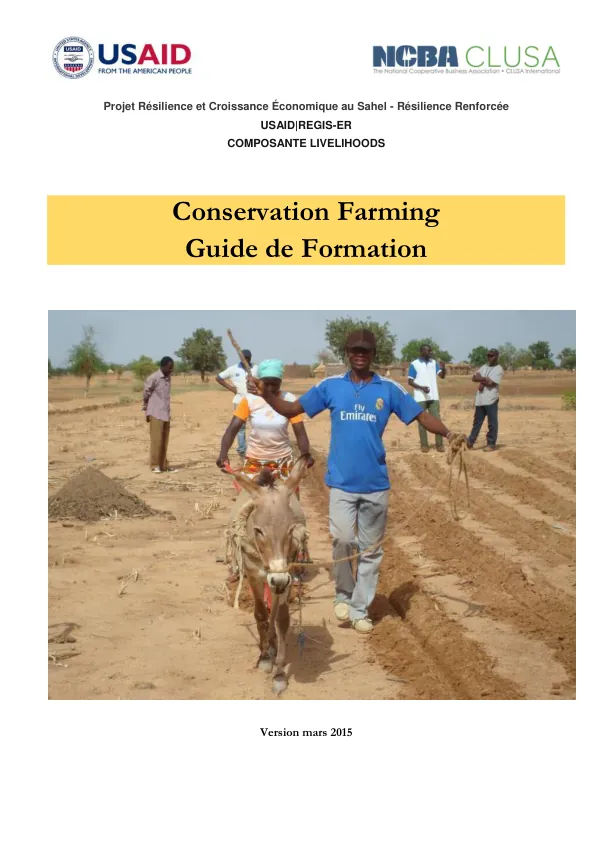
The initiative is part of the USAID|REGIS-ER program, which focuses on strengthening the resilience of local populations and reducing their vulnerability to climate-related disasters. Conservation Farming is a production system based on soil conservation and improvement of its natural fertility to achieve optimal and regular yields. It involves the simultaneous implementation of three principles at the plot level: minimum soil disturbance, crop associations and rotations, and permanent soil cover. This approach is considered a key strategy for adapting to climate change and improving food security. The USAID|REGIS-ER program has chosen to focus on promoting Conservation Farming in its intervention zones, following a successful pilot year in 2014. The program aims to support local farmers in adopting Conservation Farming practices, which are seen as a key component of a sustainable and resilient agricultural system. The Conservation Farming guide is designed to provide practical training for adult farmers who have acquired traditional agricultural knowledge and skills. The guide is structured into modules of short duration, each focusing on a specific aspect of Conservation Farming. The modules are intended to be sequential, allowing farmers to apply the knowledge and skills learned in each module to their own farming practices. The guide covers a range of topics, including the principles of Conservation Farming, the importance of soil conservation, and the role of crop associations and rotations in improving soil fertility. It also provides guidance on the implementation of Conservation Farming practices, including the use of minimum soil disturbance, permanent soil cover, and the application of organic and inorganic fertilizers. The guide emphasizes the importance of organization and community involvement in the adoption and implementation of Conservation Farming practices. It highlights the need for local structures, such as government services, to play a key role in supporting farmers in their efforts to adopt Conservation Farming. The Conservation Farming initiative in the Niger and Burkina Faso regions is seen as a key strategy for improving food security and reducing vulnerability to climate-related disasters. The USAID|REGIS-ER program is committed to supporting local farmers in adopting Conservation Farming practices, which are seen as a key component of a sustainable and resilient agricultural system. The guide is designed to be a practical tool for farmers, providing them with the knowledge and skills needed to implement Conservation Farming practices in their own farming systems. It is intended to be used in conjunction with other training and support programs, and is seen as a key component of the USAID|REGIS-ER program's efforts to promote sustainable agricultural practices in the region. The Conservation Farming initiative in the Niger and Burkina Faso regions is expected to have a positive impact on food security and rural livelihoods. By promoting sustainable agricultural practices and improving soil fertility, the initiative is seen as a key strategy for reducing poverty and improving the well-being of local communities.