USAID DEC
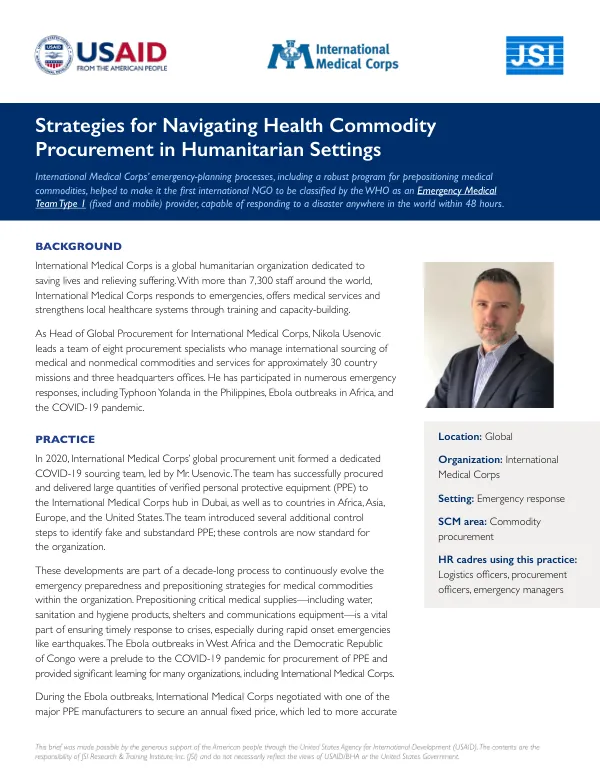
Promoting the Quality of Medicines (PQM) GMP/CMC Technical Assistance Program
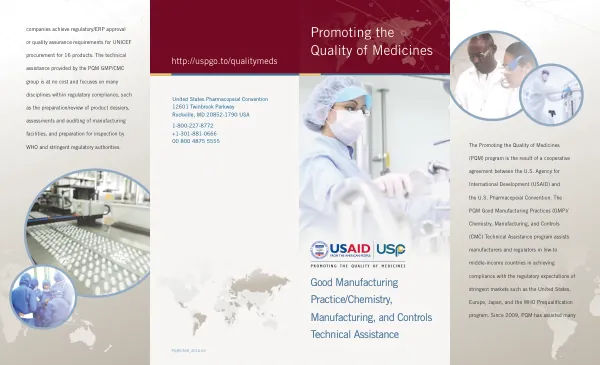
The Promoting the Quality of Medicines (PQM) program is a cooperative agreement between the U.S.
2016 · 2 pages
Sign in to readA free account is required to download.
Abstract
Agency for International Development (USAID) and the U.S. Pharmacopeial Convention. The program's primary objective is to increase the availability of quality-assured, essential priority medicines for the public health market in low-to middle-income countries. PQM provides technical assistance to pharmaceutical manufacturers and regulatory authorities in these countries to achieve compliance with stringent regulatory requirements. The assistance focuses on Good Manufacturing Practices (GMP) and Chemistry, Manufacturing, and Controls (CMC) disciplines, including the preparation and review of product dossiers, assessments and auditing of manufacturing facilities, and preparation for inspection by the World Health Organization (WHO) and other regulatory authorities. The PQM GMP/CMC Technical Assistance program supports manufacturers in achieving WHO prequalification and/or approval of their products in stringent regulatory markets, such as the United States, Europe, Japan, and the WHO Prequalification program. Since 2009, PQM has assisted many manufacturers in low-to middle-income countries in producing medicines that meet international GMP standards and achieving WHO prequalification, Specialized Regulatory Authority (SRA) approval, or Enterprise Resource Planning (ERP) approval. PQM's technical assistance includes support for product research and development, scale-up, and technology transfer, as well as on-site GMP assessments and mock audits. The program also provides training to regulatory staff in areas such as inspection of manufacturers and distributors, product assessment and registration, and medicines quality monitoring and surveillance. The PQM program has achieved significant public health impact through its technical assistance. For example, the program's assistance led to a 30% global price decrease for Cycloserine FPP, a medicine used to treat tuberculosis. Additionally, PQM's assistance helped achieve WHO prequalification for several essential medicines, including Isoniazid API, Capreomycin API, and Levofloxacin API, which addressed global shortages in these medicines. PQM's technical assistance is available to manufacturers through a series of workshops held in various regions of the world. At these workshops, participants can interact with PQM facilitators and receive clarification on key technical issues. Manufacturers can also contact PQM directly for more information on the program's technical assistance. The PQM program's workflow involves several key steps, including manufacturer identification through workshops or collaboration with PQM or external partners, completion of a PQM questionnaire, gap analysis, mock audit, and verification of the product dossier prior to submission to WHO PQ. PQM also issues a gap analysis report and works with manufacturers to complete the Corrective and Preventive Action (CAPA) plan. Through its technical assistance, PQM has enabled manufacturers to produce high-quality medicines that meet international GMP standards and achieve WHO prequalification, SRA approval, or ERP approval. This has increased the availability of quality-assured, essential priority medicines for the public health market in low-to middle-income countries.
Related documents