JHPIEGO
Protein Test: Validation of Reengineered Reagent
Pre-eclampsia/eclampsia is a leading cause of maternal deaths worldwide, contributing between 8-25% of maternal mortality globally.
2011 · 17 pages
Sign in to readA free account is required to download.
Abstract
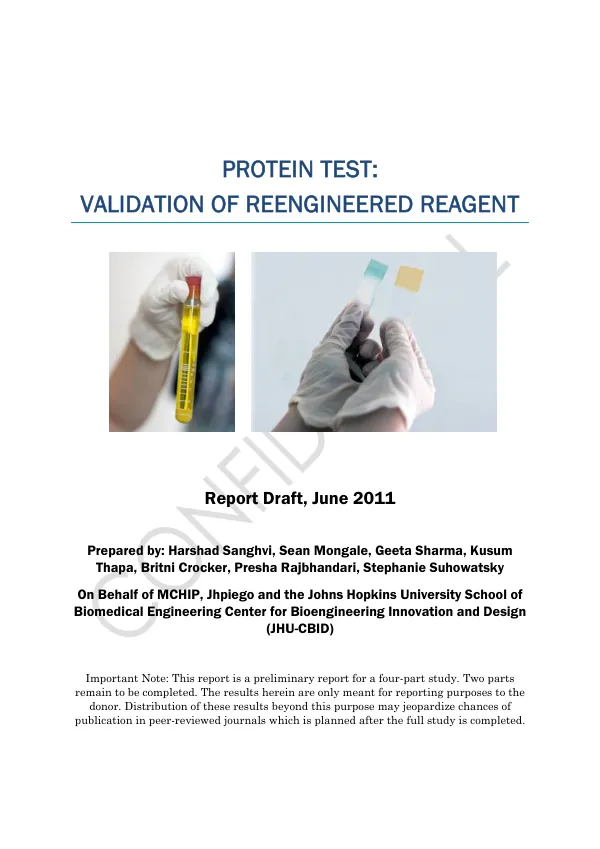
In Nepal, pre-eclampsia/eclampsia is the second leading cause of maternal deaths, accounting for 21% of maternal deaths. Early detection of elevated blood pressure and proteinuria during antenatal care (ANC) can prevent pre-eclampsia/eclampsia. However, there is a significant unmet need for protein testing, particularly in low-resource settings where conventional diagnostic tests are often expensive, dependent on laboratory infrastructure, or require trained health providers. The Jhpiego and Johns Hopkins University School of Biomedical Engineering Center for Bioengineering Innovation and Design (JHU-CBID) have developed a simple protein test that is lower cost, easy to interpret, and designed for self-test. The new protein test consists of a filter paper strip marked at one end with a modified reagent dispensed from a felt tip marker pen. Preliminary tests in the design laboratory at JHU reengineered the reagent to yield a dichotomous result and developed the dispensing platform. The test is being evaluated in a four-step process in Nepal. The first two steps aimed to confirm that the modified reagent works well. In Step 1, urine samples known to contain protein (n=289) were compared to the new test. In Step 2, urine samples (n=630) from antenatal clients attending the maternity hospital in Kathmandu were tested using dipstick, new test, and Esbach test to determine sensitivity and specificity. The specificity obtained was 99.2%, and sensitivity was 62.5%. The study also found considerable inter-observer differences in interpreting gradations of color change in the dipstick test, a problem not encountered with the dichotomous new test. The results of the first two steps of the study have informed the choice of the threshold of the dichotomous color change, and the reagent will be modified to improve sensitivity in the follow-on steps. In Steps 3 and 4, new test strips will be made at point of use from the pen platform, and tests will be done by voiding urine directly onto the prepared test strip. The study aims to develop a low-resource appropriate, color-based test for detection of proteinuria, and a key indicator of pre-eclampsia. Once fully evaluated, this simple inexpensive test can be used in the community and at the household level to support Nepal's national effort to achieve the Millennium Development Goal (MDG) 5 to reduce the maternal mortality ratio. Pre-eclampsia/eclampsia is a significant public health concern in Nepal, particularly in low-resource settings where access to quality focused antenatal care is limited. The development of a simple protein test can increase detection of pre-eclampsia/eclampsia, especially if it can be done at home in the community. The study aims to address the significant unmet need for protein testing in Nepal and contribute to the national effort to reduce maternal mortality.