USAID DEC
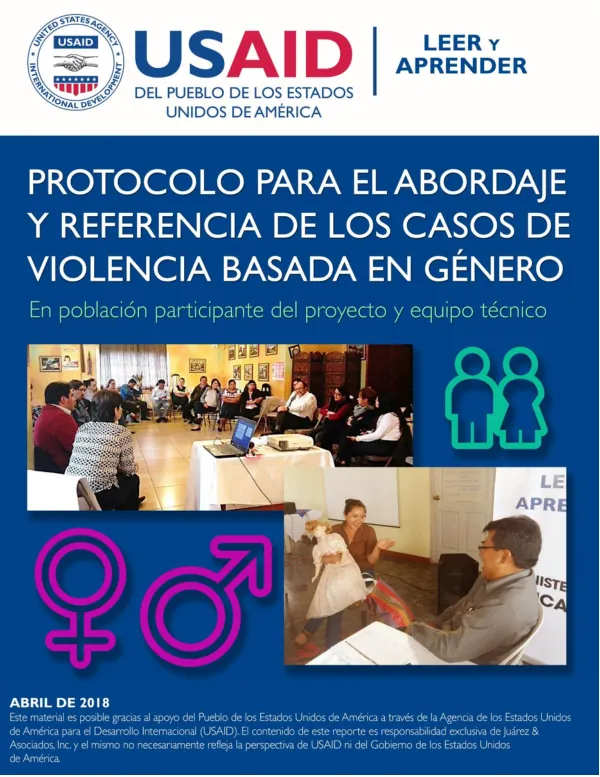
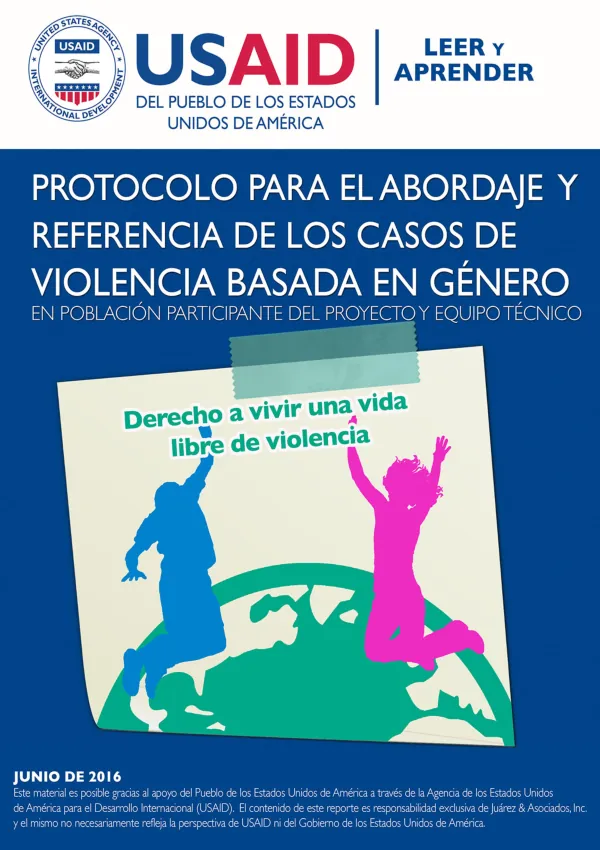
Protocolo para el abordaje y referencia de los casos de violencia basada en género en población participante del Proyecto USAID Leer y Aprender
Sign inJUÁREZ Y ASOCIADOS, INC.
Protocolo para el abordaje y referencia de los casos de violencia basada en género en población participante del Proyecto USAID Leer y Aprender
The project USAID Leer y Aprender in Guatemala aims to ensure access to quality education for out-of-school children, especially indigenous, and youth (15-24 years) in rural areas of the Western Highlands.
2016 · 25 pages
Sign in to readA free account is required to download.
Abstract
The project has established a Plan of Immediate Action to address gender-based violence and equity. A mapping of situations of risk of gender-based violence was conducted to identify the perception of situations of violence against the population served by the project and the forms in which it manifests. The mapping revealed perceptions of violence that can occur in the family, community, and project. The types of violence mentioned by participants include physical and psychological violence, followed by sexual violence, and in one group of young people, femicide was mentioned as the last link in a long chain of violence against women. The young people identified family members as perpetrators of sexual violence, whereas parents and mothers mentioned the differential treatment given to men and women in the family and community. The project has established a protocol for addressing and referring cases of gender-based violence in the population participating in the project and the technical team. The protocol is based on the results of the mapping and aims to guide the technical team and sub-contracted entities in providing immediate assistance and information on referral routes for actors involved in the project when cases of gender-based violence are detected. The protocol includes a framework for addressing and referring cases of gender-based violence, as well as procedures for referring cases of violence against girls, boys, young people, mothers, and fathers, and for referring cases of workplace harassment in the technical team. The protocol also provides guidance on preventing gender-based violence and following up on cases. The project has identified institutions and organizations that provide services for gender-based violence in the area of intervention, but these services are concentrated at the departmental level, with few at the municipal level. A directory of institutions and organizations has been created to establish references of interest at the community and municipal level, where the population served can access them mainly in their native language. The protocol is based on the definition of gender-based violence as violence directed against a person due to their gender and the expectations placed on them in a society or culture. The protocol also refers to the Convention on the Elimination of All Forms of Discrimination against Women (CEDAW), which defines violence against women as a form of discrimination and a major cause of such violence. The protocol identifies the types of violence mentioned by participants, including physical, sexual, and psychological violence, and notes that women are the primary victims of violence, with men being perpetrators in most cases. The protocol also notes that children, girls, and young people are also victims of violence, and that the community and institutions have a role to play in preventing and addressing violence. The protocol provides guidance on addressing and referring cases of gender-based violence, including procedures for reporting and referring cases, and for providing support and assistance to victims. The protocol also provides guidance on preventing gender-based violence, including strategies for promoting gender equality and challenging patriarchal norms and attitudes. The protocol is an important tool for the project USAID Leer y Aprender in addressing and preventing gender-based violence in the population participating in the project and the technical team. The protocol provides a framework for addressing and referring cases of violence, and for promoting gender equality and challenging patriarchal norms and attitudes.
Related documents