USAID DEC
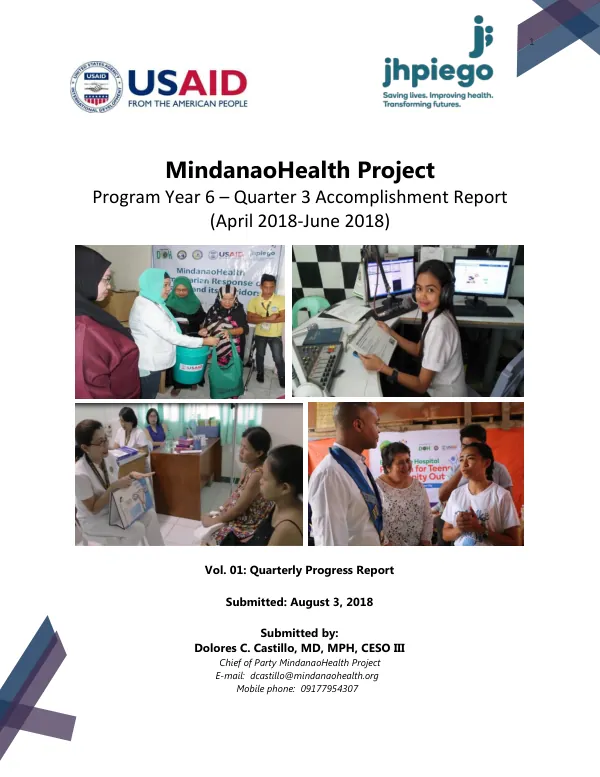
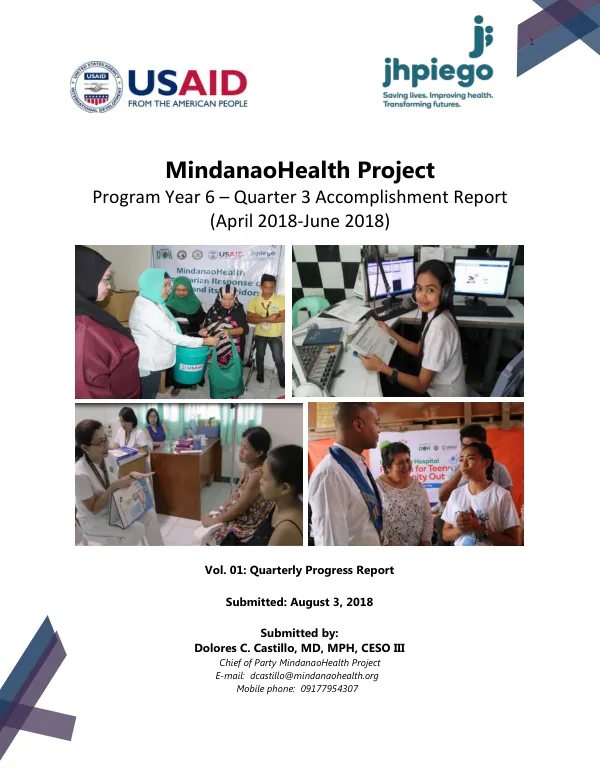
MindanaoHealth Project Program Year 6 – Quarter 3 Accomplishment Report (April 2018-June 2018)
Sign inDEPARTMENT OF HEALTH
MindanaoHealth Project Program Year 6 – Quarter 3 Accomplishment Report (April 2018-June 2018)
The MindanaoHealth Project is a program aimed at improving maternal, neonatal, and child health, as well as family planning services in the Mindanao region of the Philippines.
2018 · 162 pages
Sign in to readA free account is required to download.
Abstract
The program is supported by the United States Agency for International Development (USAID) and is implemented by the Maternal, Neonatal, Child Health/Family Planning (MNCHN/FP) Regional Projects in Luzon, Visayas, and Mindanao. The program's primary focus is on increasing access to family planning services, particularly in conflict-affected areas. To achieve this goal, the program has implemented various interventions, including training of family health associates, community health workers, and health providers on family planning and reproductive health. The program has also established a network of family planning service delivery points, which provide a range of services, including counseling, referrals, and provision of contraceptive commodities. One of the key achievements of the program is the increase in the number of modern family planning current users in USG-assisted areas. According to the program's data, the number of modern family planning current users has increased by 15% compared to the previous quarter. Additionally, the program has reported a significant reduction in the stock-out rate of contraceptive commodities at family planning service delivery points, from 30% to 10% in the current quarter. The program has also made significant progress in improving the quality of family planning services. According to the program's data, 85% of family planning service delivery points are now providing family planning counseling and services to couples, men, women, youth, and adolescents of both sexes. Furthermore, the program has trained over 500 community health workers to provide family planning information, referrals, and services to their communities. In terms of maternal and child health, the program has reported a significant reduction in the number of newborns not breathing at birth who were resuscitated in USG-supported programs. According to the program's data, the number of newborns not breathing at birth who were resuscitated has decreased by 20% compared to the previous quarter. The program has also made significant progress in improving the health outcomes of adolescents and youth. According to the program's data, 75% of adolescents and youth have been reached with family planning and reproductive health messages through the program's health outreach activities. Additionally, the program has trained over 100 youth as peer educators to promote family planning and reproductive health among their peers. Despite these achievements, the program faces several challenges, including limited access to family planning services in some areas, inadequate funding, and limited capacity of health providers to provide family planning services. To address these challenges, the program has developed a range of strategies, including increasing funding for family planning services, providing training and capacity-building support to health providers, and establishing partnerships with civil society organizations to promote family planning and reproductive health. The program's management and administrative systems are also being strengthened to ensure effective implementation and monitoring of the program. The program has established a robust monitoring and evaluation system to track progress and identify areas for improvement. Additionally, the program has developed a range of policies and procedures to ensure compliance with USAID and Department of Health regulations. Looking ahead, the program plans to continue its efforts to improve access to family planning services, particularly in conflict-affected areas. The program will also focus on strengthening its partnerships with civil society organizations and health providers to promote family planning and reproductive health. Additionally, the program will continue to monitor and evaluate its progress to ensure that it is meeting its goals and objectives.