USAID DEC
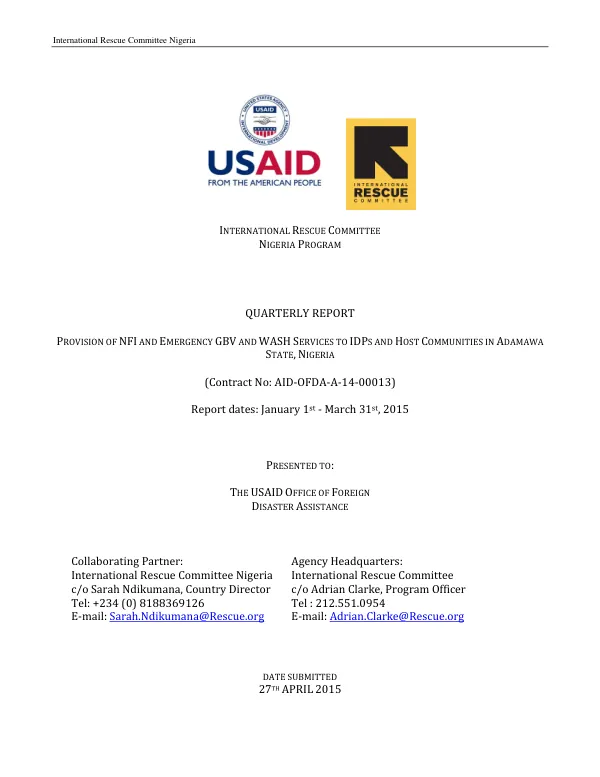
Provision of NFI and Emergency GBV and WASH Services to IDPs and Host Communities in Adamawa State, Nigeria
Sign inUNHCR
Provision of NFI and Emergency GBV and WASH Services to IDPs and Host Communities in Adamawa State, Nigeria
The humanitarian situation in Northeastern Nigeria remained turbulent during the reporting period, with Boko Haram-led skirmishes disrupting the lives of conflict-affected populations.
2015 · 17 pages
Sign in to readA free account is required to download.
Abstract
Adamawa state was at the center of the humanitarian crisis, with Boko Haram intensifying their insurgency in southern Borno state and northern Adamawa state. The movement of displaced persons to relatively safer areas continued, with hundreds of displaced individuals arriving in the Local Government Area (LGA) of Yola in Adamawa state on a daily basis. The uncertainty surrounding the presidential elections and the intensification of the counter-offensive against Boko Haram by the Multinational Joint Task Force (MNJTF) led to increased movements of displaced persons within the Northeastern region. The IDPs that were already in Yola preferred to stay, awaiting the final outcome of the election, which was postponed from February 14th, 2015 to March 28th, 2015. As the MNJTF claimed to capture Boko Haram strongholds, some IDPs spontaneously went on 'go and see' visits of their places of origin to assess the situation. Informal interactions between IRC staff and these individuals indicated that the IDPs would need enormous support in the return process, as nearly everything in their places of origin was destroyed and burned to the ground. Findings from the International Organisation for Migration (IOM) registration exercise conducted in Adamawa state during the first quarter of 2015 confirmed the fluidity of the IDP situation in the region. There are 27,612 individuals (4,381 households) living in 18 displacement sites in Adamawa, with the majority of sites located in Yola South and Girei. The majority of individuals reside in collective centers, while 44% live in camps, and 8% live in transitional centers. Most of the sites were recorded as spontaneous settlements, while the remaining sites were categorized as planned settlements. The IRC consolidated its humanitarian intervention in Adamawa state to address the most-pressing and emerging needs of those affected by the conflict in the region. The IRC's intervention activities in the region focused on addressing GBV and WASH needs in Yola LGA and the surrounding areas. GBV-related activities ensured that targeted beneficiaries had access to appropriate quality health, psychosocial, and safety services, were able to recognize the dangers of sexual and gender-based violence, and had knowledge of how and where to seek support to enable healing and emotional recovery. WASH-related activities ensured improved public health and access to improved WASH infrastructures. The IRC's GBV sector worked in close collaboration with government agencies, such as the Ministry of Women Affairs and Social Development (MWASD) and health personnel from hospital facilities at the local level, to ensure GBV survivors received the attention and treatment needed in a timely and appropriate manner. The IRC also liaised with likeminded actors, including UNHCR, UNICEF, and OCHA, to enhance the coordination mechanisms in GBV response. A meeting was convened on March 20th, 2015, and moderated by the MWASD, to institute a protection sector working group (PSWG). The meeting resulted in participants agreeing to draft terms of reference for the protection sector, which will provide guidance on how actors coordinate efforts in this particular sector. The IRC GBV team initiated coordination efforts to work with the local health sector to develop a guideline for treating rape survivors and to further develop a Memorandum of Understanding (MoU) between the IRC and the Federal Medical Center (FMC). The MoU is intended to stipulate modalities of cooperation between the two parties in the pursuit of addressing women's and girls' protection needs. The IRC seeks to have a safe space availed within the hospital wing, which will enhance access of survivors of GBV to clinical and psychosocial support.
Related documents