USAID DEC
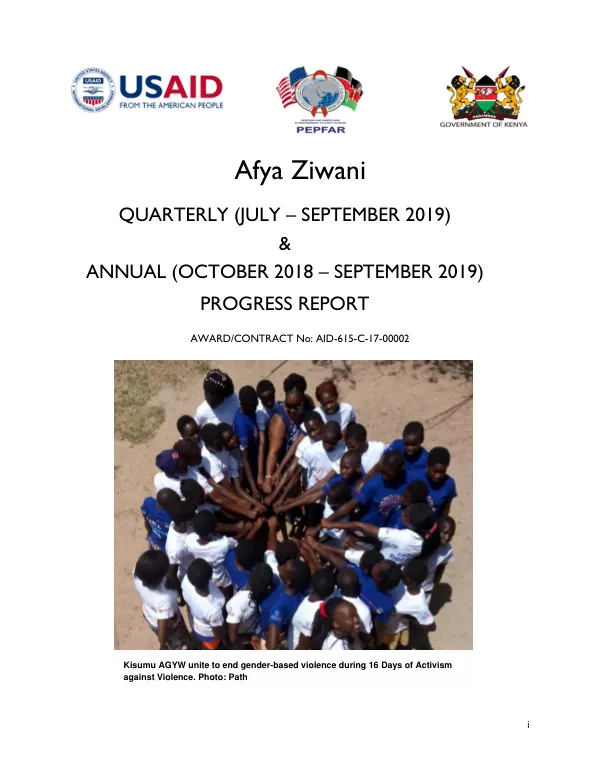
Quarterly (July – September 2019) & Annual (October 2018 – September 2019) Progress Report
Sign inPATH
Quarterly (July – September 2019) & Annual (October 2018 – September 2019) Progress Report
Afya Ziwani, a quarterly progress report for July – September 2019, and an annual progress report for October 2018 – September 2019, outlines the achievements and challenges of the program.
2019 · 95 pages
Sign in to readA free account is required to download.
Abstract
The report is prepared for Dr. Stanley Bii, US Agency for International Development / Kenya, and is authored by PATH's Country Office in Kenya. The program focuses on addressing gender-based violence (GBV) and HIV/AIDS among adolescent girls and young women (AGYW) and other priority populations. Key interventions include the DREAMS initiative, which aims to reduce HIV infections among AGYW, and the provision of GBV activities, including post-GBV clinical care. The report highlights several key achievements, including the initiation of surge with weekly reporting, rationalization and funding reductions for FY20, and progress on the gender strategy. The program has also made significant strides in providing GBV activities, with a focus on AGYW and adolescent boys and young men (ABYM). Additionally, the report notes progress on environmental mitigation and monitoring, links to other USAID programs, and links with Government Of Kenya agencies. The program has also made significant progress in reducing HIV infections among AGYW, with a 27% decrease in new infections among program participants compared to the control group. The report also highlights the importance of community health volunteers (CHVs) in promoting HIV prevention and treatment services. The Afya Ziwani program has also made significant strides in strengthening health systems, including the provision of laboratory support and TB/HIV services. The program has also implemented a differentiated care model (DCM) to improve HIV care and treatment outcomes. The report also highlights the importance of commodity security, with the program working to ensure the availability of essential medicines and supplies. The program has also made significant progress in eliminating mother-to-child transmission of HIV, with a 95% reduction in new infections among children born to HIV-positive mothers. The report concludes by highlighting the program's commitment to reducing HIV infections and improving health outcomes among AGYW and other priority populations. The program will continue to work towards its goals, with a focus on sustainability and scale-up. The Afya Ziwani program has made significant progress in reducing HIV infections among AGYW, with a 27% decrease in new infections among program participants compared to the control group. The program has also made significant strides in providing GBV activities, with a focus on AGYW and adolescent boys and young men (ABYM). Additionally, the report notes progress on environmental mitigation and monitoring, links to other USAID programs, and links with Government Of Kenya agencies. The program has also made significant progress in strengthening health systems, including the provision of laboratory support and TB/HIV services. The program has also implemented a differentiated care model (DCM) to improve HIV care and treatment outcomes. The report concludes by highlighting the program's commitment to reducing HIV infections and improving health outcomes among AGYW and other priority populations.