USAID DEC
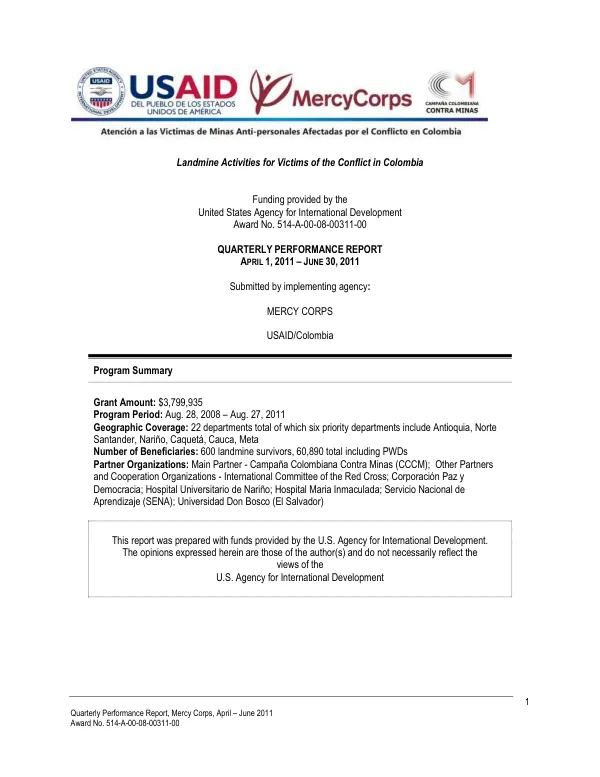
Quarterly Performance Report, Landmine Activities for Victims of the Conflict in Colombia
Sign inINTERNATIONAL COMMITTEE FOR THE RED CROSS
Quarterly Performance Report, Landmine Activities for Victims of the Conflict in Colombia
Landmine Activities for Victims of the Conflict in Colombia began in August 2008 with funding from the United States Agency for International Development.
2011 · 14 pages
Sign in to readA free account is required to download.
Abstract
The program aimed to provide assistance to landmine survivors and other vulnerable populations in 22 departments, with a focus on six priority departments: Antioquia, Norte de Santander, Nariño, Caquetá, Cauca, and Meta. During the quarter of April to June 2011, Mercy Corps and its partners, including the Colombian Campaign Against Landmines (CCCM), served over 6,330 beneficiaries. Health and rehabilitation activities were a key component of the program, with more than 4,500 persons with disabilities accessing high-quality rehabilitation services from centers in Nariño and Caquetá. Additionally, 52 patients with lower limb amputations received high-quality prosthetic devices, provided by technicians who participated in an online distance training program offered by the University Don Bosco. The project continued to increase the national pool of certified prosthetic and orthotic (P&O) providers, with 14 students successfully passing the P&O certification course and 27 students finishing their first training module. Community first aid training workshops were also conducted, with 65 community members from the department of Nariño improving their abilities to respond to emergencies. Socio-economic integration was another key component of the program, with 50 beneficiaries accessing seed capital in the departments of Cauca, Antioquia, and Norte de Santander. Public policy strengthening was also a focus, with Mercy Corps and CCCM working to develop appropriate public policies and procedures to ensure high-quality assistance to landmine survivors and other vulnerable populations. The program's advocacy efforts led to several successes, including the inclusion of landmine victims as a category of public health threat in Norte de Santander's Epidemiological Monitoring System (COVE). The project also played a key role in the transfer of information between national and local levels regarding Resolution 1319, which outlines requirements for good practices for the manufacture, elaboration, and adaptation of prosthetic and orthotic devices. The program's indicators for the quarter of April to June 2011 showed significant progress, with 1,410 persons trained, 16,507 persons served, and 110 institutions strengthened. The number of landmine survivors benefited was 1,011, and the number of persons with disabilities benefited was 31,310. The program also reported significant progress in socio-economic reintegration, with 1,276 beneficiaries graduating from vocational training and 880 jobs strengthened. The program's health indicators showed significant progress, with 128,084 beneficiaries accessing health care services, and 77,400 beneficiaries accessing rehabilitation services. The program's public policy indicators showed significant progress, with 1,106 persons benefiting from institutional strengthening, and 651 persons benefiting from public policy strengthening.
Related documents