USAID DEC
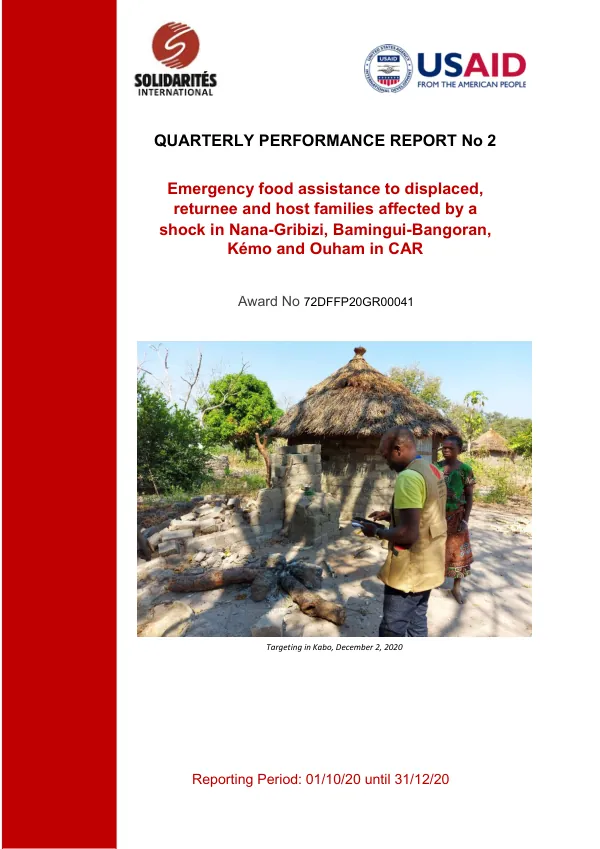
Quarterly Performance Report No 1: Emergency Food Assistance to Displaced, Returnee and Host Families Affected by a Shock in Nana-Gribizi, Bamingui Bangoran, Kemo and Ouham in CAR
Sign inPLAN INTERNATIONAL
Quarterly Performance Report No 1: Emergency Food Assistance to Displaced, Returnee and Host Families Affected by a Shock in Nana-Gribizi, Bamingui Bangoran, Kemo and Ouham in CAR
The Emergency Food Assistance Program in the Central African Republic (CAR) aims to provide support to displaced, returnee, and host families affected by a shock in Nana-Gribizi, Bamingui Bangoran, Kemo, and Ouham prefectures.
2020 · 6 pages
Sign in to readA free account is required to download.
Abstract
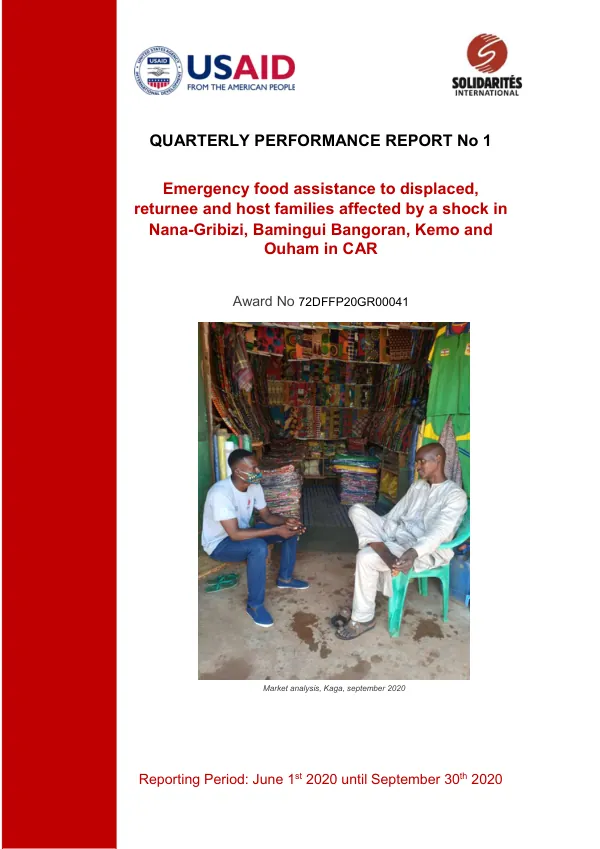
The program is implemented by Solidarités International (SI) under the Food for Peace (FFP) grant agreement. A team of twelve staff members has been recruited and trained to provide essential support for the FFP operations. The team has undergone a comprehensive four-day training to understand the Rapid-Response-Mechanism (RRM) mandate and its operational guidelines. This training has enabled the team to integrate into the RRM interventions and complement RRM operations through food assistance in the second response phase. The in-kind kit has been designed to meet the nutritional requirements for a family of five persons, consisting of milled rice, white kidney beans, vegetable oil, and salt. The voucher modality has also been established, with required documents shared with the supply department. Various service providers have been identified in different locations for safe and efficient cash distributions. Market analysis has been conducted to identify areas with robust and functioning market places, where food can be provided locally to shorten supply chains and boost the local economy. The analysis has been based on recent RRM multi-sectorial assessments (MSA) and particular missions. The identified areas include Dékoa in Kémo prefecture and Ndélé in Bamingui Bangoran prefecture. The program has faced challenges due to the COVID-19 pandemic, which has restricted coordination meetings and weakened the food security response mechanism. SI has committed to enhancing coordination with OCHA and food security actors on the ground to ensure proper implementation of the FFP approach. Access to the areas of intervention is also a challenge, with road access hampered during the rainy season and humanitarian access compromised due to the presence of armed groups. The program aims to provide food assistance to vulnerable people in a volatile and diverse environment. SI has applied its expertise in RRM operations to remain flexible and responsive to the changing context. The program will continue to monitor the situation and adapt its response to ensure that food assistance reaches those in need. The program has identified areas with high levels of food insecurity, including Kotissako village in Bamingui-Bangoran prefecture, where uncovered food assistance needs represent 93% of the population. In Badia village in Nana-Gribizi prefecture, 63% of the population requires food assistance, while in the IDP camp near the MINUSCA base in Ndélé, 98% of the population requires food assistance. The program will continue to assess the needs of the population and adapt its response to ensure that food assistance reaches those in need. The program will also work to enhance coordination with other humanitarian actors and ensure that food assistance is provided in a timely and effective manner.
Related documents