HUMANITY AND INCLUSION
Quarterly Programme Performance Report: January 1st, 2019- March 31st, 2019
The Emergency Assistance to Conflict-Affected Population in Central Kasai Province, Democratic Republic of the Congo, is a 21-month program initiated in August 2017, with a total duration of 21 months.
2019 · 5 pages
Sign in to readA free account is required to download.
Abstract
The program is funded by the United States Agency for International Development (USAID) through the Food for Peace Program, with a grant number of AID-FFP-G-17-00058. The program aims to provide emergency assistance to conflict-affected populations in Central Kasai Province, with a focus on improving food security and livelihoods. The program targets 15,276 households, comprising 92,456 individuals, with a breakdown of 45,806 males and 46,650 females. The program's geographical area of intervention is Central Kasai Province, with a focus on the health zones of Demba and Dimbelenge. The program's implementation is led by Humanity & Inclusion (HI), with a team of staff members, including a project manager, area supervisors, and logistics personnel. During the reporting period of January 1st to March 31st, 2019, the program achieved several key milestones. The recruitment process for the team was completed, with a total of five staff members resigning during the period. However, internal promotions were favored instead of new hires, given the approaching end date of the project. A training on basic food security concepts and cash transfers in emergencies was organized and facilitated by the project manager, while a training session on the DRC's labor code and HI's code of conduct was moderated by the administrative assistant. The program also participated in various coordination meetings, including the food security cluster and the food security working group, led by the World Food Programme (WFP) and the United Nations High Commissioner for Refugees (UNHCR), respectively. The program ensured effective communication and information sharing with humanitarian actors involved in the 2 health zones covered by the project. In terms of beneficiary registration, household registration activities ended in November 2018, with 6,776 households planned for the second phase being registered. A training of Bakua Mukala community committee members was conducted on February 14th, 2019, focusing on HI's distribution scheme, distribution site management, and roles/responsibilities of community committee members in distribution. The program also organized workshops with authorities on census feedback, with exhaustive census data retrieval meetings held at the territory and sector levels. The meetings were chaired by administrators and sector heads, respectively, and facilitated by the deputy project manager and area supervisors. During these meetings, HI presented its census methodology, door-to-door, and the number of households surveyed by village/group and territory. In addition, the program distributed cards to beneficiaries, with 404 households in Demba receiving their cards on February 20th, 2019. The cards were handed over to beneficiaries in the presence of community committee members, who facilitated beneficiary authentication. A record of the distribution of the cards was signed by representatives of the village community committee members and HI agents. The program's logistics team ensured the monitoring of food packaging requirements, reception of food, and supervision of the food supply chain at the 3 distribution sites in Dimbelenge. The team visited the warehouses of the two selected suppliers, Ets INNOV Congo and Ets BALOPHAR, every two days to monitor the progress of packing and provide advice on improving hygienic conditions. The quantities ordered from INNOV were delivered to the HI warehouses in Demba and those of BALOPHAR in Dimbelenge (Katende) on February 15th, 2019. The program achieved several logistical challenges, including the non-availability of trucks in good mechanical condition in the area, poor condition of roads affecting the distribution schedule, and positive aflatoxin tests on 3 separate batches of flour. However, the program was able to receive the food of the 2nd order of BALOPHAR, receive beans, oil, and salt of the 2nd order of INNOV, sign contracts with 4 carriers for the delivery of food on the Dimbelenge and Demba distribution sites, and deliver food to the 3 distribution sites of Dimbelenge.
Related documents
Documents in this collection
 2020
2020USAID DEC
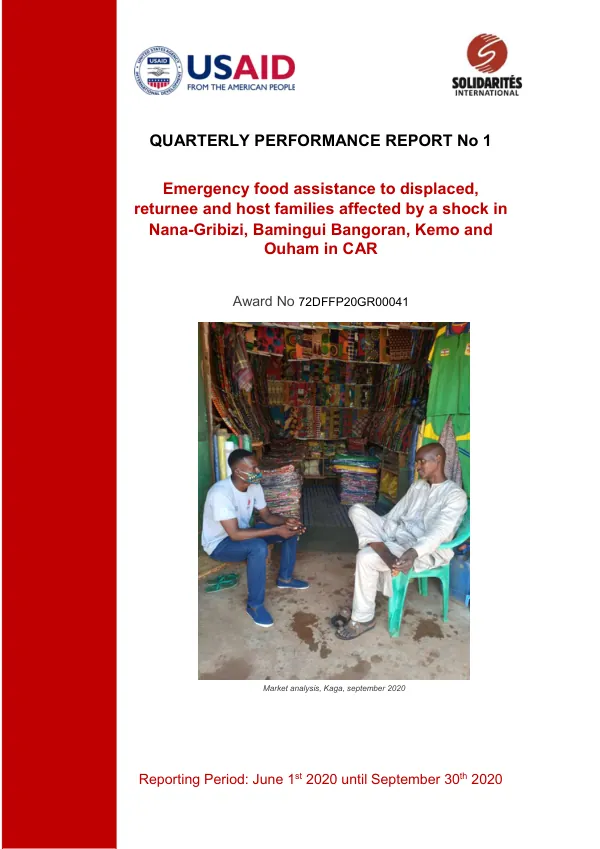
Quarterly Performance Report No 1: Emergency Food Assistance to Displaced, Returnee and Host Families Affected by a Shock in Nana-Gribizi, Bamingui Bangoran, Kemo and Ouham in CAR
Open record 2018
2018USAID DEC