USAID DEC
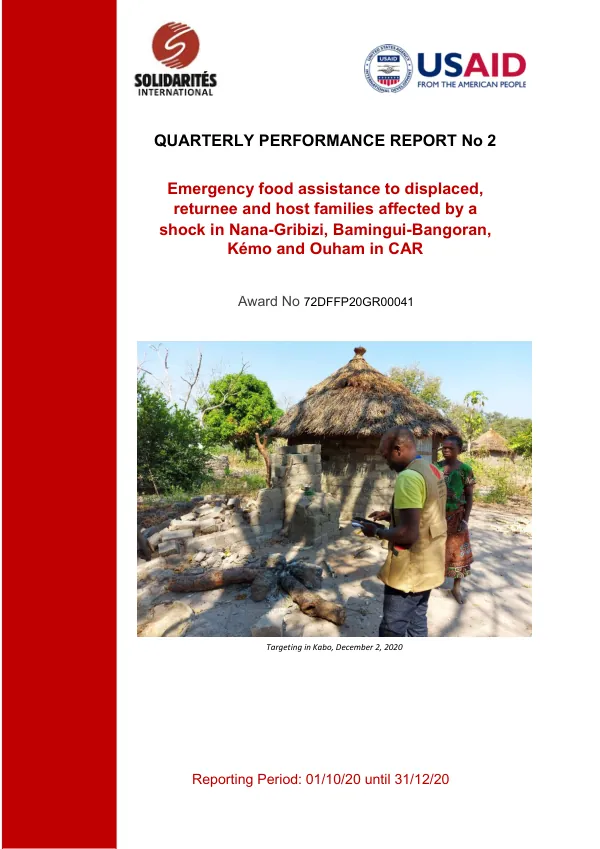
Quarterly Performance Report No 2: Emergency Food Assistance to Displaced, Returnee and Host Families Affected by a Shock in Nana-Gribizi, Bamingui-Bangoran, Kémo and Ouham in CAR
Sign inSOLIDARITÉS INTERNATIONAL
Quarterly Performance Report No 2: Emergency Food Assistance to Displaced, Returnee and Host Families Affected by a Shock in Nana-Gribizi, Bamingui-Bangoran, Kémo and Ouham in CAR
The humanitarian situation in the Central African Republic (CAR) has been marked by a significant deterioration in security and access for humanitarian actors.
2020 · 6 pages
Sign in to readA free account is required to download.
Abstract
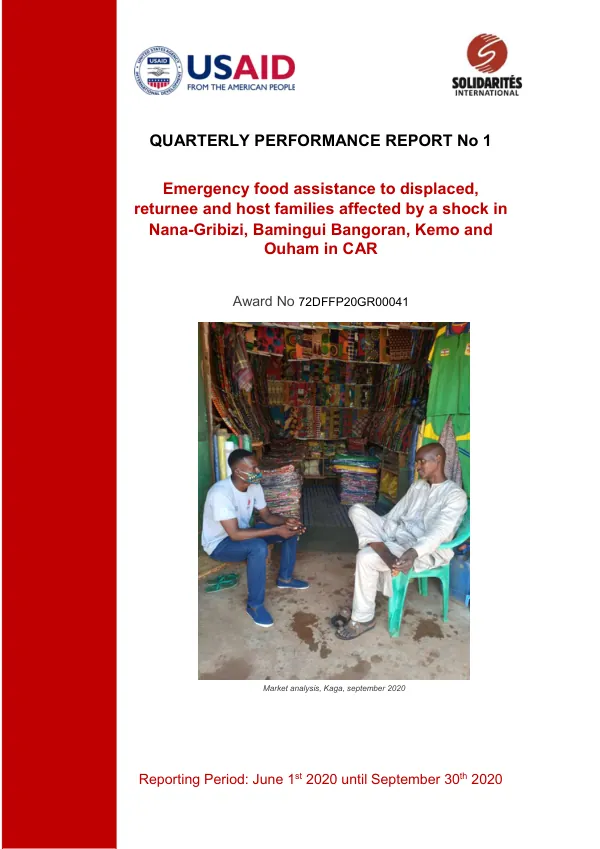
The electoral campaign, which started in December 2020, has led to a complete shift in the political and military landscape of the region, resulting in increased levels of armed robberies, menaces, and acts of car-jacking. The "Coalition des patriotes pour le changement" (CPC), a new coalition founded by the former President François Bozizé, has emerged as a major player in the region, leading to armed conflicts with the regular armed forces and the "Mission Multidimensionnelle Intégrée des Nations Unies pour la Stabilisation en Centrafrique" (MINUSCA). The security situation has been further exacerbated by the transhumance season, which started in November 2020, and has severely impacted the local population of the Ngouvota area in Kaga-Bandoro-Dékoa axis. The "Désarmement, Démobilisation, Réintégration, Rappatriement" (DDRR) process, which was integral to the signed peace agreement "Accord politique pour la paix et la reconciliation en République centrafricaine" (APPR-RCA), has been nullified since the emergence of the CPC. Despite the challenging security context, Solidarités International (SI) has continued to implement various activities within the reporting period. The FFP team has carried out preliminary activities for three interventions, including market analyses in Kaga-Bandoro, Kabo, and Ndélé. The team has also selected vendors for the fair modality using pre-packaged food baskets, which has been chosen due to the Covid-19 situation. The fair modality permits to avoid big gatherings and allows for the selection of vendors who undergo quality checks conducted by the "Agence Centrafricaine de Développement Agricole" (ACDA). The market analyses conducted by the SI team reveal that imported goods are routed to Kaga-Bandoro and Ndélé from Bangui, and that Kabo is supplied by Kaga-Bandoro. The availability of products and their prices are dependent on the access between Bangui and Kaga-Bandoro. During the rainy season or during security incidents on this axis, the availability decreases and prices inflate. Agricultural products are coming from producers in the areas that are selling them directly in both markets. The Covid-19 situation has also presented challenges for the implementation of the FFP project. The government did not lift the restrictions on gatherings during the period, forbidding the use of the fair modality. This has been particularly challenging in the CAR context, where the cash modality often presents security risks for the beneficiaries outside cities. The in-kind modality requires a much higher logistics implication to ensure the kits routing and quality checking in remote areas with no ACDA presence. The security situation has also been a major challenge for the implementation of the FFP project. Humanitarian access is hampered due to insecurity and armed conflicts. The presidential elections took place during the reporting period, with high tensions and conflicts between armed groups and the government supported by the MINUSCA in several provinces. SI had to reduce its activities during key moments of the period, such as the announcement of validated candidates, most of the electoral campaign, and the vote itself. The selection of vendors for the fair modality has also been a challenge. The selection process is not always conducted in areas where SI has an operational base permitting it to have an easy access to these vendors. In Kabo and Ndélé, with no ACDA presence, SI encounters difficulties to reach the vendors and to be able to collect the samples and documentation required. These difficulties add additional delays to the interventions planned. Favoring local food consumption as well as local suppliers in order to both better adapt operations to identified needs and boost local economy turned out to be a real challenge that impacted on the first response by delaying the fixed period.
Related documents