USAID DEC
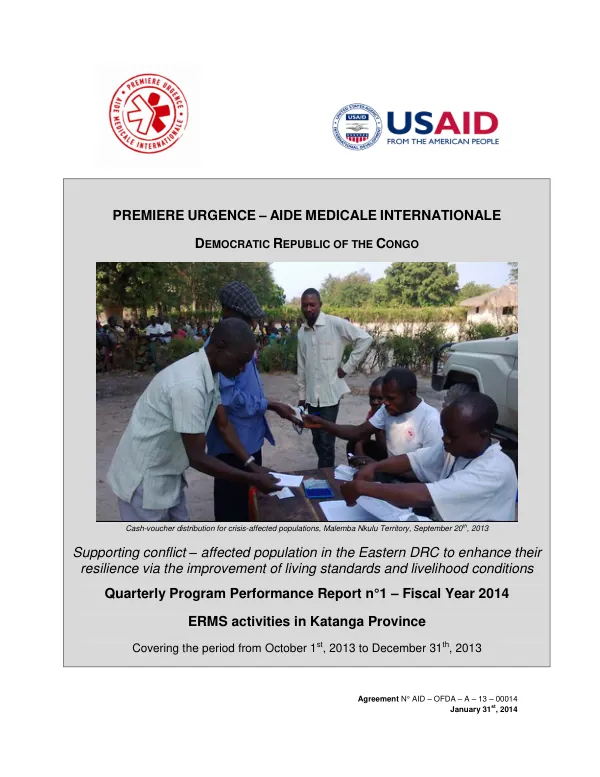
Quarterly Program Performance Report n°1 – Fiscal Year 2014: ERMS activities in Katanga Province
Sign inUSAID DEC
Quarterly Program Performance Report n°1 – Fiscal Year 2014: ERMS activities in Katanga Province
The Economic Recovery and Market Systems (ERMS) program in Katanga Province, Democratic Republic of the Congo, aims to restore livelihoods and basic living conditions of conflict-affected populations.
2014 · 7 pages
Sign in to readA free account is required to download.
Abstract
The program, funded by the US Agency for International Development (USAID) through the Office of US Foreign Disaster Assistance (OFDA), focuses on enhancing livelihoods of the most vulnerable through cash grants. The program's geographic area of operation includes Katanga Province, specifically Tanganyika District, Manono Territory, and Malemba Nkulu Territory. The target population consists of 37,500 persons, with 7,500 households, and 30,000 internally displaced persons (IDPs) and returnees. By the end of the reporting period, 30,884 beneficiaries had been reached, representing 82.35% of the target population. The program's activities are divided into four main components: preparatory measures for program implementation, community-based targeting through Relief Committees, cash-based assistance to selected recipients, and monitoring and evaluation. Key achievements include the presentation of the program to local authorities, recruitment and training of local staff, identification of priority areas and crisis-affected villages, and baseline surveys on household and market information. Community-based targeting through Relief Committees has been implemented, with one relief committee elected in each of the 19 target villages in the Malemba Nkulu territory. The Relief Committees have worked on the basis of door-to-door enumeration established by PU-AMI staff, and beneficiary lists have been displayed in the presence of NGO monitors. Cash-based assistance to selected recipients has been implemented, with 189 traders accepting the program rules and principles and signing a Memorandum of Understanding with PU-AMI. Distribution of payment orders to selected recipients has been completed, with 5,500 households receiving a set of five cash vouchers for a total value of $100. Cash payments to beneficiaries by participant shopkeepers for local purchase of assets and inputs are ongoing, with a minimum of 70% of the voucher value to be spent by the recipient at a partner store. Monitoring and evaluation activities are ongoing, with data collection and analysis from the complaint mechanism and appropriate response, follow-up of process and output/outcome indicators, and surveys on cash utilization and beneficiary satisfaction planned for the future. Regular liaison and discussions with participant shopkeepers are also ongoing to review and adapt the operating mode. The security context in the region has deteriorated since November 2013, with violent attempts occurring in the north of the Kiambi health zone. The resurgence of violence is attributed to the marginalization of pygmy communities and their extreme reactivity towards anything they cannot understand or are afraid of.