CHEMONICS
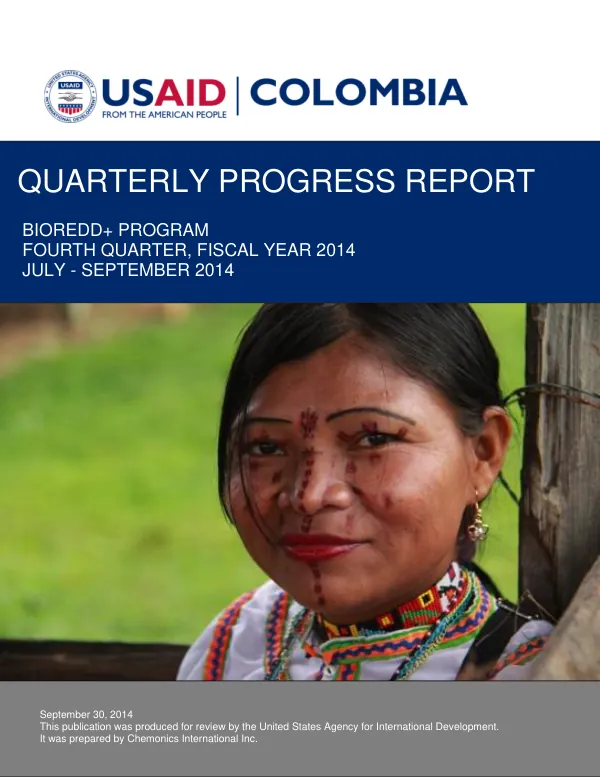
Quarterly Progress Report: Fourth Quarter, Fiscal Year 2014
The USAID Biodiversity—Reduced Emissions from Deforestation and Forest Degradation (BIOREDD+) Program is a three-year program financed by USAID, which supports Colombian efforts to strengthen environmental governance, mitigate and adapt to climate change impacts, conserve biodiversity, and promote economic development in the Colombian Pacific, as well as improving informal mining operations in Antioquia and Choco.
2014 · 52 pages
Sign in to readA free account is required to download.
Abstract
The program's contract was modified to extend its Life of Program (LOP) by six months and increase its value by US$ 4,000,000. During the fourth quarter of the 2014 fiscal year (July to September 2014), the program's technical performance continued to improve, achieving an average 84% performance against its revised set of LOP indicators for the quarter. Eight of the 14 (57%) targets have been achieved or surpassed. The Climate Change Component began to see the fruits of the significant investment of time and resources in REDD+ development, with the production of the carbon baseline and deforestation and degradation rates to predict GHG emission reductions. The Biodiversity Conservation Component continued last quarter's effort and has closed out almost its entire grants portfolio with AfroColombian Councils and Indigenous Resguardos. One of the Component's most tangible achievements has been its success in linking project finance to the implementation of local conservation agreements, particularly to underpin sustainable fishing and piangua extraction, but also with regard to forest protection. This is reflected in almost 704,000 new hectares of biological significance under improved management. Moreover, almost 7,000 people have derived economic benefits from better environmental stewardship. The Mining component continues to perform strongly, with 56 mining operations now possessing formal mining rights (93% of the revised LOP goal), more than 800 miners trained (233% over the LOP target), and all of the mining units legalized to date, eliminating mercury from their processing. The activities to rehabilitate degraded land have been more complicated than first anticipated, and while progress has been slower than expected, the results are visually impressive and literally transform landscapes from "lunar" to brilliant, green plantations. The program's progress towards key results is summarized in Table 1, which shows the number of hectares of biological significance and/or natural resources under improved natural resource management, the number of institutions/organizations with improved capacity for effective environmental resource management, and the number of people with increased economic benefits derived from sustainable natural resource management and conservation. The program has achieved significant progress towards these results, with 176% of the target for hectares of biological significance under improved management, 103% of the target for institutions/organizations with improved capacity, and 99.9% of the target for people with increased economic benefits. The program's activity design and implementation is guided by expected results, and the technical performance of BIOREDD+ continues to improve, achieving an average 84% performance against its revised set of LOP indicators for the quarter. The program's progress towards key results is reflected in the achievements of its various components, including the Climate Change Component, the Biodiversity Conservation Component, and the Mining component. The program's success in linking project finance to the implementation of local conservation agreements and its efforts to rehabilitate degraded land have been particularly notable.