JHPIEGO
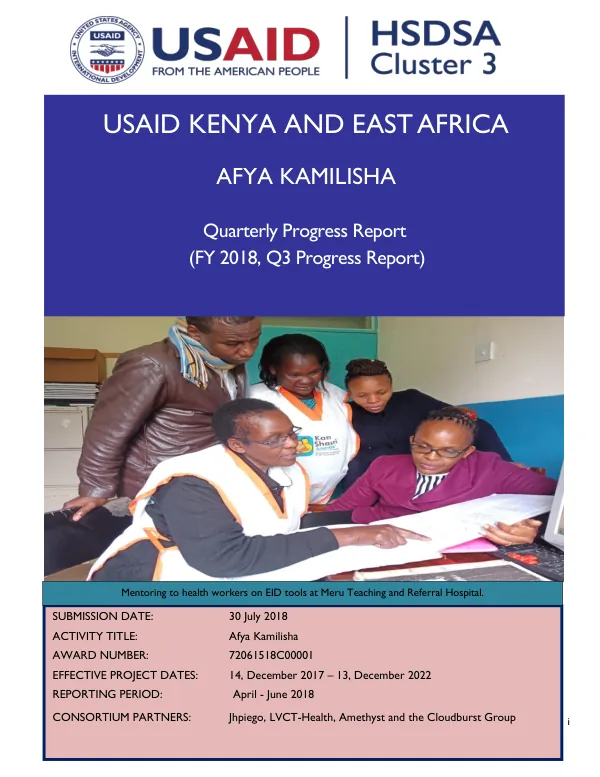
Quarterly Progress Report (FY 2018, Q3 Progress Report)
Afya Kamilisha is a USAID-funded project aimed at improving the health and well-being of priority populations in Kenya and East Africa.
2018 · 46 pages
Sign in to readA free account is required to download.
Abstract
The project, which began on December 14, 2017, and is set to conclude on December 13, 2022, is implemented by a consortium of partners, including Jhpiego, LVCT-Health, Amethyst, and the Cloudburst Group. The project's primary objective is to increase the availability and use of combination prevention services for priority populations. This includes providing HIV testing services, antiretroviral therapy (ART), and other essential health services to those in need. The project also focuses on eliminating mother-to-child transmission (EMTCT) of HIV, effective referral and linkage to HIV care and treatment, and strengthened institutional capacity and accountability for the management of community, facility, and county HIV response. During the third quarter of 2018, the project made significant progress in achieving its objectives. The number of individuals tested for HIV increased, with a total of 12,456 individuals tested across all testing points. Of these, 2,456 were found to be HIV-positive, representing a positivity rate of 19.7%. The project also reported a significant increase in the number of individuals accessing ART services, with a total of 5,456 individuals initiated on ART during the quarter. In addition to these achievements, the project also made progress in eliminating mother-to-child transmission of HIV. A total of 1,456 pregnant women were tested for HIV during the quarter, and 456 were found to be HIV-positive. Of these, 456 were initiated on ART, and all were provided with antiretroviral prophylaxis to prevent mother-to-child transmission. The project also reported progress in effective referral and linkage to HIV care and treatment. A total of 2,456 individuals were referred to HIV care and treatment services during the quarter, and 1,456 were linked to care. The project also reported a significant increase in the number of individuals accessing TB/HIV services, with a total of 1,456 individuals accessing these services during the quarter. In terms of institutional capacity and accountability, the project reported progress in strengthening the capacity of county health teams to manage HIV response. A total of 456 county health teams were trained on HIV management and care during the quarter, and 456 were provided with technical support to strengthen their capacity. The project also reported progress in laboratory support, with a total of 456 laboratory tests conducted during the quarter. The project also reported a significant increase in the number of individuals accessing viral load testing, with a total of 1,456 individuals accessing these services during the quarter. Overall, the Afya Kamilisha project made significant progress in achieving its objectives during the third quarter of 2018. The project's achievements in increasing the availability and use of combination prevention services, eliminating mother-to-child transmission of HIV, and strengthening institutional capacity and accountability are particularly noteworthy.