USAID DEC
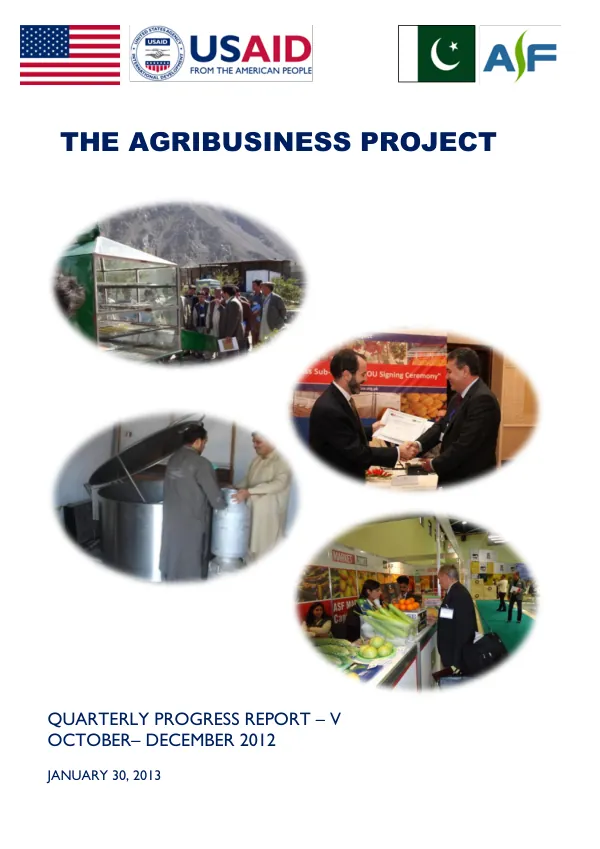
Quarterly Progress Report– V (October– December 2012)
The Agribusiness Project is a five-year initiative funded by USAID Pakistan and implemented by the Agribusiness Support Fund (ASF) in collaboration with international and national partner organizations.
2012 · 35 pages
Sign in to readA free account is required to download.
Abstract
The project aims to increase competitiveness and productivity of horticulture and livestock sub-sectors in Pakistan, with the overall goal of supporting improved conditions for broad-based economic growth, creating employment opportunities, and contributing to poverty alleviation through increased competitiveness of horticulture and livestock value chains. The project was designed to address priority problems and constraints impeding development of the agriculture sector in Pakistan. Interventions under the project focus on improving and strengthening off-farm and on-farm activities by enhancing competitiveness of enterprises to explore and exploit their potential in both domestic and international markets. A sub-sector cluster approach is being adopted by the project, whereby areas with the greatest potential for value addition, employment creation, and outreach will be prioritized and targeted. The project has two main components: Technical Assistance (TA) for Capacity Building and Program Support, and Partnership Window Cost-Sharing Grants. The TA component provides ongoing technical assistance and capacity building support to upgrade and strengthen targeted value chains in horticulture and livestock sub-sectors. This includes international TA and program delivery support, international market linkages development, establishment and strengthening of Kissan Field Schools, and capacity building, training, and awareness. Under the TA component, several sub-activities are being implemented, including the International Compliance Certifications Program, International Markets Access Program, establishment of Value Chain Platforms, International Market Linkages Program, technical and managerial trainings, organization of Kissan Field Schools, and capacity building of Business Development Service Providers. These sub-activities aim to enhance the competitiveness of enterprises, improve market access, and increase productivity and efficiency in the agriculture sector. The project has made significant progress in the first quarter of year two, with several key accomplishments reported. These include the completion of participatory rapid horticultural and livestock appraisal studies, baseline studies, and detailed studies on selected value chains. The project has also established several Value Chain Platforms, which have brought together relevant stakeholders to develop value chain road-maps and address specific or general gaps in the value chains. In addition, the project has provided technical and managerial trainings to farmers, enterprises, BDS providers, and other relevant stakeholders, and has organized Kissan Field Schools in selected value chains. The project has also selected partner NGOs for the formation of Farmer Enterprise Groups (FEGs) and has conducted stakeholders' consultations and capacity building activities. The project has also made significant progress in terms of financial management, with a total expenditure of $X million reported for the first quarter of year two. The project has also reported significant progress in terms of value chain development, with several value chains prioritized and targeted for support. Overall, the Agribusiness Project is making significant progress in its efforts to increase competitiveness and productivity of horticulture and livestock sub-sectors in Pakistan, and to support improved conditions for broad-based economic growth, create employment opportunities, and contribute to poverty alleviation through increased competitiveness of horticulture and livestock value chains.
Related documents