ELIZABETH GLASER PEDIATRIC AIDS FOUNDATION
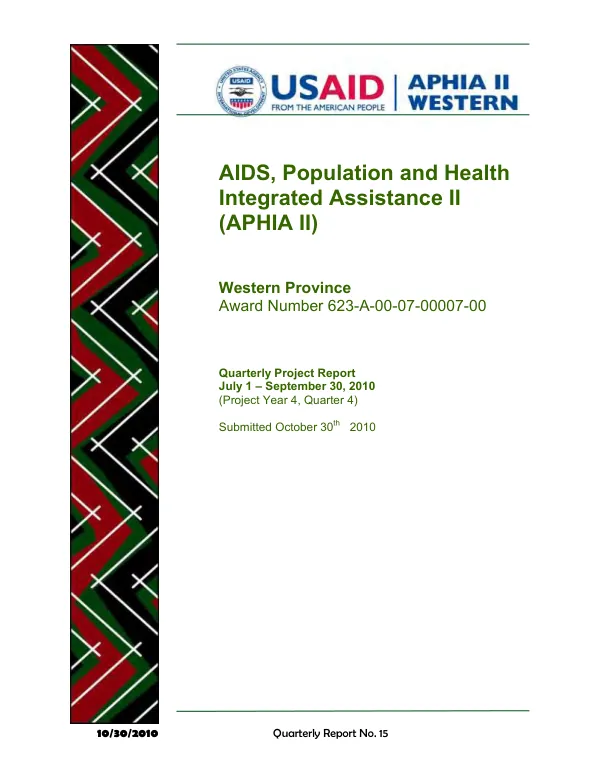
Quarterly Project Report: APHIA II Western Consortium Partners
The AIDS, Population and Health Integrated Assistance II (APHIA II) project in Western Province, Kenya, is a collaborative effort between several organizations, including PATH, JHPIEGO Corporation, Elizabeth Glaser Pediatric AIDS Foundation (EGPAF), Society for Women and AIDS in Kenya (SWAK), and World Vision (WV).
2010 · 139 pages
Sign in to readA free account is required to download.
Abstract
The project aims to improve and expand facility-based HIV/AIDS, TB, RH/FP, malaria, and MCH services, as well as civil society activities to increase healthy behaviors and care and support for people and families affected by HIV/AIDS. The project has made significant progress in improving and expanding facility-based services. According to data, the number of CD4 count tests processed has increased, and QA/QI outcomes have shown improvements in the assessment of eligible clients and those with a baseline CD4 at enrollment. Additionally, the project has established rainwater tanks at health facilities, such as the one at Hamisi DH, to improve water access and sanitation. The project has also made progress in expanding care and support services for people and families affected by HIV/AIDS. The number of new adults and children enrolled to care and those started on antiretroviral therapy (ART) has increased, as shown in Figures 5 and 6. The project has also implemented home-based care and support services for people living with HIV/AIDS (PLWA) and orphans and vulnerable children (OVC), as led by World Vision. In terms of civil society activities, the project has worked with community-based organizations to increase healthy behaviors and reduce stigma and discrimination. The project has implemented behavior change communication (BCC) interventions, community mobilization, and advocacy for healthy behaviors, as led by PATH. The project has also worked with schools and workplaces to promote healthy behaviors and reduce stigma and discrimination. The project has also made progress in improving and expanding MCH services. The number of facility deliveries has increased, as shown in Figure 9, and the project has implemented interventions to improve maternal and child health, such as the distribution of mama packs. The project has also implemented interventions to improve nutrition and reduce malnutrition, such as the provision of enriched porridge. The project has also made progress in improving and expanding TB/HIV services. The project has implemented interventions to improve TB/HIV diagnosis and treatment, such as the provision of TB/HIV data analysis. The project has also implemented interventions to improve TB/HIV prevention and care, such as the provision of isoniazid preventive therapy (IPT). The project has also made progress in improving and expanding RH/FP services. The project has implemented interventions to improve RH/FP access and utilization, such as the provision of family planning services and the distribution of contraceptive commodities. The project has also implemented interventions to improve RH/FP quality and safety, such as the provision of RH/FP training and the implementation of quality improvement initiatives. The project has also made progress in improving and expanding malaria services. The project has implemented interventions to improve malaria diagnosis and treatment, such as the provision of malaria testing and treatment. The project has also implemented interventions to improve malaria prevention and control, such as the provision of insecticide-treated bed nets and the implementation of indoor residual spraying. The project has also made progress in improving and expanding MCH services. The project has implemented interventions to improve MCH access and utilization, such as the provision of MCH services and the distribution of MCH commodities. The project has also implemented interventions to improve MCH quality and safety, such as the provision of MCH training and the implementation of quality improvement initiatives. The project has also made progress in improving and expanding TB/HIV services. The project