USAID DEC
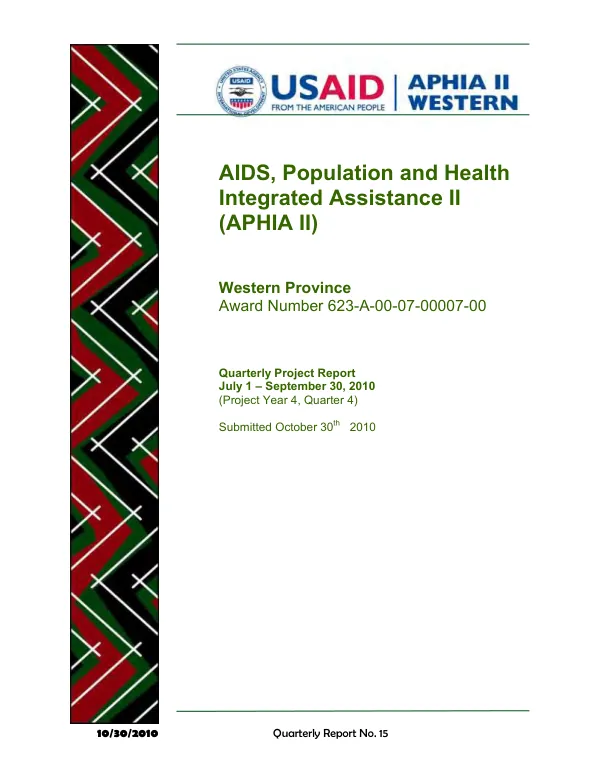
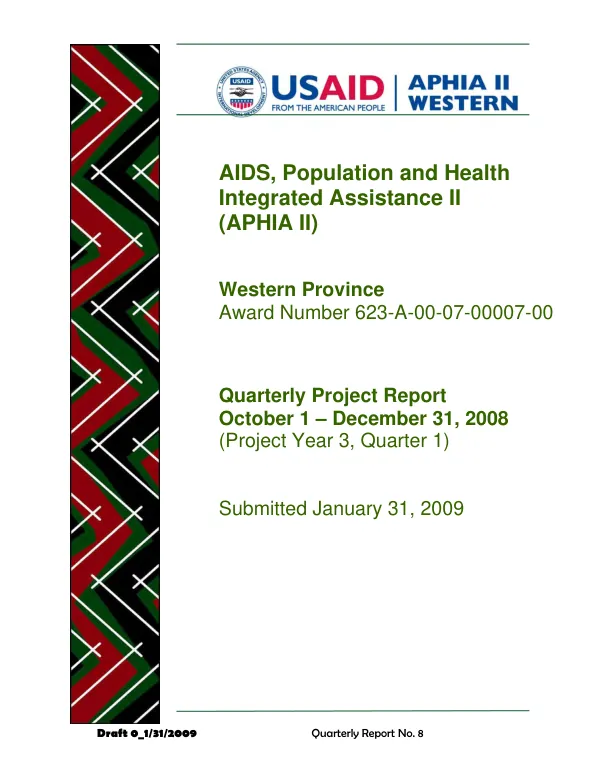
Quarterly Project Report: APHIA II Western, October 1 – December 31, 2008 (Project Year 3, Quarter 1)
Sign inELIZABETH GLASER PEDIATRIC AIDS FOUNDATION
Quarterly Project Report: APHIA II Western, October 1 – December 31, 2008 (Project Year 3, Quarter 1)
The APHIA II Western Consortium Partners, led by PATH, implemented the AIDS, Population and Health Integrated Assistance II (APHIA II) project in Western Province, Kenya.
2009 · 94 pages
Sign in to readA free account is required to download.
Abstract
The project aimed to improve and expand facility-based HIV/AIDS, TB, RH/FP, malaria, and MCH services. The consortium partners included JHPIEGO Corporation, Elizabeth Glaser Pediatric AIDS Foundation (EGPAF), Society for Women and AIDS in Kenya (SWAK), and World Vision (WV). The project focused on three key results: improved and expanded facility-based HIV/AIDS, TB, RH/FP, malaria, and MCH services; improved and expanded civil society activities to increase healthy behaviors; and improved and expanded care and support for people and families affected by HIV/AIDS. The project implemented various interventions, including behavior change communication (BCC) and community mobilization, to reduce stigma surrounding HIV/AIDS and TB. The project also targeted at-risk populations, including youth and people living with HIV/AIDS (PLWA). The consortium partners worked closely with the Ministry of Health (MOH) and other stakeholders to strengthen service delivery, improve diagnostic counseling and testing, and build capacity of service delivery providers. The project implemented various activities, including training providers, strengthening supply chain management, and improving links between ART sites and the communities they serve. The project also reported a 60% yield improvement in demonstration plots established in 15 communities. The project implemented various monitoring and evaluation activities to track progress and identify areas for improvement. The project used various indicators, including the number of adult and children enrolled on ART, PMTCT uptake, and CYP method mix. The project also reported on the frequency distribution of KCPE 2008 results for 1,007 OVC and the number of PLHA/OVC households in new houses. The project's geographic focus was Western Province, Kenya, and the project's timeframes were from October 1 to December 31, 2008 (Project Year 3, Quarter 1). The project's recommendations included scaling up home-based care and other support services for PLWA and OVC, as well as capacity building of community and faith-based organizations in Western Province. The project's implementation challenges and constraints included equipment costs, limited market access, and soil degradation. The project's consortium partners worked together to address these challenges and achieve the project's objectives. The project's results and recommendations provide valuable insights for future projects and programs aimed at improving health outcomes in Western Province, Kenya.
Related documents