USAID
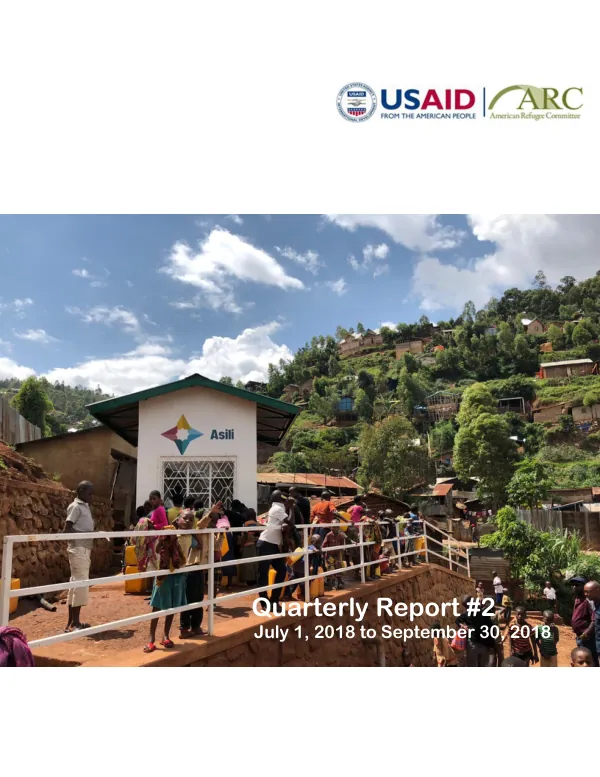
Quarterly Report #2: Asili 2.0: Scaling for Sustainability in the Kivus
The Asili 2.0: Scaling for Sustainability in the Kivus project began its second quarter on July 1, 2018, and concluded on September 30, 2018.
2018 · 16 pages
Sign in to readA free account is required to download.
Abstract
During this period, research was conducted in the selected areas where water points would be built. The community was engaged to map opportunities for the health intervention, and the team initiated administrative procedures to secure land for the water infrastructure. A marketing campaign was launched for Asili's enterprises in the area, targeting local governments, women's groups, churches, and schools. Community leaders and local leaders visited existing Asili areas to understand the model and encourage their involvement in the implementation process. Land was identified for the construction of the reservoir for the water lines in Ciriri and Camp TV Zones, which will be constructed in parallel in the next two reporting periods. Initial assessments were conducted for the third and fourth Zones under the cooperative agreement, with a deeper assessment to begin in the first quarter of FY2019, focusing on opportunities within the Uvira area. Asili 2.0 is a co-creation project between USAID, private sector partners, communities of eastern Congo, and the American Refugee Committee (ARC), aiming to create empowered communities through the provision of meaningful, high-quality services. The project recognizes that state institutions cannot adequately address the needs of many communities in eastern Congo, and the social enterprise model creates accountability to the communities in which Asili works. The project's goal is to scale a sustainable social enterprise platform to create healthier, more resilient, economically empowered, and functional communities in South Kivu. The objectives include developing viable business models for the delivery of bundled social services through a platform at scale, improving access to clean water and health services in target communities, and maintaining quality standards of clean water and health services. Asili is a member-driven hub of complementary social businesses located within zones of approximately 25,000 people. The initial businesses – agriculture, health care, and clean water – were selected due to their potential to immediately contribute to healthier, more resilient, and economically empowered communities. Asili will continue to expand and grow, utilizing the frameworks and tools developed within the initial pilot phase. The project has identified the Ciriri area for Zone 1 and the Camp TV area for Zone 2. During FY2019, the sites for Zones 3 and 4 will be identified, and Zones 5 and 6 will be identified and built-out in subsequent project years. The project's core business lines, healthcare and clean water sales, aim to generate $7,700/month of profit per zone, covering central corporate management costs. Key activities for the reporting period included a design charrette to improve the built-environment of the health clinic, which did not occur as planned due to changes in the design challenge. Instead, a new health delivery model was proposed, focusing on a "clinic in a backpack" that would utilize nurses and community health workers to provide essential medicines and tools to diagnose common illnesses and provide treatment. Asili is still in negotiation with SOS Village to acquire their health clinic in Camp TV, with conversations progressing well. The team is analyzing the information and maintaining a close collaboration with the responsible individuals of SOS healthcare center for any clarification. Dr. David Roesel, an international consultant for ASILI, visited the SOS health center this quarter and met with the current medical director of the SOS clinic. The project also aims to develop and pilot a clean energy business line, meeting with various social groups and other service providers to understand energy offerings and look for areas of partnership/coordination. However, this activity did not occur as planned, and meetings are planned for the next two quarters. Additionally, the project aims to develop and pilot a sanitation service within the five-year agreement to improve the lives of citizens in eastern Congo.