USAID DEC
Prototyping an Urban Community Resilience Initiative in SE Asia OFDA Quarterly Report
Sign inAMERICAN RED CROSS
Prototyping an Urban Community Resilience Initiative in SE Asia OFDA Quarterly Report
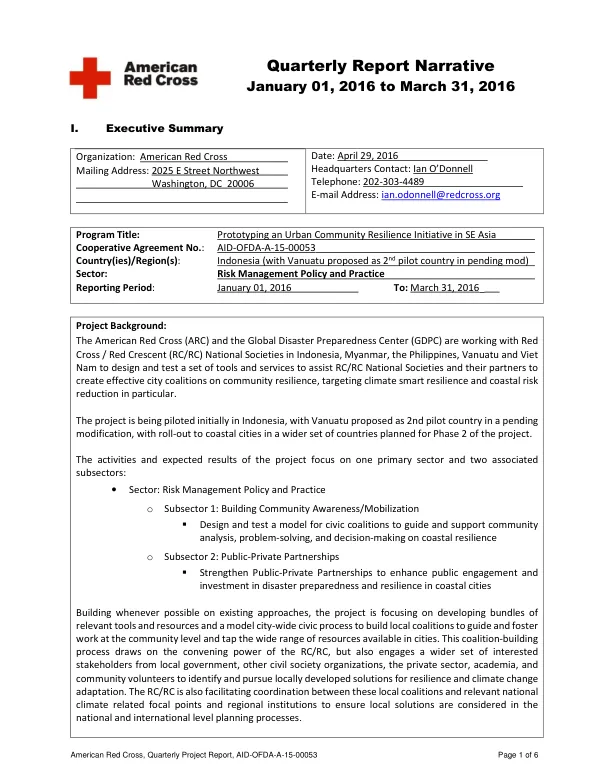
The American Red Cross, in collaboration with the Global Disaster Preparedness Center, is working with Red Cross/Red Crescent National Societies in Indonesia, Myanmar, the Philippines, Vanuatu, and Vietnam to design and test a set of tools and services to assist in creating effective city coalitions on community resilience.
2016 · 6 pages
Sign in to readA free account is required to download.
Abstract
The project focuses on climate smart resilience and coastal risk reduction, with the initial pilot taking place in Indonesia and a proposed second pilot in Vanuatu. The project aims to develop bundles of relevant tools and resources and a model city-wide civic process to build local coalitions to guide and foster work at the community level and tap the wide range of resources available in cities. The project is divided into two subsectors: Building Community Awareness/Mobilization and Public-Private Partnerships. The Building Community Awareness/Mobilization subsector aims to design and test a model for civic coalitions to guide and support community analysis, problem-solving, and decision-making on resilience. The Public-Private Partnerships subsector seeks to strengthen Public-Private Partnerships to enhance public engagement and investment in disaster preparedness and resilience in coastal cities. The project has undergone an initial set of regional inception activities, and the kick-off workshop for the project was held in early March with representatives from seven RC/RC National Societies and three regional resource organizations. Each National Society was invited to submit a short concept note outlining their interest in the project, likely partner interest at country level, their experience with coalitions and multi-stakeholder partnerships in previous projects, and their preliminary plan for initiating the project in up to two cities in their country. Concept notes were submitted by the RC/RC National Societies in five countries, and selection of the first pilot countries is pending. The project has a budget of $31,821.40 for Objective 1 in the second quarter, with $30,145.70 expended during this period. The variance in cumulative expenditures was due to delayed scheduling of the kick-off workshop and the ongoing hiring process for a Technical Advisor to serve as regional project coordinator. The project's goal is to enhance disaster preparedness and resilience in coastal cities in up to three countries in Southeast Asia, especially in response to the risks associated with climate change. The project aims to help participating coastal cities identify and address their top risks to community resilience and strengthen household resilience city- and township-wide. The project's results include stakeholders in coastal cities having easy access to tools and guidance to form civic coalitions and public-private partnerships being significantly strengthened in coastal cities. The project's needs assessment highlights the increasing number of people exposed to hazards, shocks, and stresses, especially in coastal cities, leading to increased fragility and vulnerability. However, people living in cities are also agents of change and have significant resources, skills, and capacities to bring to resilience efforts in their own communities and across their cities and districts.