UNIVERSITY OF CALIFORNIA AT DAVIS
Quarterly Report 4: November 6, 2015
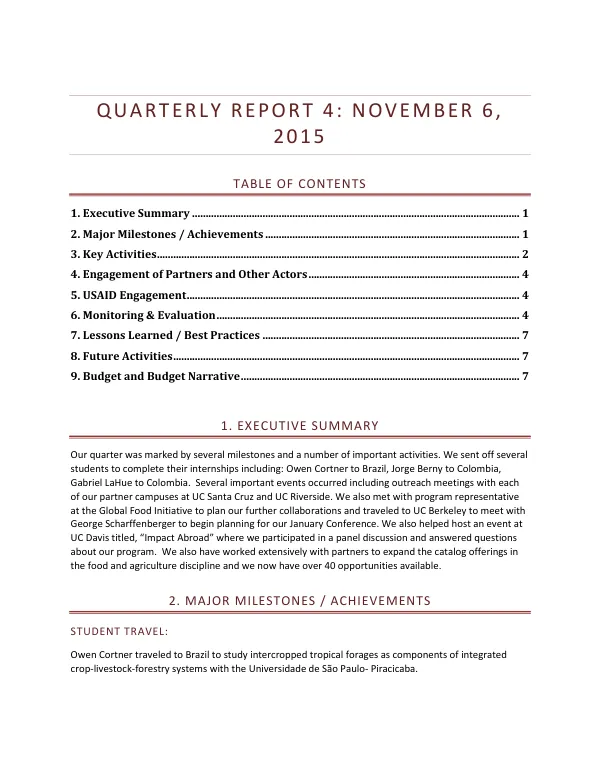
The quarterly report for November 6, 2015, highlights several major milestones and achievements.
2015 · 8 pages
Sign in to readA free account is required to download.
Abstract
Student travel programs were implemented, with Owen Cortner traveling to Brazil to study intercropped tropical forages, Gabe LaHue traveling to Colombia to study alternative water management strategies, and Jorge Berny traveling to Colombia to study innovative breeding strategies. Outreach events were held at UC Riverside, UC Santa Cruz, and UC Davis, with a total of 25 students attending. Coordination meetings were held with partner universities to discuss program implementation and planning. A staff retreat was held to plan for the upcoming quarter and year, with identified activities including setting up application review meetings, developing a new risk management protocol, and determining a process for insurance for students. The report also highlights key activities, including host outreach, engagement with the Global Innovation Exchange, and program expansion. The program has continued to build relationships with UC Santa Cruz and UC Riverside, with the support of the Global Food Initiative. A grant from USAID's mission in Brazil was secured to host projects related to biodiversity preservation and climate change in the Brazilian Amazon. The Global Food Initiative has been a key partner, providing a grant of $223,688 for the next two years to expand the program to more students and universities. The Seiber Foundation has also been engaged, with discussions indicating that they will likely fund 4 student fellowships this year. USAID engagement has been a significant aspect of the program, with a proposal being approved for projects in the Brazilian Amazon. Five students will travel to Brazil to work on projects related to disturbance and land use in the Cerrado-Amazon transition, impact of climate change on forests, assessment of plant diversity and carbon sequestration in the restoration of degraded lands, and analysis of traditional management practices in Amazonian Dark Earth sites.
Related documents