BANYAN GLOBAL
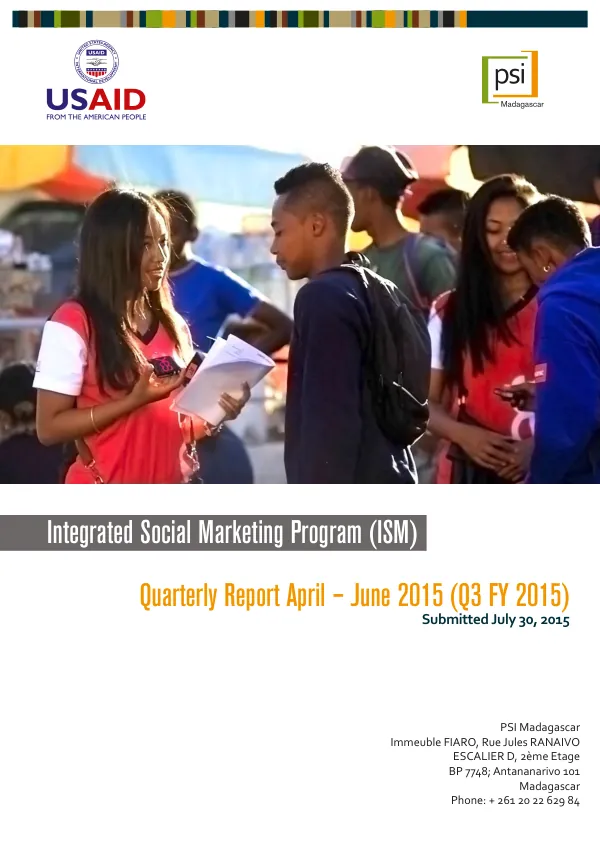
Quarterly Report April – June 2015 (Q3 FY 2015)
The Integrated Social Marketing Program (ISM) in Madagascar aims to improve the health of the Malagasy people, particularly women of reproductive age, children under five, youth, and those living in rural and underserved areas.
2015 · 89 pages
Sign in to readA free account is required to download.
Abstract
The program's main strategic objective is to use an integrated social marketing approach to increase the use of lifesaving health products and services, particularly in the areas of Family Planning/Reproductive Health, Maternal and Child Health (MCH), and Malaria. The ISM Program is a five-year initiative, funded by the Cooperative Agreement (COAG) No. AID-687-A-13-00001, with a total budget of $36,823,053. The program is implemented by PSI and its partners, including IntraHealth, Banyan Global, Human Network International (HNI), SAF, and SALFA. The ISM Team applies its combined expertise in social marketing, health clinic social franchising, and behavior change communication to bring more users into the Malagasy health market. The program's goal is to increase the use of lifesaving health products and services, particularly in the areas of Family Planning/Reproductive Health, Maternal and Child Health (MCH), and Malaria. To achieve this goal, the ISM Program focuses on several key areas, including: * Increasing the adoption and maintenance of health behaviors, particularly in the areas of Family Planning/Reproductive Health and Maternal and Child Health (MCH). * Improving the quality of selected health services in the private sector, particularly in the areas of Family Planning/Reproductive Health and Maternal and Child Health (MCH). * Increasing the availability of life-saving health products and services, particularly in the areas of Family Planning/Reproductive Health, Maternal and Child Health (MCH), and Malaria. The ISM Program also focuses on several cross-cutting areas, including Research, Monitoring and Evaluation (M&E), Gender, Environment, and Partnerships. The program's research and M&E activities aim to provide evidence-based information to inform program decisions and improve program effectiveness. The program's gender and environment activities aim to ensure that the program's interventions are sensitive to the needs of women and the environment. The ISM Program has made significant progress in the first quarter of 2015, with several key achievements reported. These include: * The implementation of a comprehensive social marketing campaign to promote the use of lifesaving health products and services, particularly in the areas of Family Planning/Reproductive Health and Maternal and Child Health (MCH). * The establishment of a network of health clinics and social franchises to provide high-quality health services to the Malagasy people. * The distribution of over 100,000 insecticide-treated bed nets to prevent malaria. * The training of over 500 health workers and social franchise managers to improve their skills and knowledge in the areas of Family Planning/Reproductive Health and Maternal and Child Health (MCH). Overall, the ISM Program is making significant progress in improving the health of the Malagasy people, particularly in the areas of Family Planning/Reproductive Health, Maternal and Child Health (MCH), and Malaria. The program's integrated social marketing approach and focus on key areas of intervention have contributed to its success, and the program is expected to continue making significant progress in the coming quarters.