USAID DEC
Quarterly Report December 2010 CCIU LTD
The Conservation Cotton Initiative Uganda Ltd (CCIU) is a project aimed at promoting sustainable cotton production in Uganda.
2010 · 12 pages
Sign in to readA free account is required to download.
Abstract
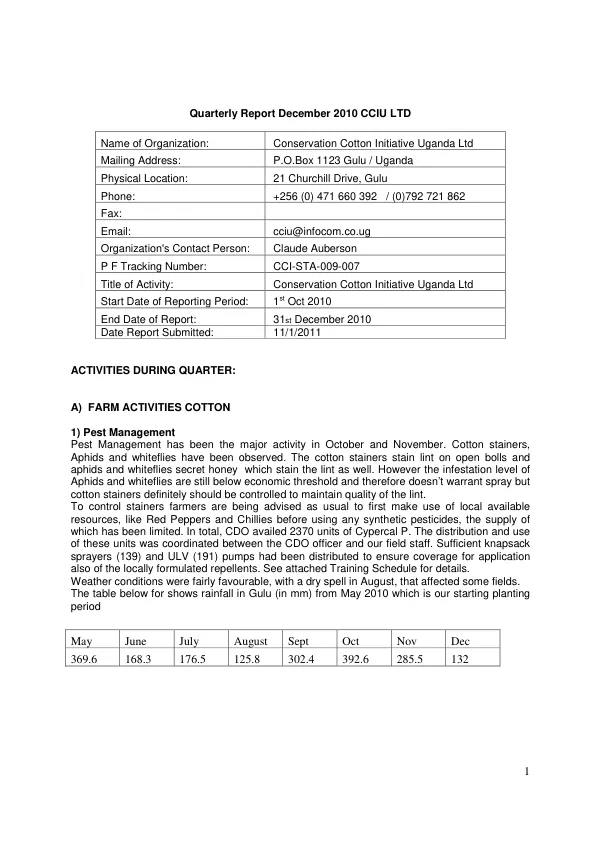
The initiative began in 2010 with funding from various sources, including the Cotton Development Fund. The project's main objective is to improve the livelihoods of cotton farmers in Uganda by enhancing their productivity, income, and access to markets. Pest management has been a major activity in the project, with cotton stainers, aphids, and whiteflies being the primary pests of concern. To control these pests, farmers have been advised to use local resources such as red peppers and chillies before resorting to synthetic pesticides. The project has also distributed knapsack sprayers and ULV pumps to farmers to facilitate the application of locally formulated repellents. Weather conditions have been favorable, with a dry spell in August affecting some fields. Harvesting of cotton has been ongoing, with farmers starting to market their produce. The late-planted cotton crop is expected to be harvested in early January 2011. To ensure that farmers receive a fair price for their cotton, the project has established a price stabilization fund, which has been reviewed and adjusted several times during the quarter. The minimum price to be paid to farmers has been set at 1600 Ushs, with a levy of 600 Ushs paid into the fund. The project has also been working with primary societies to enhance their capacity to market cotton. A training program for society officials and field officers was held in November 2010 to prepare them for the marketing season. The project has also provided societies with weighing scales, which have been calibrated and certified by the Uganda National Bureau of Standards (UNBS). The number of societies involved in marketing has increased substantially, from 9 in the previous season to 24 in the current season. The project has also established mini-gins in some societies, which have been completed on time. Sign posts have been made and are awaiting transportation to Gulu. The project has also provided funding to societies for marketing, with a total of 174,100,000 Ushs being disbursed to 24 societies. The project has also established a bank account for each society to ensure transparency and accountability. The project's activities have been coordinated with the District Cooperative Officer, who has provided support and guidance to the project. The project has also worked closely with the Ginners Association to establish a price stabilization fund and to ensure that farmers receive a fair price for their cotton. The project's overall objective is to improve the livelihoods of cotton farmers in Uganda by enhancing their productivity, income, and access to markets.
Related documents