GOVERNMENT OF SENEGAL
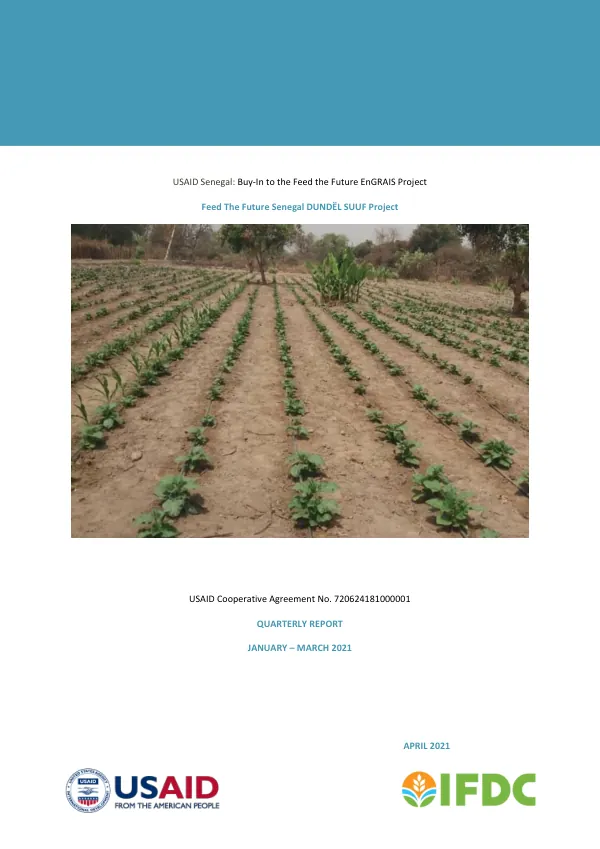
USAID Senegal: Buy-In to the Feed the Future EnGRAIS Project
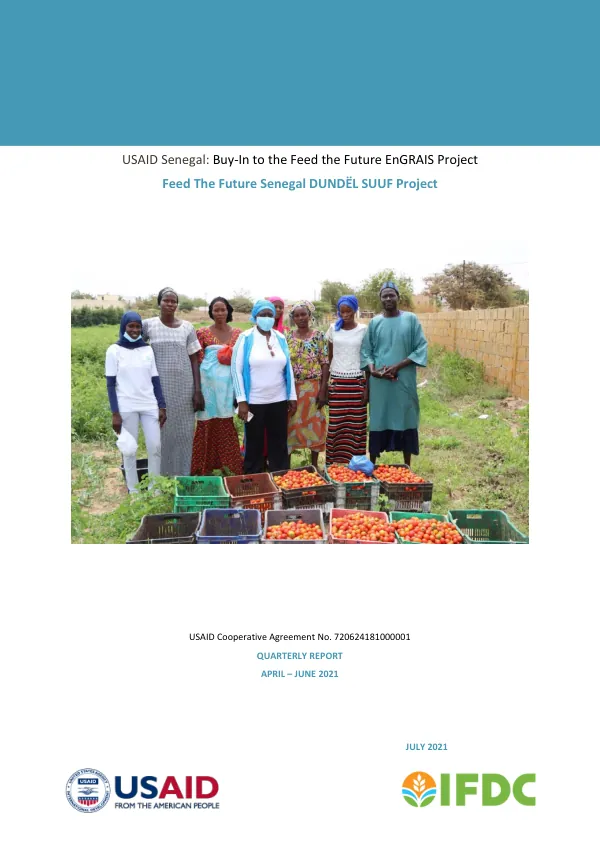
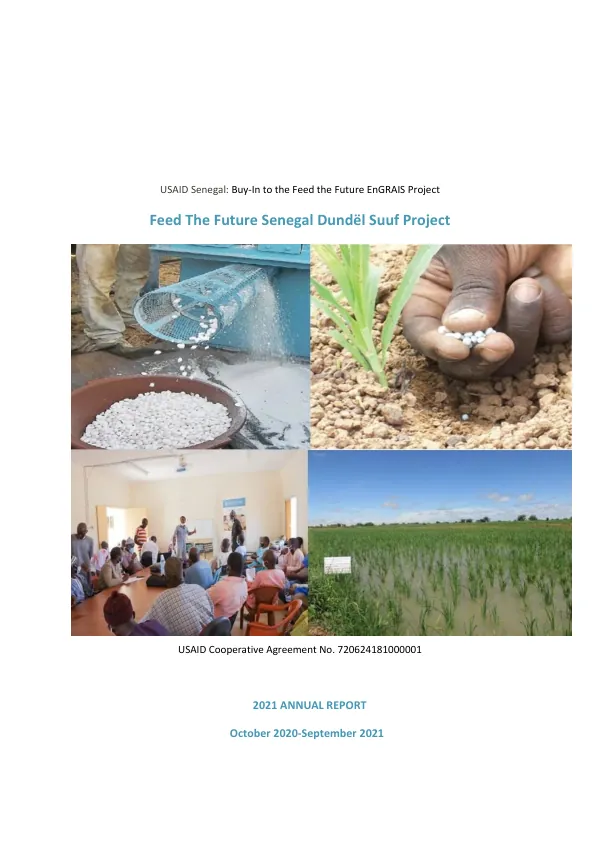
The agricultural development initiative in Senegal, known as the Dundël Suuf project, aims to increase agricultural productivity by promoting an inclusive and sustainable reduction of hunger, poverty, and malnutrition.
2021 · 24 pages
Sign in to readA free account is required to download.
Abstract
The project is a collaborative effort between the Government of Senegal, the International Fertilizer Development Center (IFDC), and the United States Agency for International Development (USAID). The project's strategic objective is to increase the availability and use of new and quality fertilizers through efficient private sector-led supply systems to improve and sustain soil fertility in Senegal. The project operates in the five Feed the Future Zones of Influence (ZoIs) in Senegal, which are Casamance, Senegal Oriental, the Peanut Basin, Niayes, and the Senegal River Valley. The target crops are dry cereals, rice, and vegetables. The main beneficiaries of the project are small farmers, input supply chain actors, extension and research agents, and vulnerable groups, including women and youth. The project's activities are organized into three major components: (1) Improved and appropriate fertilizer formulas developed and made available to farmers, (2) Proven and environmentally sound fertilizer products and technologies disseminated and upscaled, and (3) Improved fertilizer policy and regulatory environment. The project's results framework presents the goal and strategic objective of the project, which is to increase agricultural productivity to foster inclusive and sustained reduction in hunger, poverty, and malnutrition. During the second quarter of the second year of implementation, the project achieved several key milestones. A total of 1,038 soil samples were collected and sent to CropNuts Lab for analysis, with 711 samples already analyzed for nutrient deficiency. The project also finalized two databases of rainy season demonstration plots' results and published five reports synthesizing the results in each zone. Additionally, 14,829 farmers were trained, with 10,755 women (72%) and 2,842 youth (19%) participating in the training. The project also implemented 439 hectares of demonstration and extension of UDP and MD technologies and identified and provided agro-input packages (AIPs) to 900 target beneficiaries to mitigate the impact of COVID-19. The project's partner, the Senegalese Agricultural Research Institute (ISRA), worked closely with the National Institute of Pedology (INP) to conduct field activities related to soil fertility mapping. The project's analysis and mapping of soil nutrient deficiencies to better characterize fertilizer requirements is ongoing, with 711 soil samples already analyzed and 1038 samples sent for analysis. The project's progress in developing and making available improved and appropriate fertilizer formulas to farmers is a key component of its overall objective to increase agricultural productivity and reduce hunger, poverty, and malnutrition in Senegal.
Related documents