GOVERNMENT OF SENEGAL
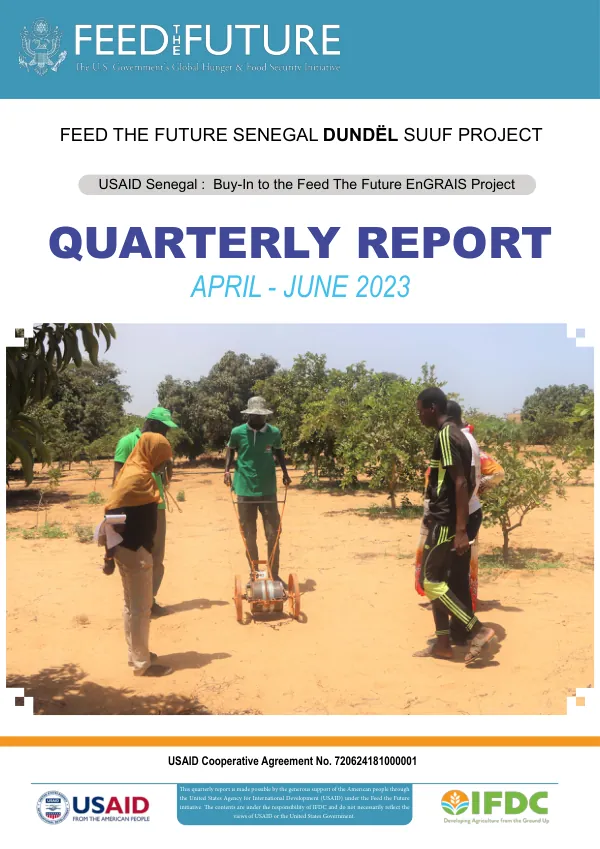
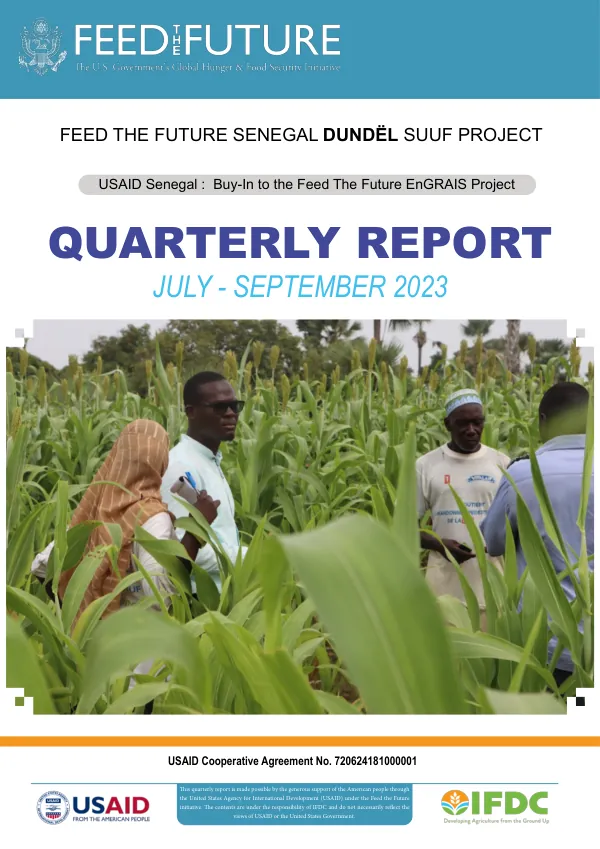
Quarterly Report: Feed the Future Senegal DUNDËL SUUF Project
The Feed the Future Senegal Dundël Suuf Project is a three-year initiative funded by USAID/Senegal at the request of the Government of Senegal.
2023 · 21 pages
Sign in to readA free account is required to download.
Abstract
The project is being implemented by the International Fertilizer Development Center (IFDC) as part of the larger Feed the Future "Enhancing Growth through Regional Agricultural Input Systems" (EnGRAIS) project in West Africa. The project's goal is to increase agricultural productivity to foster inclusive and sustained reduction in hunger, poverty, and malnutrition. The project aims to increase the availability and use of new quality fertilizers through efficient private sector-led supply systems to improve and maintain soil fertility in Senegal. To achieve this goal, the project has defined three intermediate results: (i) improved and appropriate fertilizer formulas are developed and disseminated to farmers; (ii) proven, environmentally friendly fertilizer products and technologies are disseminated and scaled up; and (iii) the policy and regulatory environment in the fertilizer sector is improved. The project's objectives and intermediate results are aligned with the agricultural development objectives set by the Government of Senegal. The project's implementation is focused on increasing the availability and use of new quality fertilizers, improving soil fertility, and promoting sustainable agricultural practices. The project's activities are designed to address concerns related to soil fertility in Senegal and to support the country's agricultural development goals. The project's implementation is being carried out in collaboration with various stakeholders, including the Government of Senegal, private sector companies, and local implementing partners. The project's activities are focused on developing and disseminating improved fertilizer formulas, promoting the use of environmentally friendly fertilizer products and technologies, and improving the policy and regulatory environment in the fertilizer sector. The project's progress is being monitored and evaluated through regular reporting and assessment. The project's quarterly reports provide an update on the project's activities, achievements, and challenges. The reports also provide information on the project's intermediate results, including the development and dissemination of improved fertilizer formulas, the promotion of environmentally friendly fertilizer products and technologies, and the improvement of the policy and regulatory environment in the fertilizer sector. The project's achievements are being measured through various indicators, including the level of adoption of improved fertilizer formulas, the increase in the use of environmentally friendly fertilizer products and technologies, and the improvement in the policy and regulatory environment in the fertilizer sector. The project's progress is being evaluated against these indicators to ensure that the project is meeting its objectives and achieving its intermediate results. The project's activities are being implemented in various regions of Senegal, including the regions of Dakar, Thiès, and Kaolack. The project's implementation is being carried out in collaboration with local implementing partners, including the Agence nationale de l'aviation civile et de la météorologie (ANACIM) and the Fédération des Producteurs du Bassin de l'Anambé (FEPROBA). The project's activities are focused on promoting sustainable agricultural practices, improving soil fertility, and increasing agricultural productivity in the regions where the project is being implemented. The project's budget is being managed by the International Fertilizer Development Center (IFDC), which is responsible for ensuring that the project's activities are implemented in accordance with the project's objectives and intermediate results. The project's budget is being allocated to various activities, including the development and dissemination of improved fertilizer formulas, the promotion of environmentally friendly fertilizer products and technologies, and the improvement of the policy and regulatory environment in the fertilizer sector.