INSTITUTE OF NUTRITION OF CENTRAL AMERICA AND PANAMA
Quarterly Report January 1–March 31, 2016
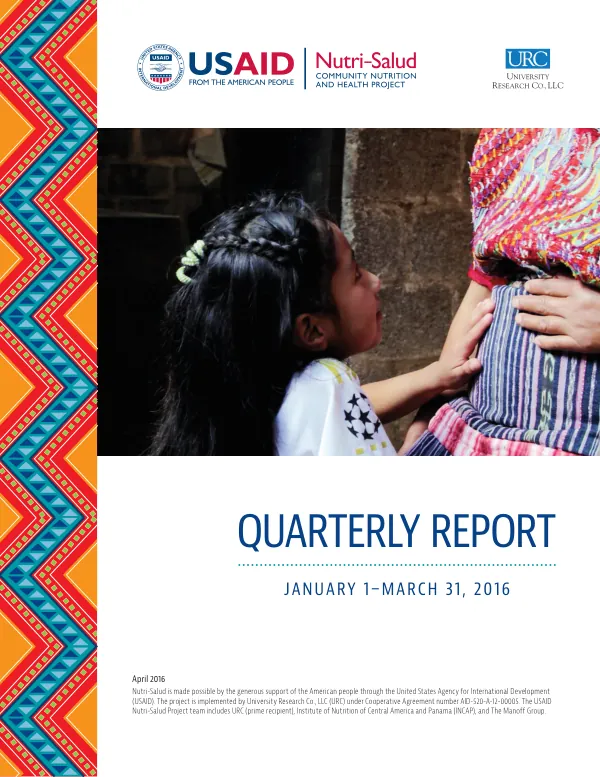
The Community Health and Nutrition Project—Nutri-Salud—emphasizes a capacity-building approach focused on strengthening basic health and nutrition services in rural areas of the western highlands of Guatemala.
2016 · 52 pages
Sign in to readA free account is required to download.
Abstract
The project is implemented by University Research Co., LLC (URC) under Cooperative Agreement number AID-520-A-12-00005, with funding from the United States Agency for International Development (USAID). The project team includes URC (prime recipient), Institute of Nutrition of Central America and Panama (INCAP), and The Manoff Group. During the reporting period, January 1 to March 31, 2016, the health sector crisis continued, but Nutri-Salud made steady progress, achieving most of its targets for the quarter. The seating of the new government in mid-January, 2016 brought both challenges and opportunities for Nutri-Salud. The project initiated coordination with the leaders of the incoming government before the official change of administration, in a successful effort to garner their support for reorganizing and strengthening primary health care (PHC). Nutri-Salud, together with the Inter-American Development Bank (IDB) and the Guatemalan Alliance for Nutrition (APN), shared a draft proposal for strengthening PHC in Guatemala and organized a process to finalize the proposal with inputs from the incoming representatives of the Ministry of Health (MOH) as well as the proposed Presidential Commission for the Reduction of Chronic Malnutrition. The project focuses on supporting the MOH at the central level as well as the Departmental Health Area (DAS) and Municipal Health District (DMS) levels to strengthen the management and delivery of PHC. With the new government's stronger focus on PHC, Nutri-Salud finds the most strategic opportunities to gradually build the local capacities and systematize processes in order to improve the quality and coverage of a basic package of services. Nutri-Salud coordinates very closely with other USAID health sector projects to ensure maximum impact of available USAID resources in a challenging and resource-poor environment. The project's goal is to improve the health and nutritional status of Guatemala's rural and indigenous populations in five departments in the western highlands who are served by the country's primary health care system. Target beneficiaries include children under five years of age, with emphasis on children under age two, and women of reproductive age, with emphasis on pregnant women. The project objectives are to improve the nutritional status of women of reproductive age and children under five by implementing seven Essential Nutrition Actions (ENA), focusing on the first 1,000 days (i.e., during pregnancy and the first two years of life); strengthen essential maternal, neonatal and child health care and family planning services at the community level with a constant health care presence in target communities; and engage communities in active solutions to their health care needs through community mobilization and linkages to local government structures. The project is implemented in the western highlands region, which is home to a largely indigenous and rural population that faces numerous social and economic disadvantages compared to urban and non-indigenous groups. The project maintains a field office in Quetzaltenango, which coordinates the implementation of all field-based activities. The Quetzaltenango office supports three field teams, who deliver Nutri-Salud's capacity-building approaches and direct technical assistance to the 6 DAS and 31 DMS covered by the project. Each field team consists of a manager, two technical advisors for service delivery, two health promotion specialists, and a field monitoring specialist. The teams coordinate closely with local counterparts, especially DAS and DMS Directors and technical staff as well as the USAID|WHIP Departmental Committees and individual projects/actors.