USAID DEC
Quarterly Report: Response to Emergency Food Security Needs in Northern Mali - January-March 2013
Sign inMERCY CORPS INTERNATIONAL
Quarterly Report: Response to Emergency Food Security Needs in Northern Mali - January-March 2013
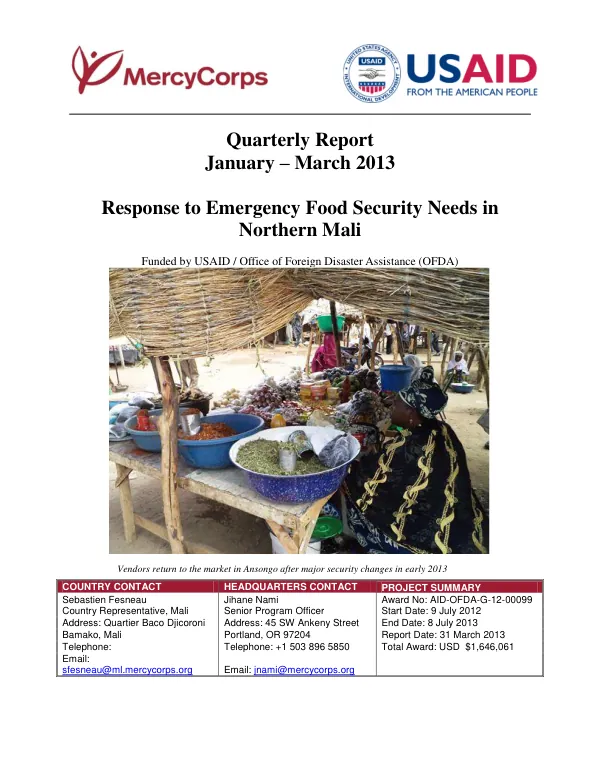
In Northern Mali, the residents of the Ansongo Commune in Gao experienced a dramatic change in security in January 2013.
2013 · 9 pages
Sign in to readA free account is required to download.
Abstract
The "Serval" joint military intervention rapidly altered the control of the region, and the Malian army reclaimed the area after several weeks of clashes. Mercy Corps offered its staff a voluntary evacuation to Niamey and temporarily suspended project activities. On February 6th, the entire team returned to Gao and re-assessed the needs of the population. Mercy Corps conducted a rapid needs assessment to identify gaps in services provided. The assessment revealed a need for deeper comprehension of the food security situation in Gao. In February, Mercy Corps carried out a mixed-methods food security assessment, analyzing food security needs through nutrition indicators, access to food, and a market analysis. The assessment showed that 94% of households in Gao experienced some level of food insecurity, and 62% of households were experiencing moderate to severe hunger. The mixed-methods approach to assessing the food security situation in the Ansongo commune provided an analysis of food security from a nutrition and markets viewpoint. The study consisted of three main components: 1) anthropometric nutrition assessment of children under five, 2) households food security survey, and 3) market vendor interviews. The main findings for the Gao region included a 70% reduction in sales reported by vendors in Gao. Results from the assessment led to altering the planned project activities to include two more months of value vouchers that allow beneficiaries to select the items they need most, including the option to purchase livestock feed. Mercy Corps implemented a program to provide immediate assistance to the most affected Malian households in the form of unconditional value vouchers for basic needs and commodity vouchers for fodder. The program aimed to meet the emergency food security needs and build the resilience of 12,000 individuals in the Ansongo district of the Gao region. The program also emphasized close monitoring of protection, gender, and accountability issues. Mercy Corps worked with local authorities, religious leaders, and the private sector (vendors) to explain the program's intentions for the targeted communities, gaining acceptance and trust within its zone of intervention. The program provided a total of 18,520 beneficiaries with access to basic needs and commodity vouchers, exceeding the target of 12,000 beneficiaries. The program also distributed a total of $513,634 worth of non-food items, exceeding the target of $423,913. The program's focus on providing unconditional value vouchers allowed beneficiaries to select the items they needed most, including the option to purchase livestock feed. The program also supported the coordinated cholera prevention plans developed by the WASH cluster in Bamako by enhancing community WASH outreach and dedicating 6,000 FCFA of each household's voucher amount to the purchase of soap, bleach, and aquatabs.
Related documents