USAID DEC
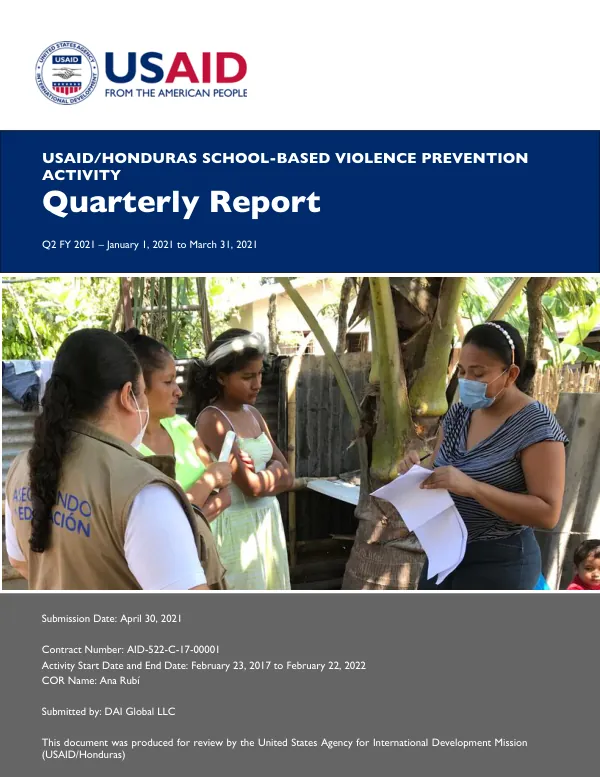
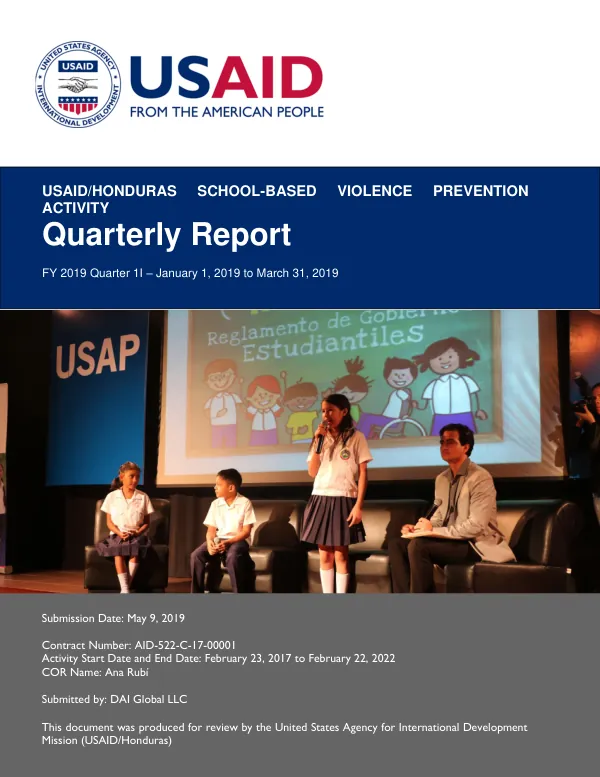
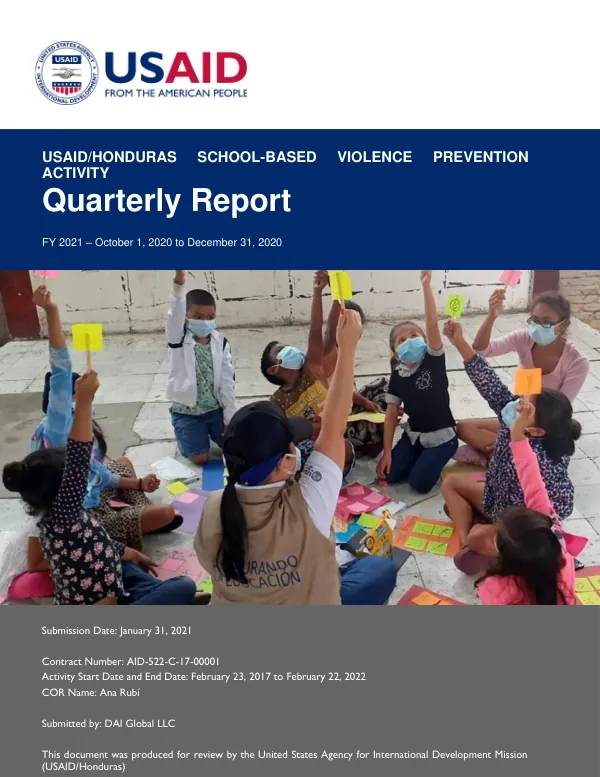
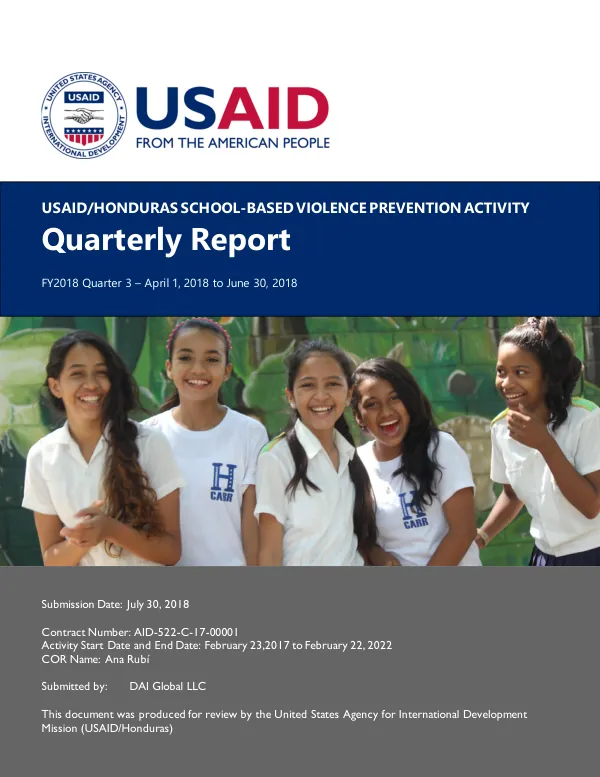
USAID/Honduras School-Based Violence Prevention Activity Quarterly Report – FY2018 Q3
Sign inDAI GLOBAL, LLC
USAID/Honduras School-Based Violence Prevention Activity Quarterly Report – FY2018 Q3
The School-Based Violence Prevention Activity, also known as Asegurando la Educación, is a five-year initiative launched in February 2017 by USAID/Honduras.
2018 · 63 pages
Sign in to readA free account is required to download.
Abstract
The activity aims to address school-based violence and contribute to violence prevention in target communities. Asegurando is implemented by DAI Global LLC, with support from subcontractor Partners of the Americas. The project has four objectives: to improve schools' ability to reduce school-based violence through the creation of safe learning environments, to strengthen local networks that increase school safety, to increase the capacity of the Secretariat of Education and social protection actors to prevent and respond to SBV, and to lower risk factors and enhance protective factors for students who qualify for secondary prevention services. During the third quarter of FY2018, Asegurando significantly increased the number of activities in all 66 schools. Community networks became increasingly functional, and the team completed the national "school safety" strategy. The work in schools took off with two flagship ALE initiatives: Educators for Peace and Community School Committees. The team trained three school teachers from each of the 66 schools to participate in the Educators for Peace training and become master trainers. These master trainers then transferred their knowledge to 231 educators and counselors in all target schools. The Community School Committees were strengthened or formed in all 66 schools, and they started undertaking important activities in schools. With technical assistance from ALE, the Committees are playing an increasingly important role in the promotion of safe learning environments in schools. Asegurando also started planning psycho-social interventions, such as A Ganar Escuela, or School to Win, which equips students with social-emotional learning skills. Other important activities in schools took place, including Crime Prevention Through Environmental Design (CPTED) and dialogue exchanges. The project aligns with the Government of Honduras' 2010 Country Vision on non-violence and security, and The Law of Fundamental Education, which highlights prevention and rehabilitation as a crosscutting issue in the national curriculum. The project also supports the US State Department's Central American Regional Security Initiative (CARSI) and the 2014 Alliance for Prosperity, a regional initiative aimed at reducing the incentives for migration. Asegurando has made significant progress in the plans to offer secondary prevention services in schools. The team trained 231 educators and counselors in all target schools, and the Community School Committees are playing an increasingly important role in promoting safe learning environments. The project's progress is a step towards achieving its four objectives and contributing to violence prevention in target communities. The project's implementation is supported by a central project office in Tegucigalpa and two field offices in San Pedro Sula and La Ceiba. The project works from a central project office in Tegucigalpa, and two field offices in San Pedro Sula (covering San Pedro and Choloma), and La Ceiba (covering La Ceiba and Tela). The project's geographic coverage includes Tegucigalpa, San Pedro Sula, La Ceiba, Choloma, and Tela. The project's progress is monitored and evaluated through the Monitoring, Evaluation, and Learning (MEL) plan. The MEL plan advances the project's monitoring and evaluation activities, and the project's implementation is guided by the Country Development Cooperation Strategy (CDCS) Development Objective 1 (DO1) to increase citizen security for vulnerable populations.