FAMILY HEALTH INTERNATIONAL
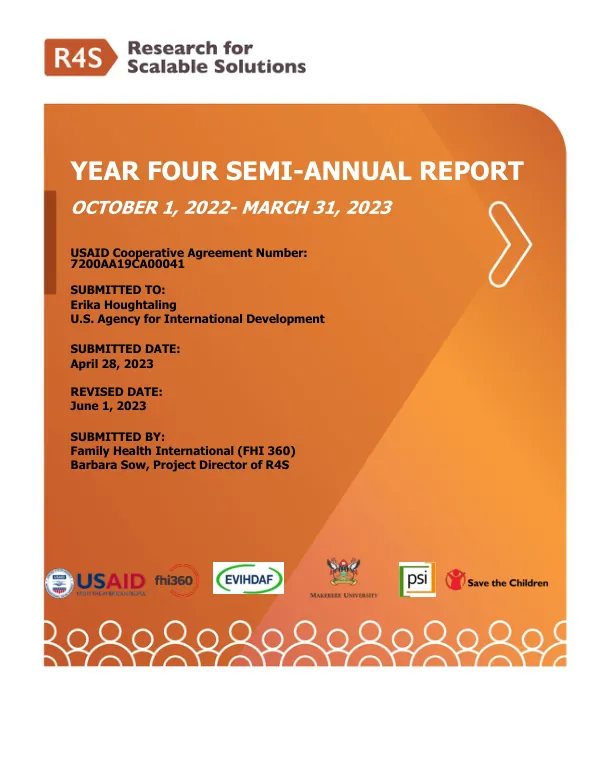
R4S Year 4 Semi-Annual Report (October 2022-March 2023)
The R4S Year 4 Semi-Annual Report covers the period from October 2022 to March 2023.
2023 · 82 pages
Sign in to readA free account is required to download.
Abstract
The report is submitted to Erika Houghtaling of the U.S. Agency for International Development (USAID) by Family Health International (FHI 360) under Cooperative Agreement Number 7200AA19CA00041. Country-level consultations were conducted in Côte d'Ivoire, Kenya, Malawi, Mozambique, Nepal, Niger, Uganda, and Kenya to develop Family Planning (FP) Research and Learning Agendas. These consultations aimed to identify research priorities and develop a framework for FP research and learning in the respective countries. Strategic FP/RH Leadership and Engagement was another cross-cutting activity that focused on strengthening leadership and engagement in FP/RH at the country level. This included supporting the development of FP/RH leadership and engagement strategies, as well as providing technical assistance to countries to strengthen their FP/RH leadership and engagement capacities. The report highlights the importance of gender integration in FP/RH programs. A literature review on the gender dimensions of self-care was conducted, and emergency contraception was provided to women in need. The report also highlights the need to ensure that women's FP needs are served in the context of PrEP roll-out. The report also discusses the Portfolio area of Digital Platforms, which focused on assessing the effectiveness of digital tools for FP, including the Counseling for Choice (C4C) tool in Côte d'Ivoire and the Game of Choice project in India. The report highlights the potential of digital platforms to improve access to FP information and services. The report also discusses the Result 2: Improved Understanding of the Cost-Effectiveness and Efficiency of Scaling Proven and Promising Service Delivery Practices. This included evaluating the cost, efficiency, and cost-effectiveness of approaches to reaching young people with modern contraceptives, as well as evaluating the scale, quality of implementation, cost, and cost-effectiveness of High Impact Practices in FP in Uganda, Mozambique, and Nepal. The report also highlights the Result 3: Increased Understanding of How Proven and Promising Practices Enhance Equitable Access to High-Quality, Voluntary FP. This included supporting country coordination to define, measure, and monitor equity, as well as establishing an Equity Taskforce. The report also discusses the Result 4: Voluntary FP use and method choice during COVID-19 pandemic. This included measuring the impact of COVID-19 on FP access and use, tracking the experiences of ECHO trial participants through COVID-19, and understanding the impact of COVID-19 on the ability of women to access FP care and products in Uganda. The report also highlights the importance of Monitoring, Evaluation, and Learning (MEL) in FP/RH programs. The report discusses the project's MEL framework, which includes indicators for measuring progress towards the project's objectives. The report also highlights the importance of Project Management and Operations in FP/RH programs. The report discusses the project's management structure, including the Leadership Team and the Project Management Unit. The report includes several appendices, including Indicator Reporting, Outcome Map, Map of Activities to Outcomes, Outcome Map Progress, Financial Reporting, and ICFP Presentations. These appendices provide additional information on the project's progress and achievements. Overall, the R4S Year 4 Semi-Annual Report highlights the project's progress and achievements in promoting FP/RH in the respective countries. The report highlights the importance of country-level consultations, strategic FP/RH leadership and engagement, gender integration, digital platforms, cost-effectiveness and efficiency, equity, and MEL in FP/RH programs.