USAID
Reclaiming Economic Analysis
Economic analysis is a crucial tool for development practitioners to make informed decisions about where to invest limited foreign assistance.
2012 · 5 pages
Sign in to readA free account is required to download.
Abstract
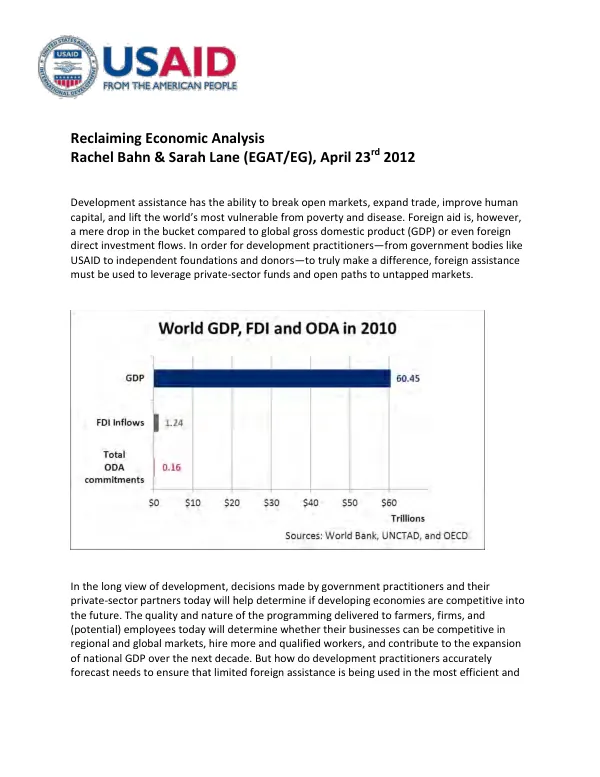
The tools in the economic analysis toolbox, such as cost-benefit analysis (CBA) and cost-effectiveness analysis (CEA), can direct practitioners to the most sustainable paths to development and ensure that scarce funds benefit the poorest by intervening where necessary and leveraging private funds and untapped sources of capital. CBA tallies the costs and benefits of a given investment to determine if the latter outweigh the former for relevant actors and for the economy as a whole. This tool requires meaningful collaboration between donor staff, government counterparts, implementing partners, and the individuals who eventually benefit from the project. CBA gives the ability to identify who benefits (or loses) from a project and by how much, and it is a powerful way to consider impacts disaggregated by gender, poverty status, ethnic group, or other characteristics of interest. The analysis rests on three key elements: time, technology, and leveraging the private sector. CBA structures costs and benefits as flows over time, considering how a project will change farm or firm incomes over the next 5, 10, or 20 years. It identifies gaps or mismatches between expenditures and revenues, predicts when farmers or firms will face a shortfall and need access to credit, and determines when a grant or loan is necessary to make a project viable. Higher-capacity computers, readily available software tools, and a universe of data sources on the Internet have made CBA a more powerful tool. Analysts can produce models much more easily and simply than was possible 30 years ago, and they can isolate the factors that will have the greatest impact on a project's success or failure. For example, by recognizing that seed prices are extremely volatile, analysts can calculate how that volatility might affect a farm-level intervention. The resurgence of CBA aligns with a shift in development—the recognition of the role and scale of the private sector. As private investment flows dwarf official development assistance, the case for targeted investments by donors such as USAID to leverage and catalyze private investment becomes stronger. USAID seeks to match funds, or bring business-minded actors into schemes to increase the sustainability of agricultural production. CBA can identify the role played by agribusiness firms or private donors and determine just how much a donor needs to invest to achieve the desired impact. It can even identify cases in which there is no need for donor funds at a project level, directing resources toward policy or investments in a different chain. USAID, like many donors, has re-established CBA in recent years, just as a renewed emphasis on evidence-based programming, structured project design, and rigorous evaluation has emerged. The Agency has trained more than 100 staff in CBA and recruited a leading expert in CBA to push forward these efforts. The Bureau for Food Security has seized on CBA to improve project design, identify critical variables for monitoring and evaluation, and communicate the impacts of Feed the Future investments. CBA is a powerful tool, but not always appropriate. Costs can almost always be monetized, but benefits cannot. For example, what is the value of one acre of rainforest protected, or the welfare impact of improving care for children and the elderly? The answers to these questions are not straightforward, particularly when markets cannot price the outcome we desire. However, by defining a goal such as preserving rainforests or reducing malaria prevalence, we can compare costs to determine which intervention is the most cost-effective. CEA can be used to identify the most sustainable interventions for a desired outcome, particularly when an intervention is simply too costly for a host country to maintain after donor support is withdrawn or where lower-cost, more appropriate technologies could be applied. With the insights provided by such analyses, we can help countries build their economies, make best use of natural resources, and increase workforce quality so that they may compete in global and regional markets. The next frontier in economic analysis will harness CBA and CEA to improve outcomes. Innovative thinking is needed to address interventions where the benefits cannot be counted or monetized. Development practitioners face challenges in quantifying civic engagement, security, or policy reform, and in defining a unit of democracy. However, rigor is required to ensure that we make sound investments, and the next frontier in economic analysis will harness CBA and CEA to improve outcomes. Emerging development research, such as the evidence that gender inequality impedes economic growth, can be incorporated into CBA models to more precisely estimate the value of investments targeting gender equality. This will help donors make more informed decisions about where to invest limited foreign assistance and ensure that scarce funds benefit the poorest by intervening where necessary and leveraging private funds and untapped sources of capital.