CHEMONICS
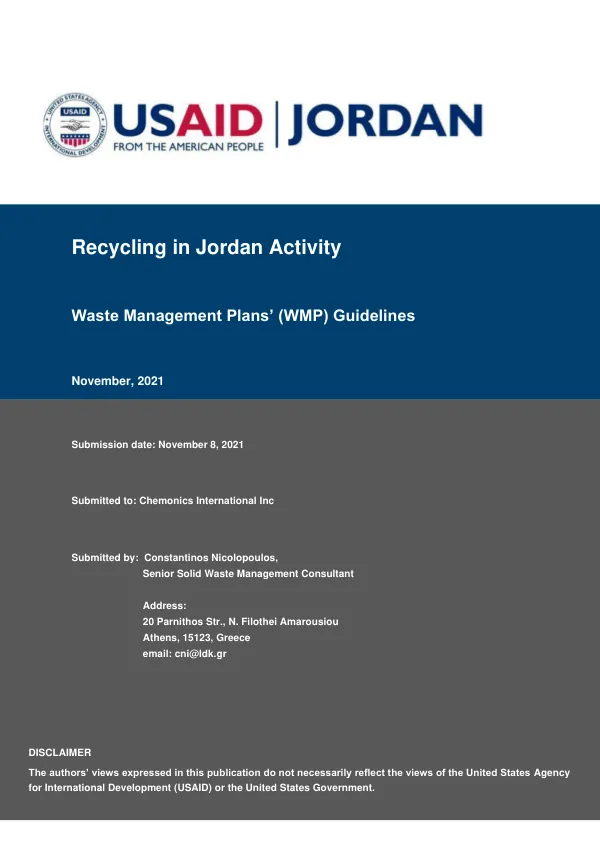
Recycling in Jordan Activity Waste Management Plans’ (WMP) Guidelines
The Recycling in Jordan Activity aims to increase the commercial sector's utilization of recycling services in Amman.
2021 · 37 pages
Sign in to readA free account is required to download.
Abstract
The project is implemented by Chemonics International Inc in partnership with the Ministry of Environment, the Greater Amman Municipality, and private sector companies. The project seeks to improve the business enabling environment for recycling services and materials, and to capitalize on opportunities to increase demand for recycling services. The project's objectives include drafting instructions for waste separation, sorting, and recycling best practices for all types of waste streams, preparing guidelines for obligatory waste management plans, and producing a qualification criterion for individuals eligible to compose waste management plans. The project's scope of work consists of five tasks: identifying and reviewing best available commercial waste separation, sorting, and recycling practices; contextualizing recycling best practices to the Jordanian commercial sector; presenting findings and recommendations to the Ministry of Environment and other stakeholders; drafting instructions for waste recycling; and producing a qualification criterion for individuals eligible to compose waste management plans. The project's implementation involves several key activities, including the identification and review of best available commercial waste separation, sorting, and recycling practices in the context of relevant legislative and regulatory frameworks. This task aims to provide an overview of the current state of commercial waste management in Jordan and to identify best practices in waste separation, sorting, and recycling. The findings of this task will be presented to the Ministry of Environment and other stakeholders, and recommendations will be made to improve the commercial sector's utilization of recycling services. The project also involves the contextualization of recycling best practices to the Jordanian commercial sector. This task aims to adapt international best practices in waste separation, sorting, and recycling to the Jordanian context, taking into account the country's legislative and regulatory frameworks, as well as the needs and challenges of the commercial sector. The findings of this task will be presented to the Ministry of Environment and other stakeholders, and recommendations will be made to improve the commercial sector's utilization of recycling services. The project's implementation plan includes several key deliverables, including the drafting of instructions for waste recycling, the preparation of guidelines for obligatory waste management plans, and the production of a qualification criterion for individuals eligible to compose waste management plans. These deliverables will be used to support the implementation of the project's objectives and to ensure that the commercial sector in Jordan is able to utilize recycling services effectively. The project's implementation timeline is not specified, but it is expected to be completed within a certain period of time. The project's budget is also not specified, but it is expected to be funded by the United States Agency for International Development (USAID). The project's success will be evaluated based on several key indicators, including the increase in the commercial sector's utilization of recycling services, the improvement in the business enabling environment for recycling services and materials, and the increase in demand for recycling services. The project's implementation involves several key stakeholders, including the Ministry of Environment, the Greater Amman Municipality, private sector companies, and the Consultant, Mr. Constantinos Nicolopoulos. The project's success will depend on the effective collaboration and coordination among these stakeholders, as well as the effective implementation of the project's activities and deliverables. The project's findings and recommendations will be presented to the Ministry of Environment and other stakeholders, and will be used to support the implementation of the project's objectives. The project's impact will be evaluated based on several key indicators, including the increase in the commercial sector's utilization of recycling services, the improvement in the business enabling environment for recycling services and materials, and the increase in demand for recycling services. The project's implementation will be monitored and evaluated regularly to ensure that the project is on track to meet its objectives. The project's success will depend on the effective implementation of the project's activities and deliverables, as well as the effective collaboration and coordination among the project's stakeholders.