URC
Reduction in Maternal and Child Mortality – Essential Medicines List
The USAID Primary Health Care Project in Iraq (PHCPI) is assisting the Iraqi Ministry of Health (MOH) to achieve its strategic goals of quality primary health care services.
2014 · 1 pages
Sign in to readA free account is required to download.
Abstract
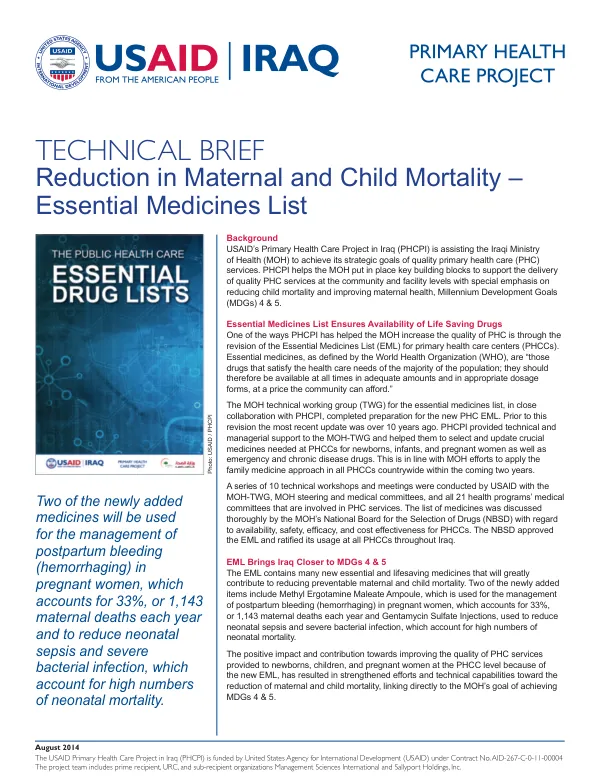
PHCPI helps the MOH put in place key building blocks to support the delivery of quality primary health care services at the community and facility levels with special emphasis on reducing child mortality and improving maternal health, Millennium Development Goals (MDGs) 4 & 5. One of the ways PHCPI has helped the MOH increase the quality of primary health care is through the revision of the Essential Medicines List (EML) for primary health care centers (PHCCs). Essential medicines, as defined by the World Health Organization (WHO), are those drugs that satisfy the health care needs of the majority of the population; they should therefore be available at all times in adequate amounts and in appropriate dosage forms, at a price the community can afford. The MOH technical working group (TWG) for the essential medicines list, in close collaboration with PHCPI, completed preparation for the new PHC EML. Prior to this revision, the most recent update was over 10 years ago. PHCPI provided technical and managerial support to the MOH-TWG and helped them to select and update crucial medicines needed at PHCCs for newborns, infants, and pregnant women as well as emergency and chronic disease drugs. This is in line with MOH efforts to apply the family medicine approach in all PHCCs countrywide within the coming two years. A series of 10 technical workshops and meetings were conducted by USAID with the MOH-TWG, MOH steering and medical committees, and all 21 health programs' medical committees that are involved in primary health care services. The list of medicines was discussed thoroughly by the MOH's National Board for the Selection of Drugs (NBSD) with regard to availability, safety, efficacy, and cost effectiveness for PHCCs. The NBSD approved the EML and ratified its usage at all PHCCs throughout Iraq. The EML contains many new essential and lifesaving medicines that will greatly contribute to reducing preventable maternal and child mortality. Two of the newly added items include Methyl Ergotamine Maleate Ampoule, which is used for the management of postpartum bleeding (hemorrhaging) in pregnant women, and Gentamycin Sulfate Injections, used to reduce neonatal sepsis and severe bacterial infection. The positive impact and contribution towards improving the quality of primary health care services provided to newborns, children, and pregnant women at the PHCC level because of the new EML has resulted in strengthened efforts and technical capabilities toward the reduction of maternal and child mortality, linking directly to the MOH's goal of achieving MDGs 4 & 5. The revised EML is expected to bring Iraq closer to achieving these goals, particularly in reducing preventable maternal and child mortality.