SAVE THE CHILDREN FEDERATION/US
Refine Year Workplan for Okhokelamo ni Solha Resilience Food Security Activity
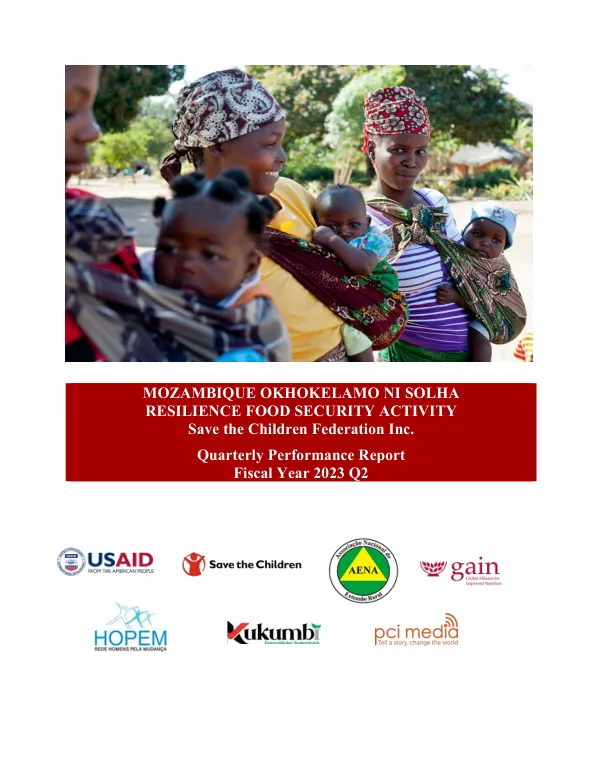
The Okhokelamo ni Solha Resilience Food Security Activity is a 5-year program launched by Save the Children and its partners in October 2022.
2023 · 19 pages
Sign in to readA free account is required to download.
Abstract
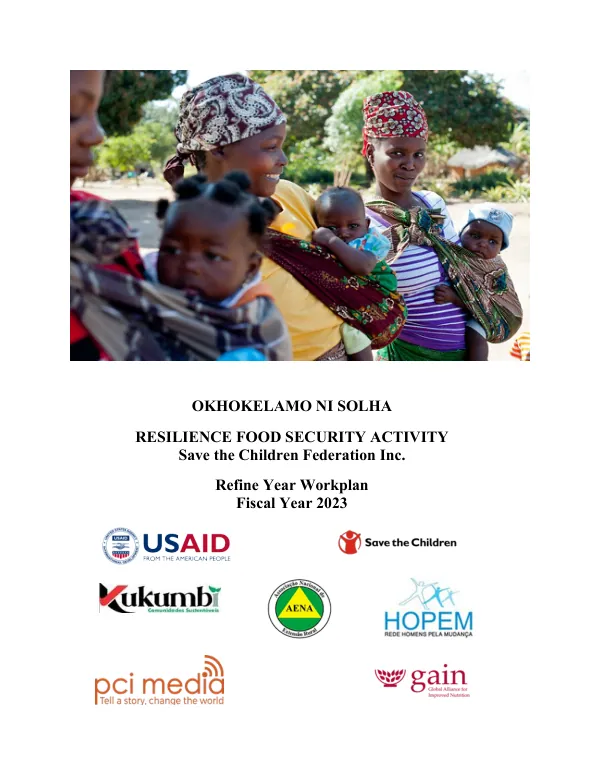
The program aims to sustainably improve nutrition outcomes for children under 2 years of age in Zambezia Province, Mozambique. The program will take a life-stages approach to strengthen the skills, capacity, agency, resilience, and confidence of women and adolescent girls, while also engaging adolescent boys, husbands, fathers, and the community at large for collective action to achieve this goal. The program will reach 1,157,575 participants in six districts of Zambezia Province and will be implemented through community-level platforms, including Community Health Committees, Caregiver Support Groups, Village Savings and Loan Associations, Positive Youth Development groups, First Time Parents groups, and Youth Advisory Councils. These platforms will support and reinforce one another, ensuring that plans addressing the social and behavior change determinants for health, nutrition, gender, and youth status are inclusive, centered in co-creation and empathy, and reflect the voice and priorities of women and girls. Okhokelamo ni Solha will further contribute to communities and improve nutrition through the distribution of specialized nutritious foods. During the lean season, the program will distribute Corn-Soy Blend Plus and fortified vegetable oil to vulnerable thousand-day families and adolescent girls aged 15 to 19, with additional Supercereal Plus targeted specifically for children aged 6-24 months. The program's overall goal will be achieved through three objectives: sustainably improving women's nutrition, improving infant and young child feeding, and reducing early pregnancy and improving nutrition among adolescent girls. The program will work through a Community Action Cycle process, which enables communities to identify core issues that contribute to poor health and nutrition outcomes and develop practical steps to reduce barriers and achieve progress. The program's Formative Research Plan includes four different formative studies: a youth needs assessment, a social and behavior change study, a gender study, and a Cost of the Diet study. These studies will address information gaps identified through the review of the Theory of Change and initial desk review and will inform the refinement of the Activity's Theory of Change, programmatic approaches, and activities. The program's stakeholder engagement and capacity development plan will involve engaging formal and informal community leaders in the Community Action Cycle process, an effective means of strengthening capacity and driving collective action to resolve some of the community's own health and development concerns. The program will also contribute to communities and improve nutrition through the distribution of specialized nutritious foods. The program's staff capacity building/development plan will focus on building the capacity of program staff to implement the program's activities and achieve its objectives. The program will also conduct a full list of activities through FY24 Q2, which are included in the Detailed Implementation Plan (DIP) (Annex 1).