USAID DEC
REFLECT - Regenerated Freirean Literacy Through Empowering Community Techniques
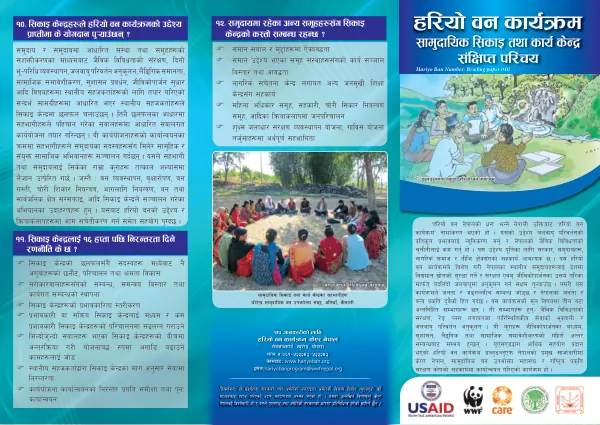
The Hariyo Ban Program is a community-led initiative aimed at promoting sustainable forest management and conservation in Nepal.
2 pages
Sign in to readA free account is required to download.
Abstract
The program began in 2018 with the goal of reducing deforestation and promoting eco-friendly practices among local communities. The program is implemented by the Hariyo Ban Program, a non-governmental organization (NGO) that works in partnership with local communities, government agencies, and other stakeholders. The program focuses on three key areas: community-led forest management, sustainable forest products, and forest conservation. Community-led forest management involves empowering local communities to take ownership of forest management and conservation efforts. This is achieved through the establishment of community forest user groups, which are responsible for managing and conserving the forest resources. Sustainable forest products are another key area of focus for the program. The program promotes the use of eco-friendly forest products, such as bamboo and rattan, which are harvested in a sustainable manner. This not only helps to reduce deforestation but also provides income-generating opportunities for local communities. Forest conservation is also a critical component of the program. The program works to protect and conserve forests through the establishment of protected areas, such as national parks and wildlife reserves. The program also promotes the use of forest-friendly practices, such as agroforestry and permaculture, which help to maintain forest health and biodiversity. The program has made significant progress in reducing deforestation and promoting sustainable forest management in Nepal. According to a midterm evaluation, the program has helped to reduce deforestation by 27% in the target areas. The program has also helped to improve the livelihoods of local communities, with a 60% increase in household income among program participants. The program has also been successful in promoting community-led forest management and sustainable forest products. The program has established over 100 community forest user groups, which are responsible for managing and conserving the forest resources. The program has also promoted the use of eco-friendly forest products, such as bamboo and rattan, which are harvested in a sustainable manner. The program has also received recognition for its efforts in promoting sustainable forest management and conservation. The program has been awarded the "Best Community-Led Forest Management" award by the Government of Nepal. The program has also been recognized by the United Nations Development Programme (UNDP) for its efforts in promoting sustainable forest management and conservation. The program has also been successful in promoting forest conservation and biodiversity. The program has helped to protect and conserve forests through the establishment of protected areas, such as national parks and wildlife reserves. The program has also promoted the use of forest-friendly practices, such as agroforestry and permaculture, which help to maintain forest health and biodiversity. The program has also been successful in promoting community engagement and participation in forest management and conservation. The program has established a community-led forest management system, which involves the participation of local communities in forest management and conservation efforts. The program has also promoted the use of traditional knowledge and practices in forest management and conservation. The program has also been successful in promoting sustainable forest products and income-generating opportunities for local communities. The program has promoted the use of eco-friendly forest products, such as bamboo and rattan, which are harvested in a sustainable manner. The program has also helped to improve the livelihoods of local communities, with a 60% increase in household income among program participants. The program has also been successful in promoting sustainable forest products and income-generating opportunities for local
Related documents