USAID DEC
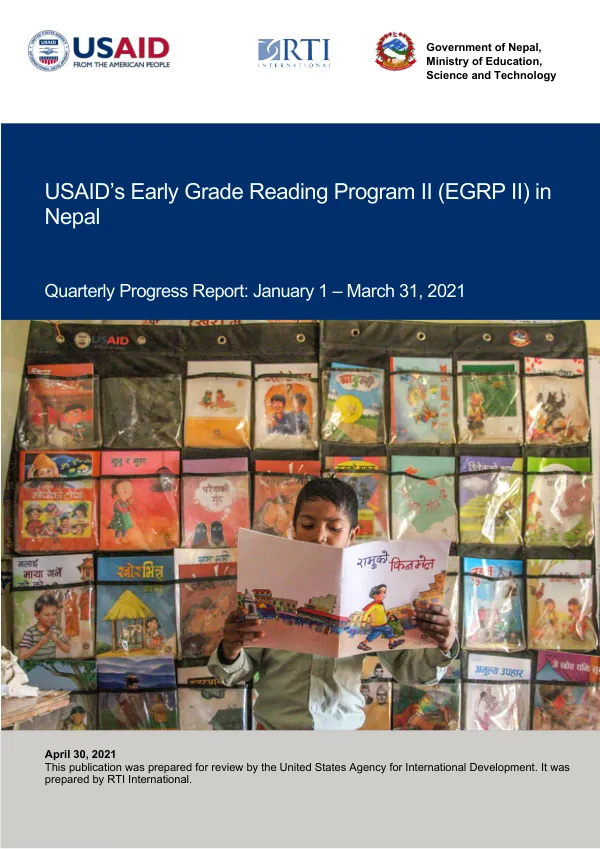
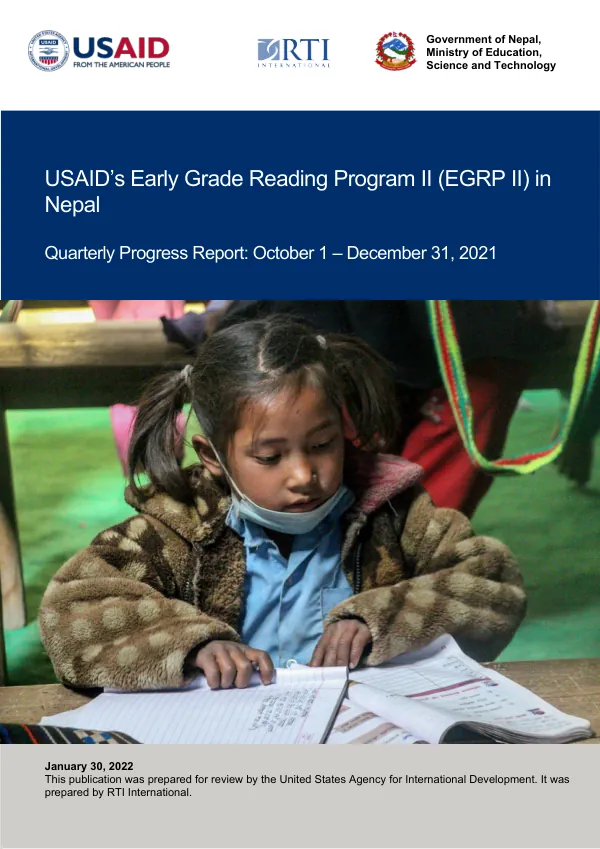
USAID’s Early Grade Reading Program II (EGRP II) in Nepal: Quarterly Progress Report, October 1 – December 31, 2021
Sign inRTI INTERNATIONAL
USAID’s Early Grade Reading Program II (EGRP II) in Nepal: Quarterly Progress Report, October 1 – December 31, 2021
The Early Grade Reading Program II (EGRP II) in Nepal aims to improve reading skills among early grade students.
2021 · 93 pages
Sign in to readA free account is required to download.
Abstract
The program is implemented in 20 districts, with a focus on increasing the number of students who can read at grade level by the end of grade 3. EGRP II is a collaborative effort between the Government of Nepal (GON), local governments, and USAID. The program is divided into four objectives: supporting the development and rollout of the Instructional Content (IC) and scaling up Early Grade Reading (EGR) services; building municipal- and provincial-level capacity for delivering EGR services; improving local governments' ability to provide Training and Professional Support (TPS), coaching, mentorship, and supervision; and supporting continuity of learning in response to the COVID-19 pandemic. During the quarter, significant progress was made in achieving these objectives. The IC rollout and implementation continued, with training provided to over 1,000 teachers and education officials. The Ministry of Education, Science and Technology (MOEST) policy and planning for the National Early Grade Reading Program (NEGRP) also progressed, with the development of a policy framework and costed plans for NEGRP implementation. Capacity building for municipal and provincial officials and Local Education Unit (LEU) staff was also a key focus area, with training provided on data-driven decision making and the use of data to inform program implementation. The program also supported the development of policies and costed plans for NEGRP under the IC, with 15 local governments participating in the process. In addition, the program made significant progress in improving local governments' ability to provide TPS, coaching, mentorship, and supervision. Training and support were provided to LEU staff on the use of the TPS Guideline and resource materials, and joint monitoring and coaching visits were conducted with local governments. The program also supported continuity of learning in response to the COVID-19 pandemic, with EGR learning engagement for students during extended school closures and preparation for EGR instruction upon schools' reopening. The program also conducted routine monitoring, reporting, and collaborative learning, and developed a MEL system and dashboards to track progress. The program's progress was also reflected in the achievements of its participants. Trainees in the provincial TOTs, by province, district, and gender, showed significant increases in training quality ratings, with 85% of participants rating the training as excellent or good. The proposed early grade reading benchmarks for grades 1-3 also showed significant progress, with 90% of participants achieving the benchmarks. Overall, the EGRP II program in Nepal made significant progress in achieving its objectives during the quarter, with a focus on improving reading skills among early grade students and supporting continuity of learning in response to the COVID-19 pandemic. The program's achievements were reflected in the progress of its participants, with significant increases in training quality ratings and achievement of early grade reading benchmarks. The program's success was also reflected in the local government in-kind contributions for the learning clusters, with 15 local governments contributing resources and support to the program. The program's communications, branding, and marking efforts also showed significant progress, with media coverage of EGRP II and suggested social media posts. The program's finance and expenditure status also showed significant progress, with estimated expenditures of $1.2 million for the quarter. The program's cumulative costs and projected expenses also showed significant progress, with a total of $5.6 million spent to date.
Related documents