AMHARA DEVELOPMENT ASSOCIATION
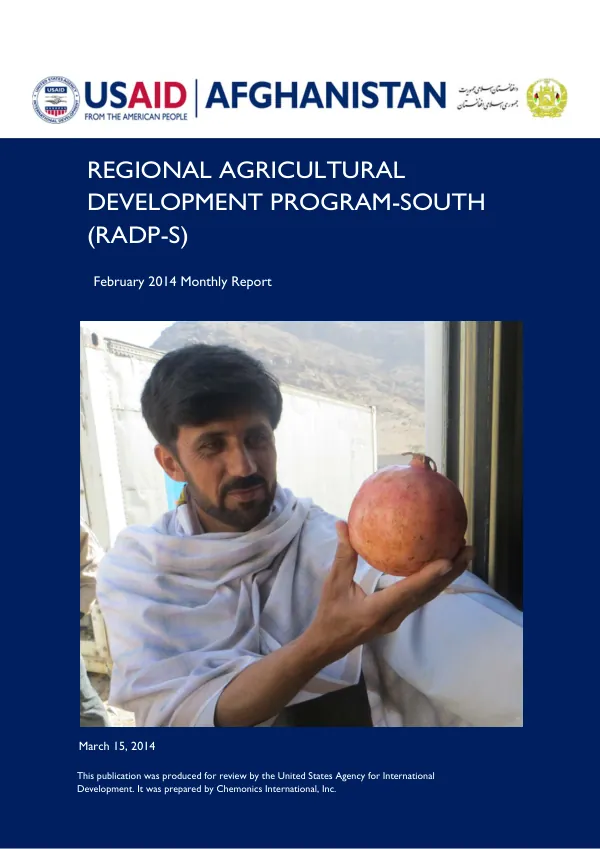
Regional Agricultural Development Program-South February 2014 Monthly Report
The Regional Agricultural Development Program-South (RADP-S) aims to improve food and economic security for rural Afghans in the provinces of Kandahar, Helmand, Zabul, and Uruzgan.
2014 · 18 pages
Sign in to readA free account is required to download.
Abstract
To achieve this goal, RADP-S focuses on improving the productivity and profitability of the wheat, high value crops, and livestock value chains, while addressing policy, legal, and regulatory constraints affecting value chain development. The program supports the consolidation of licit economies to fuel sustainable long-term economic growth, including providing alternatives to poppy cultivation. RADP-S implementation approach dovetails with Afghan and U.S. government strategies in its focus on advancing food security, regenerating agribusiness, and increasing agriculture sector jobs and incomes. The program aims to strengthen the capacity of producers, associations, traders, and agribusinesses to respond to market demands; facilitate lasting market linkages between value chain actors; and support an enabling environment that allows the private sector to thrive. Afghan organizations are at the forefront of implementation, and key cross-cutting issues of women's empowerment, agribusiness value chain facilitation, and alternative development are addressed in all facets of the program. In February 2014, RADP-S Key Implementing Partners (KIPs) made significant progress. Afghan Development Association (ADA), Coordination of Humanitarian Assistance (CHA), and the Dutch Committee for Afghanistan (DCA) received fully-executed subcontracts, established provincial offices, and hired key staff. They also participated in RADP-S-led orientations in administrative and technical program objectives and procedures. Communications and outreach KIP, Equal Access, hired two Communications Managers who are now embedded in RADP-S Kabul and Kandahar offices to lead the design of innovative outreach campaigns. RADP-S hosted administrative and technical orientation workshops to provide KIPs with crucial support as they mobilize key staff and draft their first-year work plans. The administrative workshop took place in Kabul on February 25 and built KIP capacity in recruitment and hiring policies, procedures, and best practices. The technical orientation took place on February 27 in the classroom of the AMTEX Village Technical Training Facility in Kandahar and was attended by 73 program staff from ADA, CHA, DCA, Equal Access, and RADP-S. The all-day event provided KIP provincial leadership with initial direction for contributing to program deliverables as well as an overview of the project's technical vision. RADP-S engaged frequently with USAID counterparts during the reporting period, including hosting the Ag Implementing Partner Coordination Meeting on February 13. This meeting provided a rare and crucial forum for seven technically related implementers to form a joint enterprise in the spirit of common cause and to identify points of synergy across and between each other, with emphasis on collaboration with RADP-S. It also served as a valuable occasion for the IPs to introduce themselves and present their scopes of work to the new USAID Office of Agriculture Director, Wayne Nilsestuen, and to hear his vision for agriculture programs in Afghanistan. The program places a strong emphasis on collaboration and coordination with other stakeholders, including the Government of the Islamic Republic of Afghanistan, the Ministry of Agriculture, Irrigation, and Livestock, and other implementing partners. RADP-S aims to leverage the expertise and resources of these stakeholders to achieve its goals and create a more sustainable and inclusive agricultural economy in the region.