AMHARA DEVELOPMENT ASSOCIATION
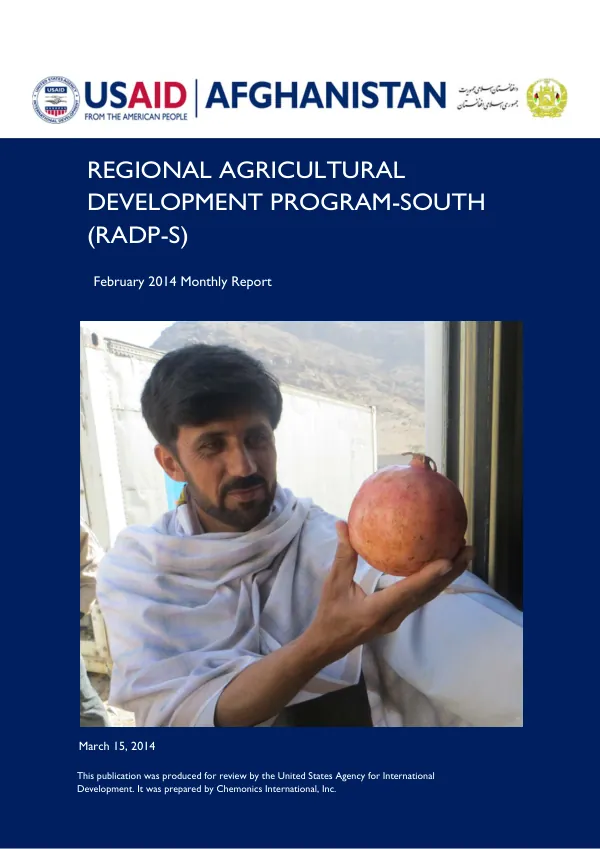
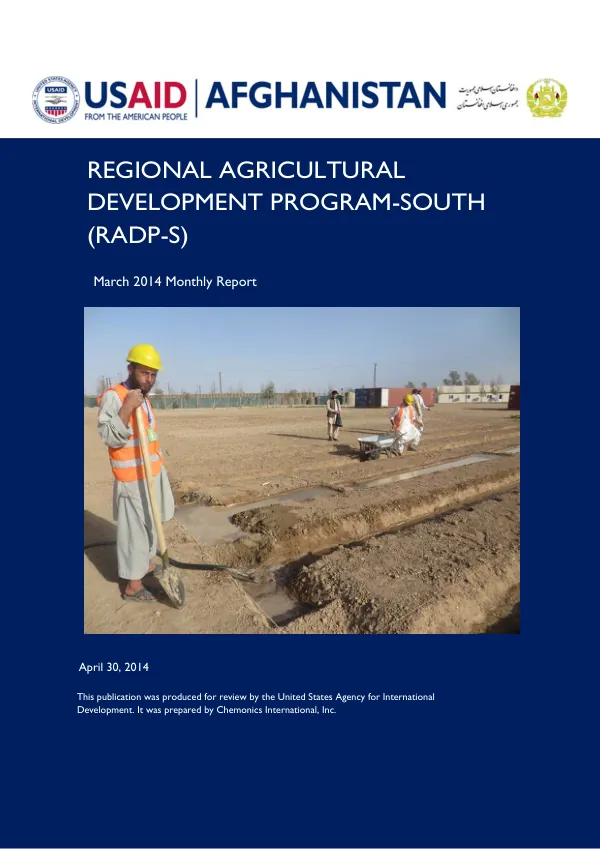
Regional Agricultural Development Program-South March 2014 Monthly Report
The Regional Agricultural Development Program-South (RADP-S) aims to improve food and economic security for rural Afghans in the provinces of Kandahar, Helmand, Zabul, and Uruzgan.
2014 · 15 pages
Sign in to readA free account is required to download.
Abstract
The program focuses on improving the productivity and profitability of the wheat, high value crops, and livestock value chains, while addressing policy, legal, and regulatory constraints affecting value chain development. RADP-S supports the consolidation of licit economies to fuel sustainable long-term economic growth, including providing alternatives to poppy cultivation. The implementation approach of RADP-S dovetails with Afghan and U.S. government strategies in its focus on advancing food security, regenerating agribusiness, and increasing agriculture sector jobs and incomes. RADP-S aims to strengthen the capacity of producers, associations, traders, and agribusinesses to respond to market demands; facilitate lasting market linkages between value chain actors; and support an enabling environment that allows the private sector to thrive. The program places the Afghan private sector at the forefront of implementation and addresses key crosscutting issues of women's empowerment, agribusiness value chain facilitation, and alternative development in all facets of the program. During the month of March, RADP-S aggressively positioned itself to roll out implementation of capacity-building activities immediately upon execution of the Memorandum of Understanding between the Ministry of Agriculture, Irrigation, and Livestock and USAID. Employing the expertise of RADP-S' Productivity and Production Unit and the technical specialists of RADP-S' key implementing partners (KIPs), the project drafted a total of 28 capacity-building interventions for the wheat and high value crop value chains. The livestock technical working group additionally developed nine distinct capacity-building interventions in support of RADP-S commercial poultry production activities and strategized rollout of the livestock nutrition and basic veterinary worker (BVW) strengthening programs. The value chain facilitation (VCF) component strengthened and distinguished itself as a distinct and expanding project unit. During the reporting period, RADP-S initiated implementation of Action for Enterprise's recommendations for integrating VCF into the project work plan. For example, RADP-S reconfigured its project staffing to include one expat VCF Unit Advisor, one VCF Manager, and nine VCF Specialists. This new VCF Unit will support the initiatives of market actors from each RADP-S value chain to expand their markets, promote their competitiveness, and develop the products and services they provide to Afghan farmers. RADP-S' key implementing partners, the Afghan Development Association and Coordination of Humanitarian Assistance, played a crucial role in the development of capacity-building interventions for the wheat and high value crop value chains. The project also engaged in critical discussions regarding the selection criteria of lead farmers who will host demonstration activities for the projects in the districts. The RADP-S team worked closely with the Productivity and Production Unit to ensure that the capacity-building interventions align with the project's overall objectives and strategies. The RADP-S program places a strong emphasis on women's empowerment and agribusiness value chain facilitation. The program aims to strengthen the capacity of women-headed households to participate in the agricultural economy and to promote their access to markets and resources. The RADP-S team also worked closely with the Ministry of Agriculture, Irrigation, and Livestock to ensure that the program's activities align with the government's agricultural development strategies and priorities. Overall, the RADP-S program is making significant progress in its efforts to improve food and economic security for rural Afghans. The program's focus on capacity-building, value chain facilitation, and women's empowerment is critical to achieving its overall objectives and strategies. The RADP-S team will continue to work closely with its implementing partners and stakeholders to ensure that the program's activities are aligned with the project's overall objectives and strategies.