CHEMONICS
Regional Agricultural Development Program-South November 2014 Monthly Report
The Regional Agricultural Development Program-South (RADP-S) aims to improve food and economic security for rural Afghans in the provinces of Kandahar, Helmand, Zabul, and Uruzgan.
2014 · 12 pages
Sign in to readA free account is required to download.
Abstract
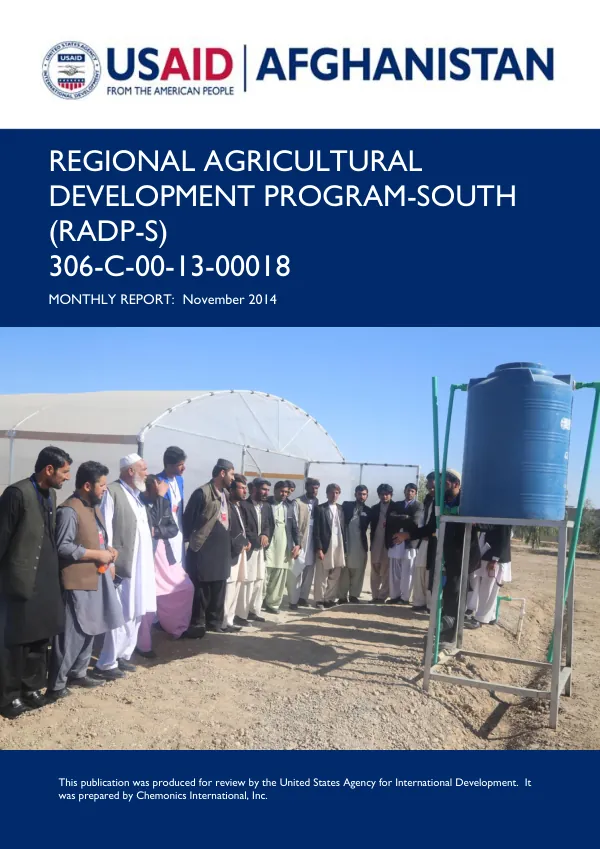
The program focuses on improving the productivity and profitability of the wheat, high value crops (HVC), and livestock value chains, while addressing policy, legal, and regulatory constraints affecting value chain development. RADP-S supports the consolidation of licit economies to fuel sustainable long-term economic growth, including providing alternatives to poppy cultivation. Implementation of RADP-S is aligned with Afghan and U.S. government strategies in advancing food security, regenerating agribusiness, and increasing agriculture sector jobs and incomes. The program strengthens the capacity of producers, associations, traders, and agribusinesses to respond to market demands, facilitates lasting market linkages between value chain actors, and supports an enabling environment that allows the private sector to thrive. RADP-S places the Afghan private sector at the forefront of implementation and addresses key cross-cutting issues of women's empowerment, agribusiness value chain facilitation, and alternative development in all facets of the program. During the month of November, RADP-S conducted training sessions throughout the 15 districts in the four targeted provinces. The trainings focused on wheat and HVC topics, including wheat sowing time, crop rotation, seed rate, orchard management, and greenhouse establishment. By the end of November, 4,971 farmers had attended a training in wheat or HVC conducted by RADP-S. The program's gender integration team conducted basic nutrition trainings in Helmand, Uruzgan, and Kandahar provinces, with 107 female trainees in attendance. RADP-S value chain facilitation team held four pre-application workshops for the Annual Program Statement (APS), providing assistance to 58 local businesses interested in applying to the APS program. The Kandahar Fresh Fruit Association (KFFA), with technical assistance from RADP-S, packed and shipped a trial shipment of Kandahari pomegranates to London, UK, marking the first unsubsidized international shipment of Kandahari pomegranates to a Western European market. RADP-S hosted master trainers from all four provinces at the AMTEX Technical Training Facility and Demonstration Farm from November 16 through November 29. These two weeks of intensive training provided the master trainers with the necessary classroom and field-based instruction to continue delivering quality instruction to beneficiaries throughout RADP-S' 15 target districts. Province-wide training on wheat and HVC was conducted in November, focusing on topics such as orchard establishment, orchard maintenance, wheat sowing time, crop rotation, seed rate, and land preparation for the planting of wheat. Trainings were conducted on demonstration farms to provide farmers with hands-on experience and facilitate a more participatory discussion between trainers and farmers. Many farmers still used old or "traditional" systems of growing, and the techniques being taught were new to them. Training topics for HVC focused on orchard plant nutrition, vineyard nutrition, vineyard establishment, and establishing greenhouses, specifically their structural design and benefits. Master trainers provided similar trainings at district-based demonstration farms on the topics of wheat and HVC in Helmand province's Lashkar Gah, Nad Ali, Nawa, and in Uruzgan province in the districts of Tirin Kot, Chora, and Dehrawod. Using plans developed by RADP-S program staff, each demonstration farm was leveled with the demarcation of farm boundaries determined for wheat, orchard, and other HVC planting.