CATHOLIC RELIEF SERVICES ORGANIZATION
Research for Development Conference Report: Uganda 2019
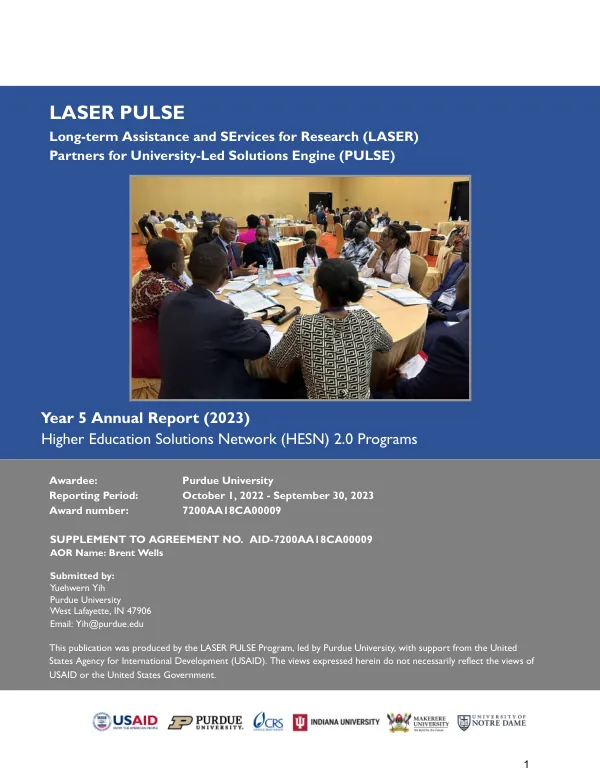
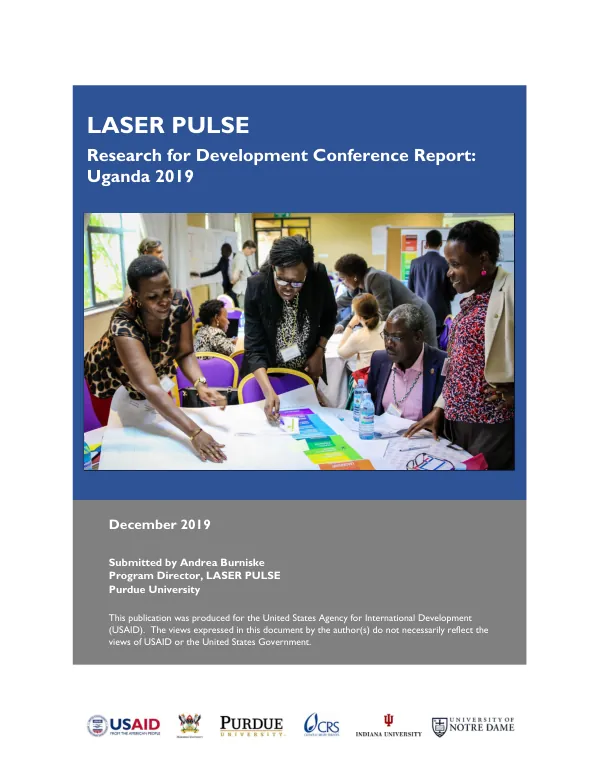
The LASER PULSE Research for Development Conference Report: Uganda 2019, submitted by Andrea Burniske, Program Director, LASER PULSE, Purdue University, in December 2019, outlines the objectives and outcomes of the conference held in Kampala, Uganda, from May 6-8, 2019.
2019 · 16 pages
Sign in to readA free account is required to download.
Abstract
The conference aimed to connect researchers with implementers as partners in development, addressing challenges in translating research into practical solutions. The LASER PULSE initiative, a five-year USAID-funded program led by Purdue University, focuses on three pillars: Research Capacity Building, Research Translation, and Sustainable Networks. The program seeks to enhance discovery and application in policy and practice of university-sourced, evidence-based solutions to development challenges. The R4D conferences, held in rotating regions in countries where USAID has a presence, bring together researchers, implementers, and practitioners to co-design solutions to development challenges. The conference in Uganda focused on the sectors of water security, food security, and early grade basic education, with a priority on Uganda, Kenya, and Tanzania. The conference activities included research networking sessions, presentations on effective practices for supporting the translation of research, and focused discussions around opportunities to enhance research opportunities for women and for junior faculty. The Comprehensive Issue Analysis (CSF) process identified key capacity gaps that need to be addressed in order to increase institutional support for, and researcher practice with respect to, embedded research in academic institutions of USAID interest countries (UICs). The findings from the Research Capacity Assessment, conducted by Makerere University, highlighted a general lack of university leadership in support of development research and a need to ignite untapped potential from women and junior faculty. The conference outcomes included the identification of key capacity gaps and the need to address them to increase development research outputs and impacts from low-income country universities. The conference also highlighted the importance of co-designing solutions to development challenges, showcasing examples of research that was translated into products, practices, or policies as solutions to development challenges. The LASER PULSE initiative has the capacity to embed translation of research as one of its core activities, and the conference outcomes will inform the development of a call for proposal reflecting regional development challenges with the potential for research-based solutions. The conference also provided a platform for knowledge creation, skill building, and networking among researchers, implementers, and practitioners. The conference demonstrated the potential of the R4D conferences to bring together diverse stakeholders and facilitate the co-design of solutions to development challenges. The outcomes of the conference will inform the development of future conferences and sectoral focus development for grant proposals that follow. The LASER PULSE initiative continues to support embedded research translation through a global network of universities, government agencies, non-governmental organizations, and the private sector. The conference also highlighted the importance of addressing the capacity gaps identified in the Research Capacity Assessment, including the need for university leadership in support of development research and the need to ignite untapped potential from women and junior faculty. The LASER PULSE initiative will continue to work towards addressing these capacity gaps and increasing development research outputs and impacts from low-income country universities. The conference outcomes will also inform the development of future conferences and sectoral focus development for grant proposals that follow. The LASER PULSE initiative continues to support embedded research translation through a global network of universities, government agencies, non-governmental organizations, and the private sector.
Related documents