USAID DEC
Research on Surface Disinfection of Four Chlorine Types Using Escherichia coli and the Ebola Surrogate Phi6
Sign inUNIVERSITÉ DE TUFTS
Research on Surface Disinfection of Four Chlorine Types Using Escherichia coli and the Ebola Surrogate Phi6
The Ebola virus is a filovirus that belongs to the Filoviridae family.
2017 · 8 pages
Sign in to readA free account is required to download.
Abstract
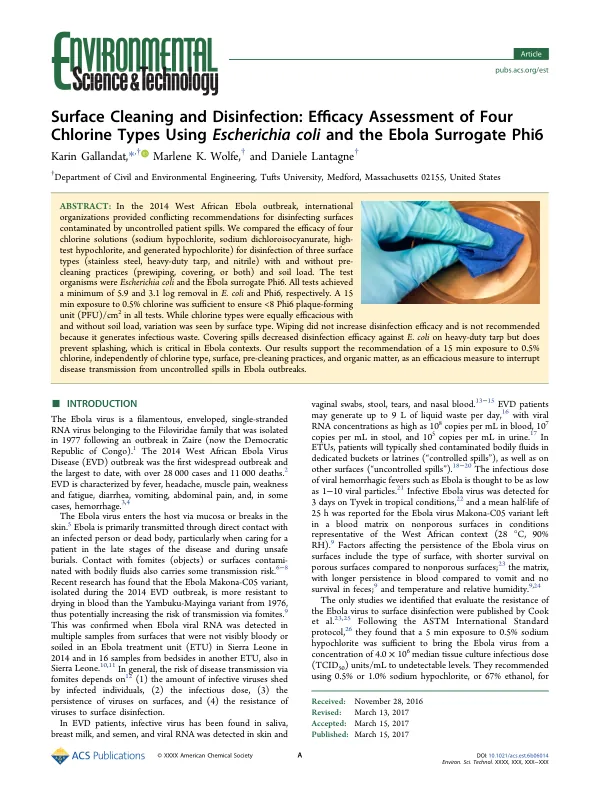
It was first isolated in 1977 following an outbreak in Zaire, now the Democratic Republic of Congo. The 2014 West African Ebola virus disease (EVD) outbreak was the first widespread outbreak and the largest to date, with over 28,000 cases and 11,000 deaths. EVD is characterized by fever, headache, muscle pain, weakness, fatigue, diarrhea, vomiting, abdominal pain, and, in some cases, hemorrhage. The Ebola virus enters the host through mucosa or breaks in the skin. It is primarily transmitted through direct contact with an infected person or deceased body, particularly when caring for a patient in the late stages of the disease and during unsafe burials. Contact with fomites or surfaces contaminated with bodily fluids also carries some transmission risk. Research has found that the Ebola Makona-C05 variant, isolated during the 2014 EVD outbreak, is more resistant to drying in blood than the Yambuku-Mayinga variant from 1976, thus increasing the risk of transmission via fomites. Studies have shown that the Ebola virus can persist on surfaces for extended periods, with viral RNA detected in multiple samples from surfaces that were not visibly soiled or contaminated in Ebola treatment units (ETUs) in Sierra Leone in 2014 and in 2015. The persistence of the Ebola virus on surfaces depends on several factors, including the type of surface, the presence of organic matter, and environmental conditions such as temperature and relative humidity. The World Health Organization (WHO), the Centers for Disease Control and Prevention (CDC), and Doctors Without Borders (MSF) have provided guidelines for disinfecting surfaces contaminated with the Ebola virus. These guidelines recommend the use of 0.5% chlorine solutions for surface disinfection in ETUs, but they differ in terms of exposure time and recommended practices, such as pre-cleaning and covering spills to prevent splashing. Four types of chlorine were available during the 2014 Ebola outbreak: high-test hypochlorite (HTH), sodium dichloroisocyanurate (NaDCC), and sodium hypochlorite (NaOCl), which can be produced industrially and stabilized or on-site using an electrolytic generator. These chlorine sources have different chemical properties and advantages and drawbacks. For example, low-pH chlorine solutions are expected to be more effective for disinfection than high-pH solutions, and NaDCC is expected to be more effective than other chlorine types in the presence of organic matter. The goal of this research was to provide data for the development of evidence-based recommendations for surface disinfection in Ebola outbreaks and other emergency situations. The study aimed to evaluate the efficacy of HTH, NaDCC, and stabilized and non-stabilized NaOCl solutions for the disinfection of three Ebola-relevant surface types, including stainless steel, nitrile, and heavy-duty tarp. The study also aimed to evaluate how recommended practices, such as pre-cleaning and covering spills, affect surface disinfection efficacy, and to determine how the presence of a soil load affects surface disinfection efficacy. The study selected three surfaces that were relevant for Ebola contexts: stainless steel, nitrile, and heavy-duty tarp. The study also selected four chlorine types: HTH, NaDCC, and stabilized and non-stabilized NaOCl. The study tested 0.5% chlorine at the shortest exposure time (10 minutes) with four different practices: (a) doing nothing before applying the chlorine, (b) wiping the surface with a surgical towel, (c) covering the spill with a surgical towel, and (d) wiping the surface and then covering the spill. The study found that all four chlorine types were equally effective for surface disinfection, with a minimum of 5.9 and 3.1 log removal in E. coli and Phi6, respectively. The study also found that a 15-minute exposure to 0.5% chlorine was sufficient to ensure <8 Phi6 plaque-forming units (PFU)/cm2 in all tests. The study concluded that the presence of a soil load did not affect the efficacy of surface disinfection, and that wiping did not increase disinfection efficacy and is not recommended because it generates infectious waste.
Related documents
Documents in this collection
 2017
2017USAID DEC
Handwashing and Ebola virus disease outbreaks: A randomized comparison of soap, hand sanitizer, and 0.05% chlorine solutions on the inactivation and removal of model organisms Phi6 and E. coli from hands and persistence in rinse water
Open record 2017
2017USAID DEC