USAID DEC
Resilience in the Wake of Disaster: Studying the Impact of Post-Earthquake Interest-Free Loans on Resilience in Nepal
Sign inFEED THE FUTURE
Resilience in the Wake of Disaster: Studying the Impact of Post-Earthquake Interest-Free Loans on Resilience in Nepal
The agricultural development initiative in Nepal, launched in response to the 2015 earthquake, focused on providing interest-free loans to affected communities through a revolving fund.
2016 · 2 pages
Sign in to readA free account is required to download.
Abstract
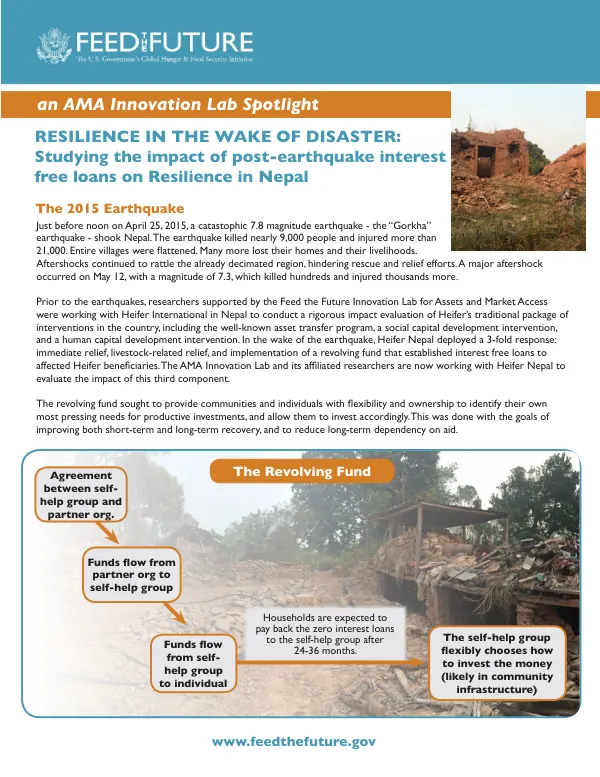
The fund was established by Heifer International in collaboration with the Feed the Future Innovation Lab for Assets and Market Access. The primary objective of the revolving fund was to empower communities to identify and address their most pressing needs for productive investments, thereby improving both short-term and long-term recovery. The revolving fund operated through a self-help group model, where funds flowed from a partner organization to a self-help group, and then to individual households. Households were expected to repay the zero-interest loans to the self-help group after 24-36 months. The self-help group had the flexibility to invest the money in community infrastructure, allowing for community-led decision-making and ownership. The evaluation of the revolving fund aimed to assess its impact on resilience in the wake of the earthquake. Researchers sought to answer several key questions, including whether the transfer made Heifer beneficiaries more resilient, how households spent the money, and whether the revolving fund "revolved" as intended. The evaluation also aimed to identify the repayment rates, who repaid and who defaulted, and how the revolving fund was being reinvested. The study employed a comparative approach, comparing outcomes among three groups: beneficiaries of traditional Heifer interventions, beneficiaries of traditional Heifer interventions and the revolving fund, and a control group that received neither benefits. Researchers sought to evaluate the impact of the revolving fund on various outcomes, including investment-related activities, resilience and coping strategies, income, productive assets, consumption, nutrition, food security, women's empowerment, and aspiration. The evaluation involved two surveys: one in 2016 to assess the one-year post-earthquake impacts of the fund, and a second follow-up survey in 2018 to assess the "revolving" nature of the fund, including repayment rates and community-level investments. The study aimed to provide insights into risk coping and resilience in the wake of a devastating natural disaster, particularly whether timely access to small loans improves resilience in these situations, and whether such loans can be used to rebuild sustainable livelihoods. The research team, led by Nicholas Magnan from the University of Georgia, collaborated with Montana State University, IFPRI, the Nepal School of Social Sciences and Humanities, and Heifer International. The project received funding of $923,878 from 2014 to 2017, with a focus on asset, social capital, and human capital transfers, and commodity livestock.
Related documents