USAID DEC
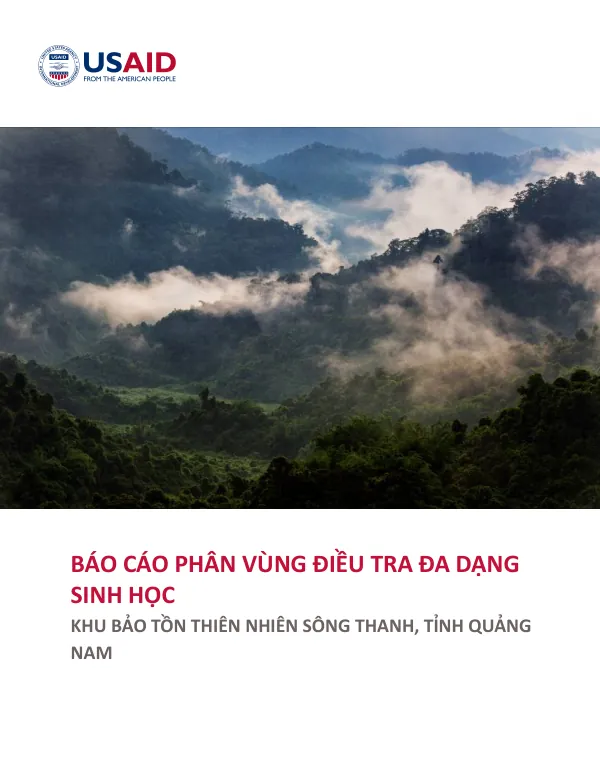
Zonation for Biodiversity Inventories in Song Thanh Nature Reserve in Quang Nam Province
Sign inECODIT, INC.
Zonation for Biodiversity Inventories in Song Thanh Nature Reserve in Quang Nam Province
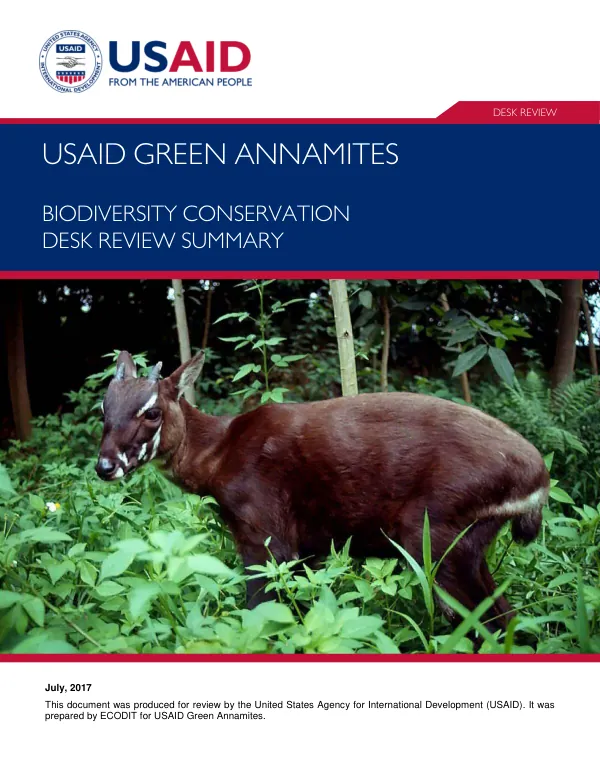
The Central Annamites region in Vietnam is home to a diverse array of flora and fauna, including several species of high conservation value.
2018 · 25 pages
Sign in to readA free account is required to download.
Abstract
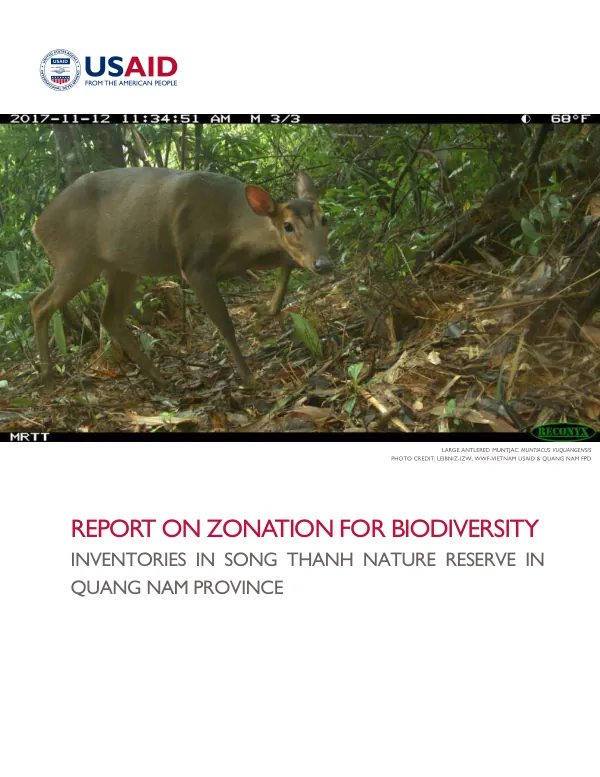
The region is characterized by a large continuous natural forest area, which houses important protected areas (PAs) in Quang Nam and Thua Thien Hue provinces. The PAs in this region are home to several endemic species, including the Saola, large antlered muntjac, Truong Son muntjac, Owston's civet, crested argus, and Annamite striped rabbit. The Green Annamites project, funded by USAID and implemented through ECODIT, aims to protect and restore these species and their habitats. The project supports Vietnam's transition to climate-smart, low emissions, and resilient development that protects people, landscapes, and biodiversity in the Central Annamites. The project focuses on Quang Nam and Thua Thien Hue provinces, where several PAs are located. The Song Thanh Nature Reserve (STNR) in Quang Nam province is one of the PAs targeted by the Green Annamites project. The STNR has an area of 76,964.4 ha and meets the eligibility criteria for establishing a National Park (NP) in Quang Nam province. The core zone of the STNR is divided into two functional sub-zones: strictly-protected sub-zones (54,896.97 ha) and ecological restoration sub-zones (22,067.43 ha). The buffer zone intersects Nam Giang and Phuoc Son districts and covers 12 communes. A zonation report for the STNR has been prepared, which includes thematic maps of species, occupancy/wildlife habitat, threats, and forest cover. The maps were created in Shapefile format using the VN2000 coordinate system. GIS and remote sensing techniques were used to identify the location of management zones for the STNR. The report found that 90.86% of the total natural area is under forest cover types, while 9.14% is under non-forest types. Seven forest categories were identified and classified, including evergreen broadleaf - rich forest, evergreen broadleaf - medium forest, and forest plantation. Twelve high conservation value species of animal and bird were selected as representatives to develop a key and important species layer map. These species include the Annam partridge, Annamite striped rabbit, crested argus, large antlered muntjac, and several others. The distribution, presence, and habitats of these species are associated with forest cover types. The high conservation value species are located in the rich and medium forests belonging to both strictly protected sub-zone (SPZ) and ecological restoration sub-zone (ERZ). Six threats were identified to develop a threat layer map, including illegal logging, wildlife hunting and trapping, exploitation of non-timber forest products (NTFPs), gold mining, forest encroachment, and livestock grazing. The report found that illegal logging and wildlife hunting had impacted a large area, even entire areas of the STNR. However, the number of threats and scope of their impacts are associated with the distribution and occupancy of animal species and forest cover types. The zonation report provides recommendations for the establishment of the STNR as a National Park. The report suggests that the core zone should be divided into strictly-protected sub-zones and ecological restoration sub-zones, while the buffer zone should be managed to prevent encroachment and protect the integrity of the forest. The report also recommends that the STNR should be managed to protect the high conservation value species and their habitats, and to prevent the impacts of threats such as illegal logging and wildlife hunting.