CHEMONICS
RIVER HEALTH REPORT FOR DELIVERABLE NO. 6
The Marico River Conservation Association (MRCA) is a registered Not for Profit Company (NPC) that operates along the Marico and Koster Rivers.
2016 · 14 pages
Sign in to readA free account is required to download.
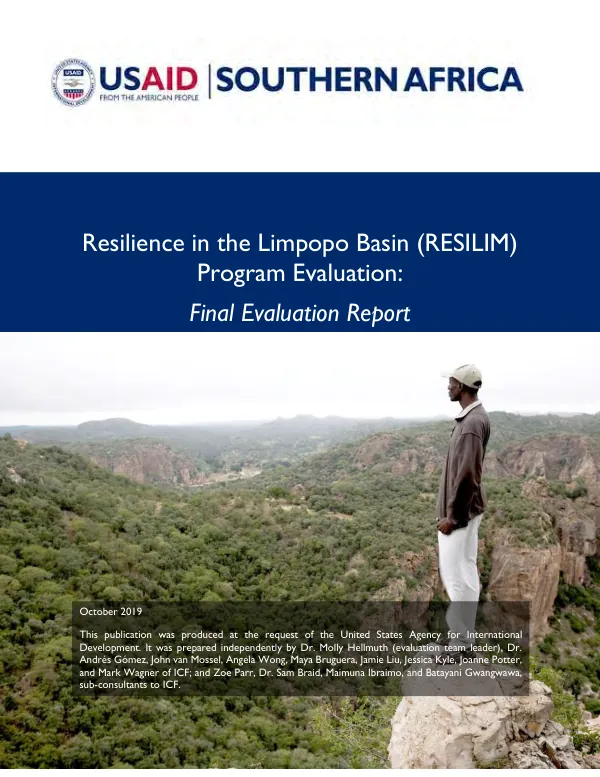
Abstract
The organization's primary goal is to reconcile the conservation of the Marico River's ecological reserve with its sustainable use by communities that are struggling to survive. MRCA is driven by strong moral and ethical grounds, with a focus on promoting the correct thing to do. The MRCA's Resilience in the Limpopo Basin (RESILIM) program was initiated on June 4, 2013, through a five-year contract funded and administered by USAID/Southern Africa. The overall goal of the RESILIM program is to improve trans-boundary management of the Limpopo River Basin, with the aim of enhancing resilience of people and ecosystems. The program has three interrelated components: (1) promoting science-based adaptation strategies for integrated, trans-boundary water resource management, (2) conserving biodiversity and sustainably managing high-priority ecosystems, and (3) building the capacity of stakeholders to sustainably manage water and ecosystems. The MRCA's methodology focuses on increasing the knowledge capacity of youth in order to effectively manage water and ecosystems resources. The organization aims to expand the knowledge and awareness of climate impacts and adaptation measures, strengthen the collective ability of youth to act as ambassadors in rural communities, and promote resilience. The specific tasks of the assignment include training additional river health monitors, identifying monitoring or survey points, conducting pre and post evaluations of river health, and ensuring continuous monitoring, including lab reports. The MRCA's report on deliverable highlights the results of the river health surveys conducted in January and March 2016. The surveys were conducted at six sampling points along the Marico River, with a focus on assessing the river's health and identifying potential impacts on the ecosystem. The results indicate that the water condition was relatively clear at the upstream sampling points, but became increasingly muddy downstream due to high sediment loads and erosion caused by erosion and agriculture. The water samples collected at Sampling Point 5, just downstream of Groot-Marico town, were sent for lab tests to determine whether the water contained E. coli. The lab results indicated that the water was safe for consumption. However, the water level was low due to drought, and the water was slightly muddy downstream of the Vergenoedg dam. The MRCA's river health report highlights the importance of monitoring the river's health and identifying potential impacts on the ecosystem. The report emphasizes the need for continued monitoring and evaluation of the river's health, as well as the implementation of measures to mitigate the effects of erosion and agriculture on the river. The MRCA's partnership with Resilim aims to promote resilience in the Limpopo Basin, with a focus on improving trans-boundary management of the Limpopo River Basin. The partnership has three interrelated components: (1) promoting science-based adaptation strategies for integrated, trans-boundary water resource management, (2) conserving biodiversity and sustainably managing high-priority ecosystems, and (3) building the capacity of stakeholders to sustainably manage water and ecosystems. The MRCA's conclusion highlights the importance of continued monitoring and evaluation of the river's health, as well as the implementation of measures to mitigate the effects of erosion and agriculture on the river. The organization emphasizes the need for a collaborative approach to managing the Marico River, with a focus on promoting resilience and promoting the correct thing to do. The MRCA's references highlight the importance of citing relevant literature and reports in order to support the organization's findings and recommendations. The references include reports from the RESILIM program, as well as academic studies on the topic of river health and resilience.