NATIONAL AGRICULTURE INSTITUTE
Road Map towards the Malabo Declaration: Commitment to intra-African trade
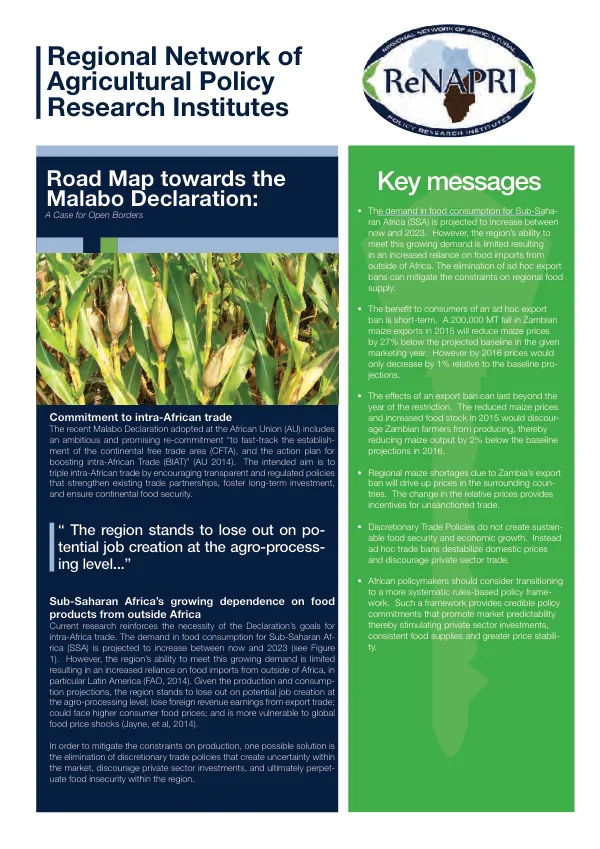
The Malabo Declaration, adopted by the African Union, aims to fast-track the establishment of a continental free trade area and boost intra-African trade.
2015 · 4 pages
Sign in to readA free account is required to download.
Abstract
The declaration seeks to triple intra-African trade by promoting transparent and regulated policies that strengthen existing trade partnerships, foster long-term investment, and ensure continental food security. Sub-Saharan Africa's growing dependence on food products from outside the continent is a pressing concern. Research indicates that the demand for food in Sub-Saharan Africa is projected to increase between now and 2023, but the region's ability to meet this demand is limited, resulting in an increased reliance on food imports from outside Africa. This reliance has significant consequences, including the loss of potential job creation at the agro-processing level, loss of foreign revenue earnings from export trade, higher consumer food prices, and increased vulnerability to global food price shocks. To mitigate the constraints on production, the elimination of discretionary trade policies that create uncertainty within the market, discourage private sector investments, and perpetuate food insecurity within the region is a possible solution. Discretionary trade policies, such as ad hoc export bans, have been shown to have an opposite effect, destabilizing domestic prices and discouraging private sector traders. The ReNAPRI market and trade model is used to simulate and forecast the outcome of a Zambian maize export ban. The model demonstrates an immediate 27% decrease in Zambian domestic maize prices below the baseline price projections for 2015, but the benefit to consumers is short-term. In 2016, the model shows maize prices would decrease by only 1% relative to the baseline projections. The reduced maize prices and increased food stock would discourage Zambian farmers from producing, thereby reducing maize output by 2% in 2016. Zambia's trade ban stimulates maize exports within the region, benefiting South African and Zimbabwean maize exporters, but losing Zambian private maize traders. Regional maize shortages drive up prices in surrounding countries, providing incentives for unsanctioned trade, as Zambian traders engage in arbitrage through informal markets. This scenario benefits producers within the region but threatens household food security for consumers. African policymakers should consider transitioning from a discretionary trade and marketing policy framework to a more systematic rules-based policy framework. Nurturing credible policy commitments will promote market predictability, stimulating private sector investments, consistent food supplies, and greater price stability. This approach is essential for maximizing domestic growth and stability, as demonstrated by the Malabo Declaration's commitment to intra-African trade.