AECOM INTERNATIONAL
Russeifah Site (Area 3) Remediation Feasibility Study
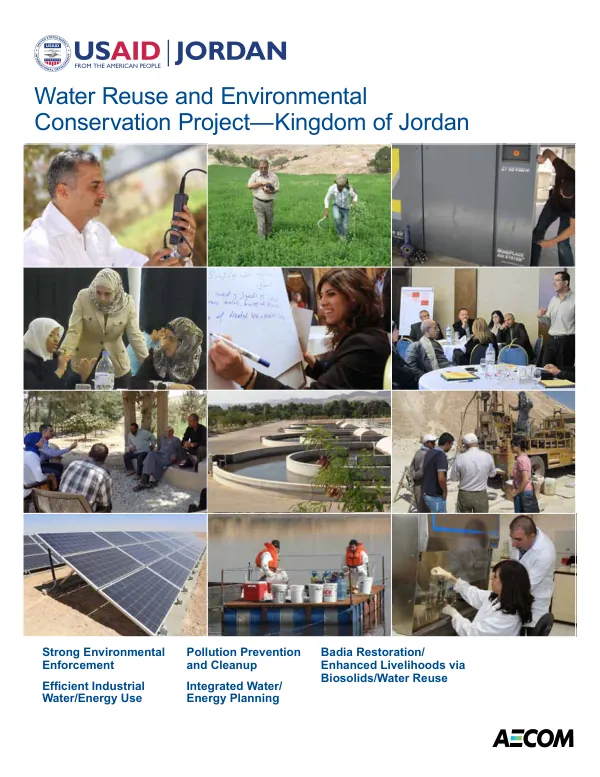
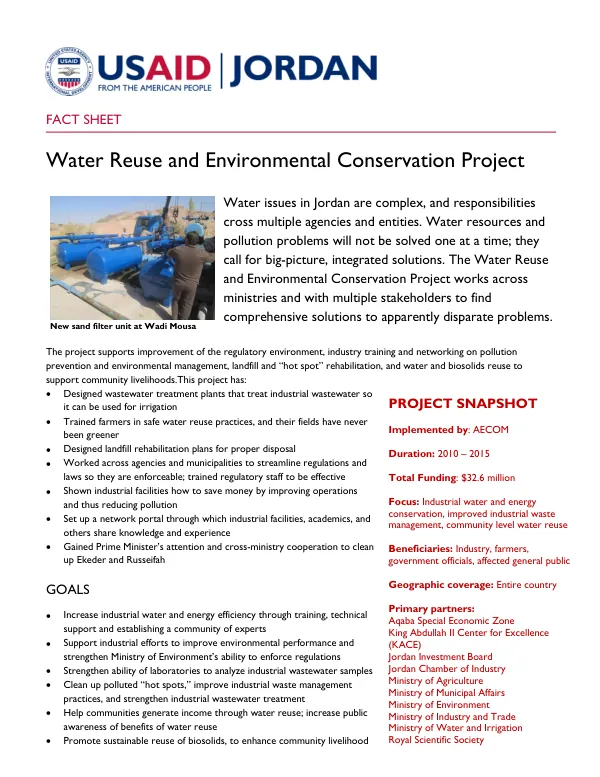
The USAID Water Reuse and Environmental Conservation Project is a five-year initiative implemented by AECOM and a team of international and Jordanian partner firms.
2014 · 51 pages
Sign in to readA free account is required to download.
Abstract
The project has four main tasks: Task 1 – Con and Regulatory Strengthening, Task 2 – Pollution Prevention and Industrial Management, Task 3 – Disposal Rehabilitation and Feasibility Study, and Task 4 – Water Reuse for Community Livelihood Enhancement. The project's Task 3 involves preparing a feasibility assessment (FA) for alternative techniques for rehabilitating the Russeifah site, and then preparing design documents for the remediation. The Russeifah site is composed of six individual areas, each with its own unique contamination history. The contamination in each area is directly or indirectly the result of the development and operation of the phosphate mining industry. The six areas are: Tunnels, Overburden Piles, Phosphate Stockpile, Landfill, Pit, and Lagoon. The primary focus of this FA is the remediation and beneficial use of Area 3 (Phosphate Stockpile), while the remaining areas are the subjects of other reports. The phosphate mining industry in Russeifah began in the mid-1930s, and the development of the industry led to rapid population growth in the area. The residential area is encroaching on Areas 3, 4, and 5, while businesses and industry are pressing on Areas 1, 6. None of the areas is now in use by the phosphate mining industry. The project aims to prepare a feasibility assessment for alternative techniques for rehabilitating the Russeifah site and then prepare design documents for the remediation. The Russeifah site is contaminated due to the development and operation of the phosphate mining industry. The contamination in each area is directly or indirectly the result of the industry's activities. The six areas are: Tunnels, Overburden Piles, Phosphate Stockpile, Landfill, Pit, and Lagoon. The primary focus of this FA is the remediation and beneficial use of Area 3 (Phosphate Stockpile). The phosphate mining industry in Russeifah began in the mid-1930s, and the development of the industry led to rapid population growth in the area. The residential area is encroaching on Areas 3, 4, and 5, while businesses and industry are pressing on Areas 1, 6. None of the areas is now in use by the phosphate mining industry. The project aims to prepare a feasibility assessment for alternative techniques for rehabilitating the Russeifah site and then prepare design documents for the remediation. The feasibility assessment will identify alternative techniques for rehabilitating the site, and then the project will prepare design documents for the remediation. The remediation will involve the removal of contaminated soil and other materials from the site. The project will also involve the implementation of measures to prevent further contamination of the site. The measures will include the installation of a containment system to prevent the spread of contamination from the site. The containment system will be designed to prevent the spread of contamination from the site to the surrounding environment. The project will also involve the implementation of measures to restore the site to a safe and beneficial use. The measures will include the removal of contaminated soil and other materials from the site, and the implementation of measures to prevent further contamination of the site. The measures will also include the installation of a containment system to prevent the spread of contamination from the site to the surrounding environment. The project will also involve the implementation of measures to restore the site to a safe
Related documents