USAID FAMINE EARLY WARNING SYSTEMS NETWORK
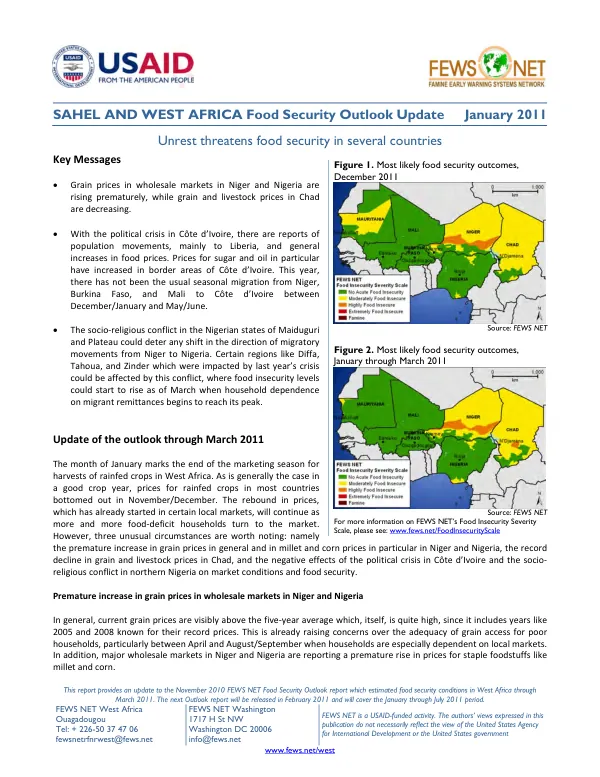
Sahel and West Africa Food Security Outlook Update March 2011
The Sahel and West Africa region is facing significant food security challenges due to ongoing fighting in neighboring countries.
2011 · 3 pages
Sign in to readA free account is required to download.
Abstract
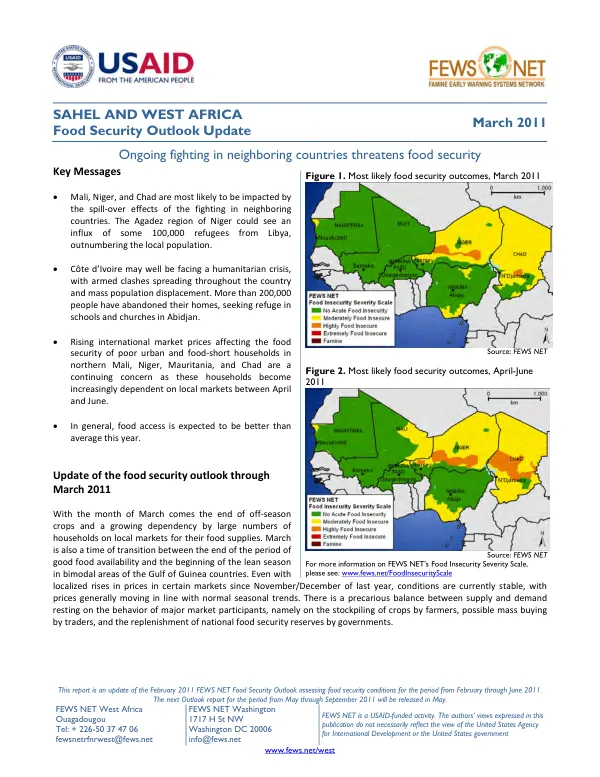
Mali, Niger, and Chad are most likely to be impacted by the spill-over effects of the fighting, with the Agadez region of Niger potentially seeing an influx of 100,000 refugees from Libya. Côte d'Ivoire is also facing a humanitarian crisis, with armed clashes spreading throughout the country and mass population displacement. Regional markets are functioning normally, but there are concerns over rising international market prices for food and energy. Grain markets are still functioning normally, with prices generally close to seasonal averages. However, there are reports of shortages of maize in Senegal and the Senegal River Valley in Mauritania and western Mali. The situation is exacerbated by the loss of migration income by households in Burkina Faso, Mali, and Niger, at a time of great need. The conflict in Côte d'Ivoire is having a significant impact on the region, with trade networks adapting to the situation. Cattle exports via Ghana and imports of oil and other processed foods have picked up, but longer travel times are increasing shipping costs and driving up retail prices. The situation is becoming increasingly dire, with reports of shortages of maize and a steady loss of migration income by households in Burkina Faso, Mali, and Niger. Niger is likely to be the hardest hit country, with the loss of migration income due to the conflict in Côte d'Ivoire equivalent to three to four months of food consumption. The expected number of displaced persons exceeds the size of the local population in the main receiving area of Niger, whose remoteness will make it difficult to ensure an adequate supply of food. Unless local food reserves can be increased to cover the additional needs created by the influx of displaced persons, this area could be facing a serious food crisis in the days ahead. The situation in Côte d'Ivoire is precarious, with food availability in Abidjan still precarious due to restrictions on circulation and racketeering by the police and militias. This is creating shortages and disproportionately steep price increases. The escalation in armed fighting in certain districts has displaced massive numbers of residents fleeing the violence, who have been forced to seek refuge in schools and churches. In general, food access is expected to be better than average this year, but the situation is precarious and subject to change. The region is facing significant challenges, including the impact of the conflict in Côte d'Ivoire, rising international market prices, and the loss of migration income by households in Burkina Faso, Mali, and Niger.
Related documents