USAID DEC
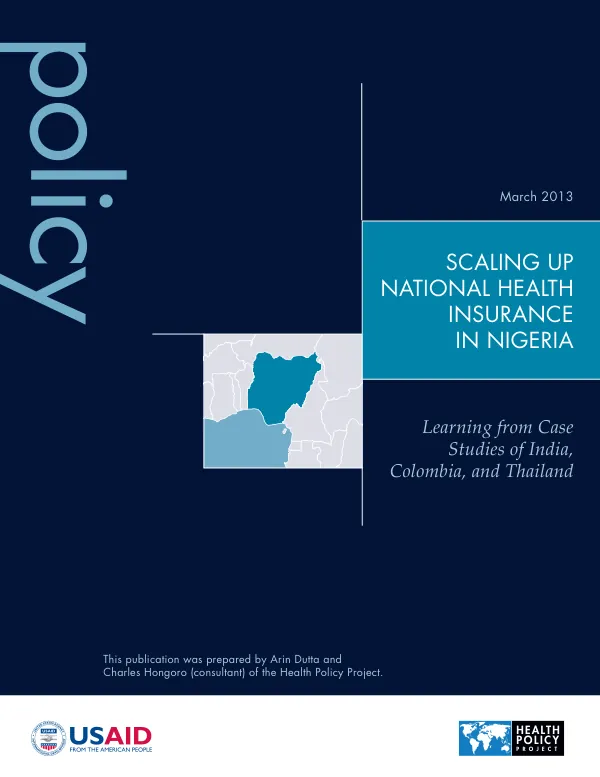
Scaling Up National Health Insurance in Nigeria: Learning from Case Studies of India, Colombia, and Thailand
Sign inFUTURES GROUP INTERNATIONAL, LLC
Scaling Up National Health Insurance in Nigeria: Learning from Case Studies of India, Colombia, and Thailand
Nigeria's National Health Insurance Scheme (NHIS) has been the primary initiative to expand health insurance coverage since its launch in 1999.
2013 · 52 pages
Sign in to readA free account is required to download.
Abstract
However, as of mid-2012, the scheme covered only about 3 percent of the population, with approximately 5 million individuals enrolled. Policymakers in Nigeria are interested in learning from the experiences of other developing countries in achieving higher health insurance coverage. The Health Policy Project conducted case studies of three countries - Colombia, India, and Thailand - as they developed government policies to achieve universal health coverage. Colombia approved its universal health insurance scheme in 1993, creating the National Social Security System for Health, which currently covers more than 95 percent of the population. The scheme has two insurance regimes: the Contributory Regime (CR) and the Subsidized Regime (SR). The CR covers workers and families with monthly incomes above $170, while the SR targets poor or informal workers. Both regimes have access to the same health benefits package, with the CR funded by a mandatory payroll tax contribution of 11 percent and the SR funded by national and local tax revenues and a 1.5 percent payroll tax. Colombia's experience offers several lessons for Nigerian policymakers, including the importance of passing legislation to provide a legal basis for implementing a national social security system. India's experience with health insurance is also relevant to Nigeria. The country has a complex healthcare financing system, with multiple government-funded health insurance schemes. The Rashtriya Swasthya Bima Yojana (RSBY), launched in 2008, is a government-funded health insurance scheme that provides coverage to the poor and vulnerable populations. The scheme has been evaluated, and its performance has been mixed, with some successes and challenges. One of the key lessons from India's experience is the importance of targeting the poor and vulnerable populations through government-funded health insurance schemes. However, implementing universal health coverage in India has been challenging, with several obstacles, including inadequate funding and inefficient delivery systems. Thailand's experience with universal health coverage is also worth noting. The country has a long history of healthcare reform, with the introduction of the Universal Coverage Scheme (UCS) in 2002. The UCS provides comprehensive health insurance coverage to all citizens, with a focus on primary care and preventive services. The scheme has been evaluated, and its performance has been positive, with improved health outcomes and increased access to healthcare services. The Thai experience offers several lessons for Nigerian policymakers, including the importance of investing in primary care and preventive services, as well as the need to ensure that the healthcare system is accessible and affordable for all citizens. Overall, the case studies of Colombia, India, and Thailand provide valuable lessons for Nigerian policymakers as they seek to expand and improve the NHIS.